Relative muscle mass and grip strength as complementary correlates of metabolic syndrome: a nationwide DXA-based study of Korean adults
Abstract
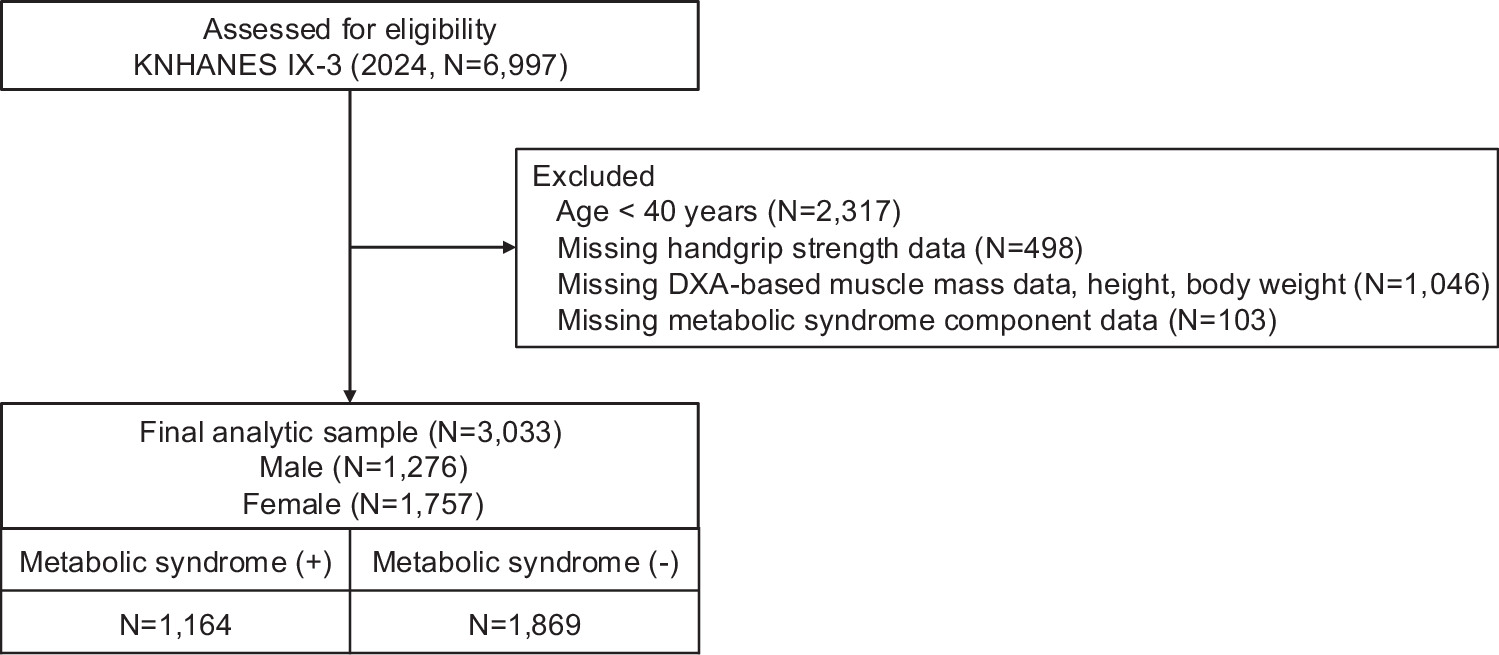
PURPOSE: Both muscle mass and strength relate to metabolic health, but their separate contributions to metabolic syndrome (MetS) are unclear. Using the 2024 Korea National Health and Nutrition Examination Survey (KNHANES) with concurrent dual-energy X-ray absorptiometry (DXA)-based appendicular skeletal muscle mass (ASM) and handgrip strength (HGS), we examined the independent associations of relative muscle mass and HGS with MetS in Korean adults aged ≥40 years. METHODS: We analyzed 3033 adults from KNHANES. ASM/body weight (ASM/BW) and HGS/body weight (relative HGS) served as primary indicators. Participants were classified into four groups by sex-specific medians of both indicators, and complex-sample logistic regression estimated odds ratios (ORs) for MetS with both indicators entered simultaneously. RESULTS: In the fully adjusted joint model, ASM/BW was inversely associated with MetS in men (OR 0.79, 95% CI 0.73-0.86) and women (OR 0.86, 0.80-0.92), as was relative HGS (men OR 0.98, 0.96-0.99; women OR 0.97, 0.95-0.98). The odds of MetS were highest with concurrently low muscle mass and strength (men OR 3.04; women OR 2.42). The ASM/BW association persisted when MetS was defined without the waist criterion, whereas the relative HGS association was attenuated; ASM/BMI showed similar inverse associations, whereas ASM/Ht² showed a different pattern. CONCLUSION: ASM/BW showed more consistent associations with MetS across the sensitivity analyses performed than relative HGS, although associations differed by normalization method, the optimal choice of which remains uncertain. Because the design is cross-sectional, these findings indicate association only and require prospective validation before clinical application.
From the paper
- Participants
We analyzed 3033 adults from KNHANES.
- Result
In the fully adjusted joint model, ASM/BW was inversely associated with MetS in men (OR 0.79, 95% CI 0.73–0.86) and women (OR 0.86, 0.80–0.92), as was relative HGS (men OR 0.98, 0.96–0.99; women OR 0.97, 0.95–0.98).
Quoted word for word from the full text on link.springer.com.
The paper
The Catholic University of Korea Seoul St. Mary's Hospital; Chung-Ang University
Endocrine, Oct 17, 2026, Open access


