A systematic review and meta-analysis of the effects of different exercise modalities on frailty in older adults
Dose-response, preregistered CRD420251179862
Abstract
OBJECTIVE: To synthesize randomized evidence on unimodal resistance exercise, walking, and Tai Chi for frailty in older adults and to explore whether intervention characteristics may help explain between-study heterogeneity. Unlike broader reviews of multicomponent or non-pharmacological interventions, this review focuses on these three standalone modalities and reports modality- and dose-characteristic subgroup estimates. METHODS: This systematic review and meta-analysis followed PRISMA 2020 and was prospectively registered in PROSPERO (CRD420251179862). Five databases were searched from inception to October 2025. Two reviewers independently screened records, extracted data, and assessed risk of bias with the Cochrane tool. Standardized mean differences (SMDs) were pooled using inverse-variance models; random-effects models were used when substantial heterogeneity was present. Prespecified subgroup analyses examined exercise modality and intervention characteristics. Leave-one-comparison-out sensitivity analysis was used to assess influence. Funnel-plot findings were considered exploratory because few comparisons were available. RESULTS: Ten articles contributed 13 eligible exercise-control comparisons comprising 1,361 participant observations (682 intervention and 679 control). The overall random-effects estimate favored exercise (SMD = -0.57, 95% CI -0.91 to -0.24), but heterogeneity was substantial (I ² = 88%) and the approximate 95% prediction interval crossed the null (-1.73 to 0.57). Resistance-exercise comparisons showed a significant pooled association with lower frailty scores (SMD = -0.78, 95% CI -1.22 to -0.35), whereas walking and Tai Chi estimates were imprecise and not statistically significant. Leave-one-comparison-out estimates remained in the same direction (SMD range, -0.65 to -0.46), although heterogeneity remained high. Dose-characteristic subgroup findings were based on small numbers of comparisons and should be regarded as exploratory rather than as evidence of an optimal prescription. CONCLUSION: Resistance-exercise trials showed a significant pooled reduction in frailty scores, but the available evidence does not establish superiority over walking or Tai Chi because no direct head-to-head or network comparison was performed. High heterogeneity, imprecise modality subgroups, and sparse dose strata limit certainty. The dose-related findings should be used to generate hypotheses for adequately powered comparative trials rather than to prescribe an optimal regimen.
From the paper
- Studies
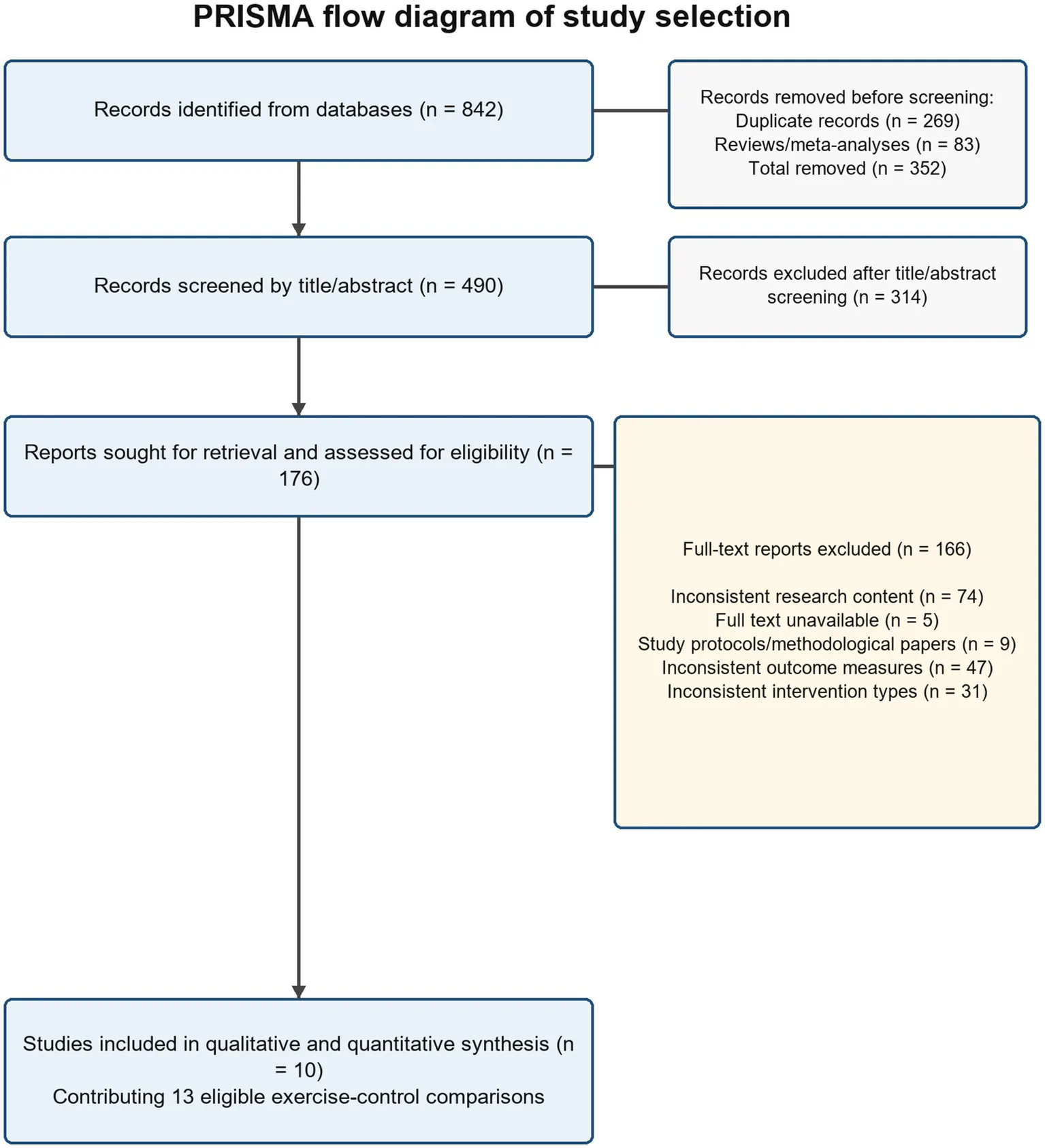
The remaining 10 articles were included in the qualitative and quantitative synthesis and contributed 13 eligible exercise-control comparisons.
- Result
Across all 13 comparisons, the random-effects estimate favored exercise (SMD = −0.57, 95% CI −0.91 to −0.24), with substantial heterogeneity ( I = 88%); the approximate 95% prediction interval (−1.73 to 0.57) indicates that the effect in a new setting could plausibly include no benefit.
- Limitation
Important limitations are the small number of comparisons within modality and dose strata; high residual heterogeneity; inconsistent definitions and reporting of exercise intensity; use of different frailty instruments (including Fried-derived scores and frailty indexes) …
Quoted word for word from the full text on frontiersin.org.
The paper
Beijing Sport University; Zhejiang Provincial People's Hospital
Frontiers in Public Health, Oct 2, 2026, Open access


