Tai Chi aided mobility in seniors with muscle loss and knee arthritis
Tai Chi reduced mobility-test time by 2.52 seconds more than health education plus home exercise at 12 weeks.
Blinded
Limit: The average benefit fell below the prespecified 2.8-second threshold for individual improvement
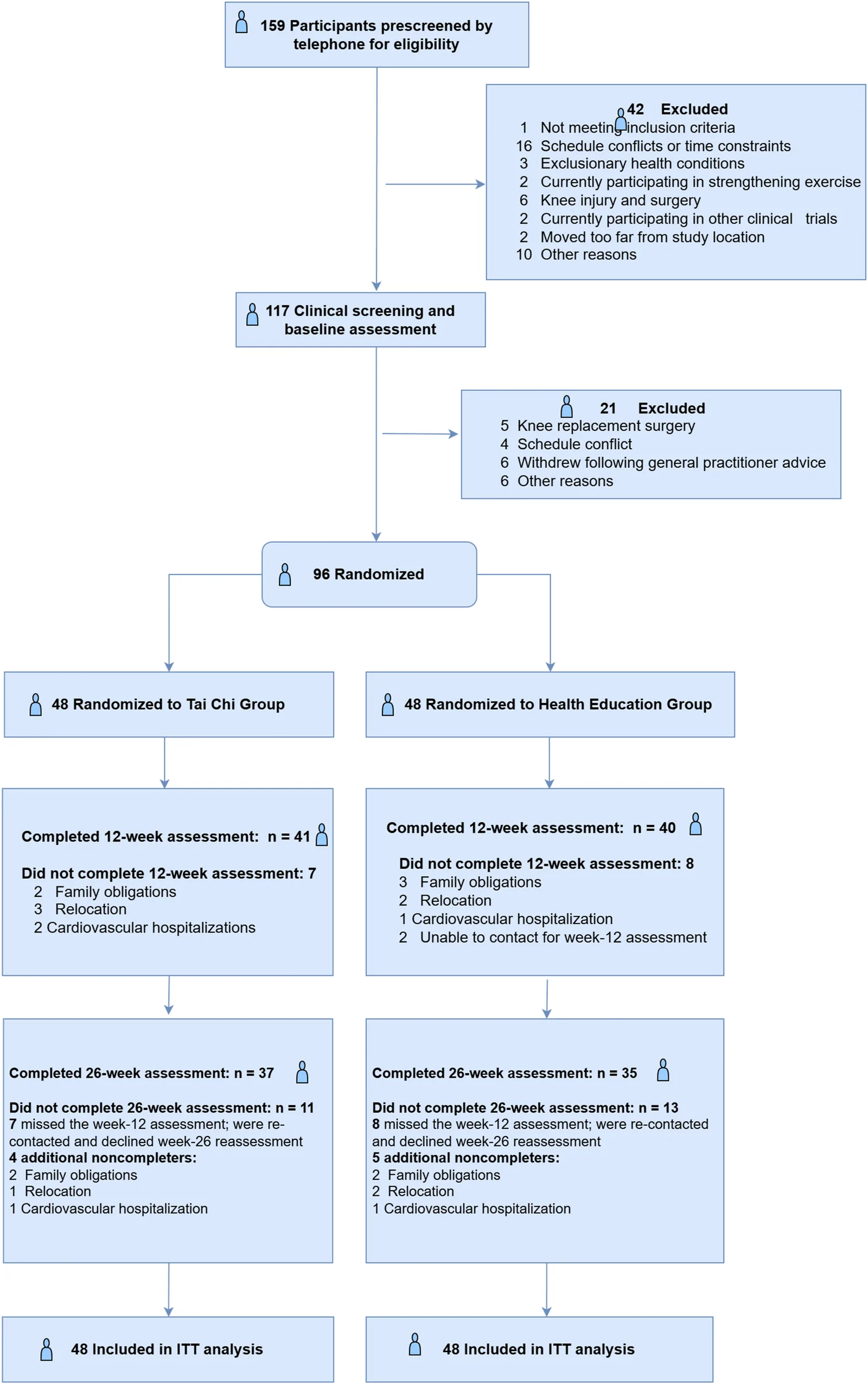
A two-site randomized trial enrolled 96 adults aged 65–85 with sarcopenic knee osteoarthritis: knee joint disease alongside muscle loss and weakness. Researchers assigned them to a 12-week simplified, eight-form Tai Chi program or health education plus progressive home exercise. Assessors did not know participants’ group assignments.
The main outcome was time on the Timed Up and Go test, which involves standing up, walking and sitting down. Tai Chi reduced test time by 2.52 seconds more than the comparison program at week 12. Improvements of at least 2.8 seconds occurred in 28 of 48 Tai Chi participants (58.3%), versus 6 of 48 comparison participants (12.5%). At week 26, the average advantage was smaller, at 1.46 seconds. No intervention-related serious adverse events occurred.
Why it matters
The trial addressed how to support mobility in older adults living with both muscle loss and knee joint disease.
Caveats
The average 12-week advantage fell slightly below the prespecified 2.8-second threshold for improvement in an individual. The trial did not establish benefits for people outside ages 65–85 or without both conditions.
The paper
Osteoarthritis and Cartilage Open, Sep 23, 2026, Open access


