The association of triglyceride-glucose body roundness index with carotid atherosclerosis in type 2 diabetes: a cross-sectional study
Dose-response
Abstract
BACKGROUND: The triglyceride-glucose body roundness index (TyG-BRI) has emerged as a promising biomarker correlated with elevated risks of adverse cardiovascular events. Notably, the potential linkage between TyG-BRI and carotid atherosclerosis (CAS) has not been formally evaluated in individuals with type 2 diabetes mellitus. METHODS: This cross-sectional observational study consecutively enrolled 1060 adults with type 2 diabetes mellitus in Fujian, China. Anthropometric measurements and fasting venous blood biochemical data were collected to calculate TyG-BRI. CAS was ascertained using high-resolution B-mode ultrasound. Spearman correlation analysis was performed to examine the correlations between TyG-BRI and metabolic indicators. Following stepwise adjustment for confounding variables, hierarchical binary logistic regression and restricted cubic spline curves were applied to evaluate the association of TyG-BRI with CAS risk as well as potential effect modifiers. Finally, receiver operating characteristic (ROC) curve analysis was conducted to evaluate the identification capability of TyG-BRI for CAS. RESULTS: Patients with CAS had significantly higher TyG-BRI levels than non-CAS controls. TyG-BRI was positively correlated with carotid intima-media thickness, glycated hemoglobin (HbA1c), blood pressure, total cholesterol, low-density lipoprotein cholesterol, and uric acid. In fully adjusted models, elevated TyG-BRI was non-linearly associated with higher CAS risk (P for overall association < 0.001, P for non-linearity < 0.01). Per 1-standard-deviation increment in TyG-BRI, the ORs were 1.503 (95% CI 1.281-1.763, P < 0.001) for carotid intima-media thickening, 1.453 (95% CI 1.236-1.709, P < 0.001) for carotid plaque, and 2.247 (95% CI 1.820-2.773, P < 0.001) for CAS. Associations remained consistent across subgroups stratified by age, sex, body mass index (BMI), HbA1c and hypertension, with a stronger effect in participants with BMI < 24 kg/m² (OR 4.838, 95% CI 3.007-7.784, P < 0.001). ROC analysis showed TyG-BRI significantly identified CAS (AUC = 0.698, 95% CI 0.664-0.731, P < 0.001), outperforming TyG and TyG-BMI while matching the performance of the composite indices of TyG combined with waist circumference or waist-to-height ratio. CONCLUSION: TyG-BRI demonstrated an independent, non-linear dose-response association with CAS risk in type 2 diabetes. Its integration into cardiovascular risk stratification holds promise for enabling earlier identification of CAS.
From the paper
- Participants
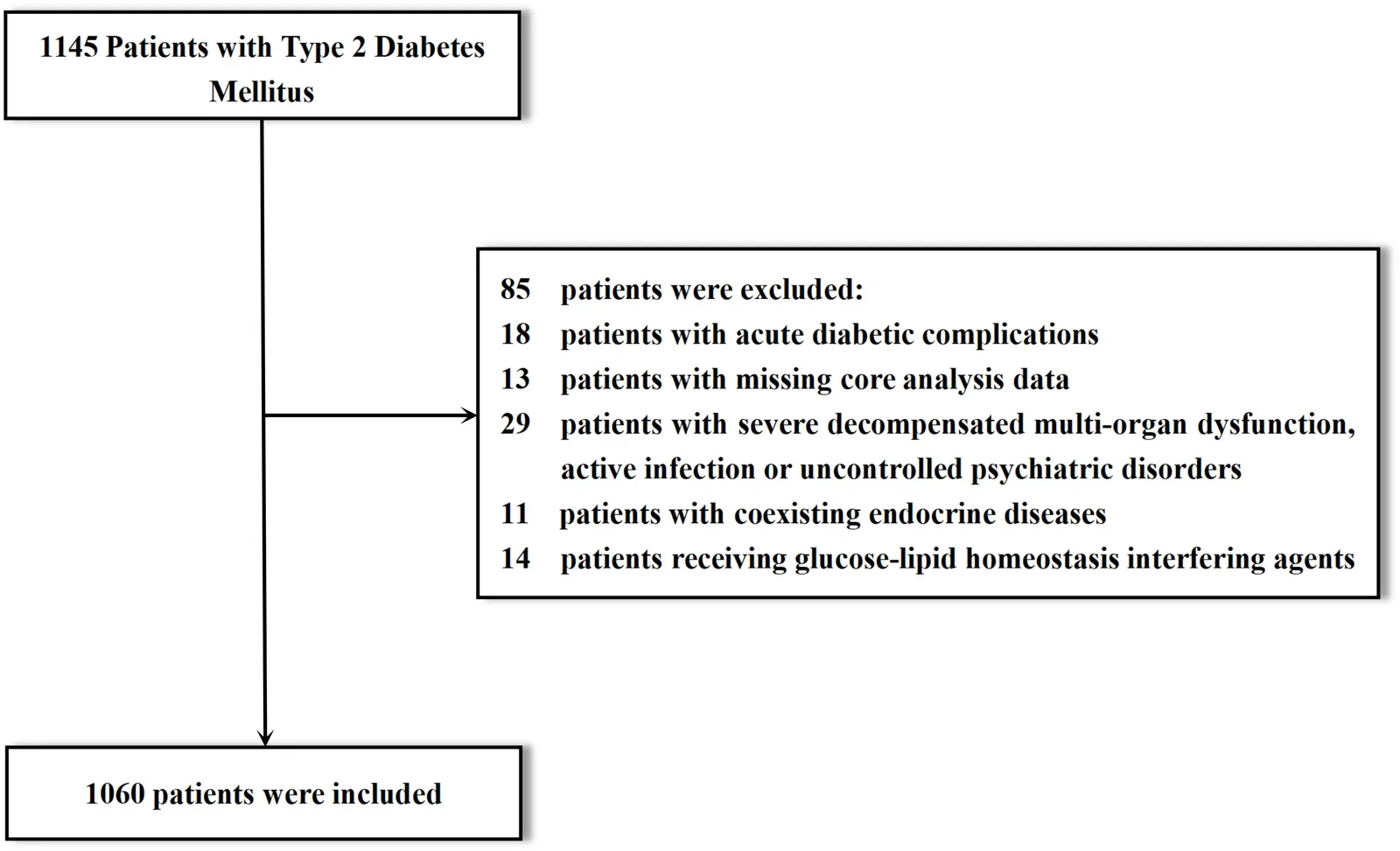
As shown in Figure 1, a total of 1060 individuals diagnosed with type 2 diabetes mellitus after excluding 85 patients based on exclusion criteria.
Results, Baseline demographic and clinical characteristics of the study participants
- Result
In detail, per 1-standard-deviation increment in TyG-BRI, independent associations were observed for CMT (OR: 1.503, 95% CI: 1.281–1.763, P < 0.001), carotid plaque (OR: 1.453, 95% CI: 1.236–1.709, P < 0.001), and CAS (OR: 2.247, 95% CI: 1.820–2.773, P < 0.001).
- Limitation
First, the cross-sectional design cannot establish a causal relationship between elevated TyG-BRI and the occurrence of CAS.
Quoted word for word from the full text on frontiersin.org.
- Triglyceride-glucose-body roundness index
- Carotid atherosclerosis
- Type 2 diabetes
- Carotid intima-media thickening
- Carotid plaque
- Humans
The paper
Fujian Medical University
Frontiers in Endocrinology, Oct 1, 2026, Open access
