Glucagon-Like Peptide-1 Receptor Agonists and Incident Cardiovascular Events and Death in Treated Serious Mental Illness, Type 2 Diabetes, and Obesity
Abstract
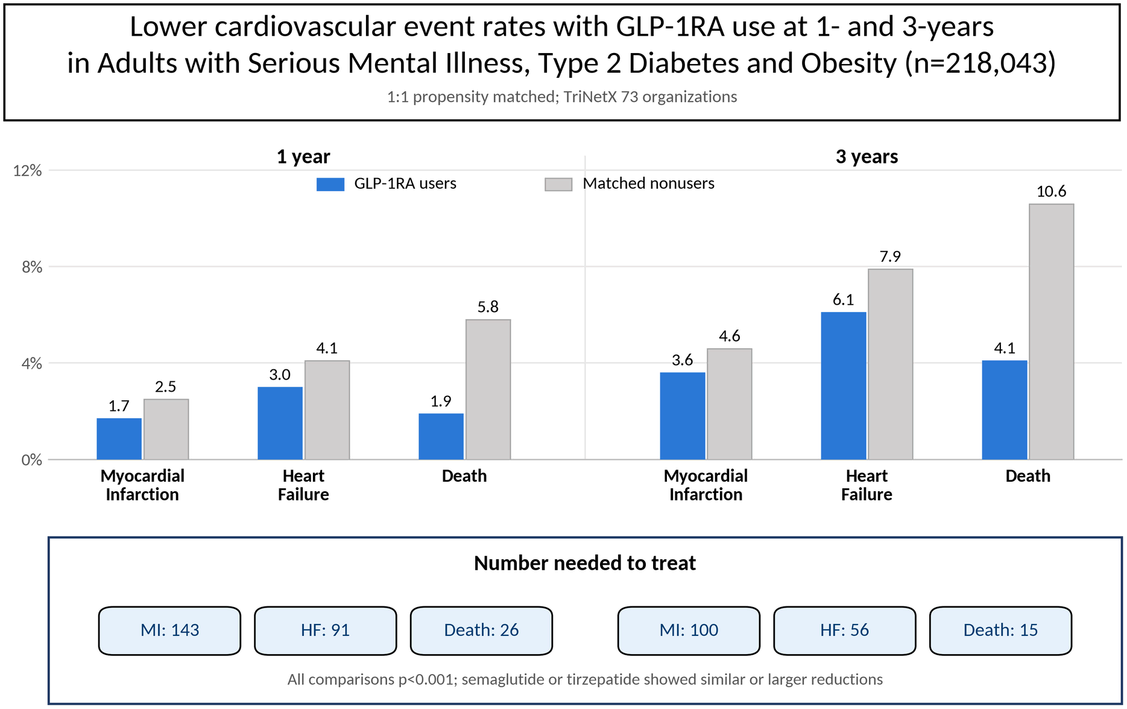
BACKGROUND: Adults with serious mental illness (SMI), type 2 diabetes, and obesity have elevated cardiovascular risk. Glucagon-like peptide-1 receptor agonists (GLP-1RAs) have established cardiometabolic benefits in the general population, but their effects in SMI are unclear. We evaluated whether GLP-1RA use was associated with lower risks of incident myocardial infarction (MI), heart failure (HF), and all-cause death. METHODS: This was a retrospective propensity score-matched cohort study of 218 043 adults with SMI, type 2 diabetes, obesity, and active antipsychotic or antidepressant medications in the TriNetX database (73 health care organizations). Outcomes were incident MI, HF, and all-cause death at 1 and 3 years. The primary exposure was GLP-1RA use versus nonuse; secondary analyses examined semaglutide or tirzepatide. Exploratory analyses evaluated sex, race, and sodium-glucose cotransporter-2 inhibitor and dipeptidyl peptidase-4 inhibitor use. RESULTS: GLP-1RA use was associated with lower risks of incident MI, HF, and all-cause death. Risk differences at 1 and 3 years were -0.007 and -0.010 for MI, -0.011 and -0.018 for HF, and -0.039 and -0.065 for death (all P<0.001). Semaglutide or tirzepatide use was also associated with lower risks of MI, HF, and death (all P<0.001). Findings were directionally consistent after accounting for sodium-glucose cotransporter-2 inhibitor and dipeptidyl peptidase-4 inhibitor use. CONCLUSIONS: Adults with treated SMI, type 2 diabetes, and obesity using GLP-1RAs, particularly semaglutide or tirzepatide, had significantly reduced 1- and 3-year risks of incident MI, HF, and all-cause death versus nonusers. These pooled associations should be interpreted in the context of SMI's clinical heterogeneity and the limitations of administrative case ascertainment.
The paper
St. John's Episcopal Hospital New York NY USA; School of Medicine and Bursky School of Public Health Washington University in St. Louis MO USA
Journal of the American Heart Association, 16 Oct 2026


