Combined Associations of Glycoprotein Acetylation With Lipoprotein (a) and hs-CRP (High-Sensitivity C-Reactive Protein) on Risk of Cardiovascular Disease in MESA
Abstract
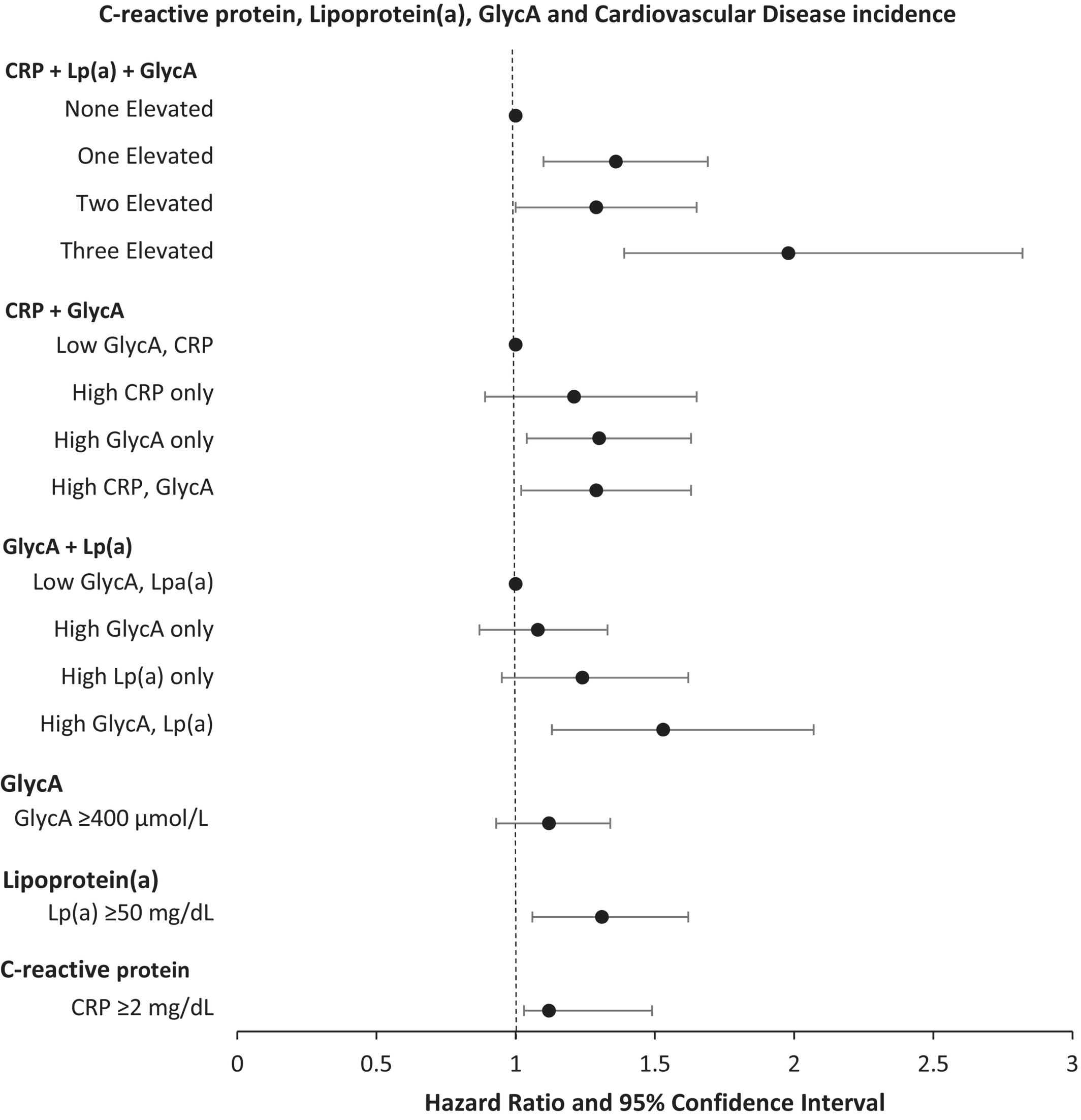
BACKGROUND: Higher plasma glycoprotein acetylation (GlycA) concentrations are associated with an increased risk for incident cardiovascular disease (CVD). We investigated the combined associations of GlycA with lipoprotein (a) (Lp[a]) and hs-CRP (high-sensitivity C-reactive protein) with incident CVD. METHODS: We followed 6676 MESA (Multi-Ethnic Study of Atherosclerosis) participants, aged 45 to 84 years, without baseline CVD. Lp(a), GlycA, and hs-CRP were evaluated categorically using standard cut points (Lp[a]: 50 mg/dL; GlycA: 400 μmol/L; hs-CRP: 2 mg/L). We used multivariable-adjusted Cox hazards models to evaluate individual and combined associations of these 3 biomarkers with incident CVD, coronary heart disease, and stroke. RESULTS: Compared with those with low GlycA and low Lp(a) levels, an increase in both incident CVD and coronary heart disease risk was observed for those participants with high levels of either or both of these biomarkers. Risk was highest for those with both high GlycA and high Lp(a) levels (CVD hazard ratio [HR]=1.55 [95% CI: 1.15-2.10) and coronary heart disease (HR=1.92 [95% CI, 1.33-2.77). A similar pattern was not observed for individuals with high levels of both GlycA and hs-CRP. Compared with participants with low levels of GlycA, Lp(a), and hs-CRP, those with high levels of all 3 biomarkers had a 1.98-fold higher CVD risk (95% CI, 1.39-2.82), a 2.23-fold higher coronary heart disease risk (95% CI, 1.45-3.44), and a 2.51-fold higher stroke risk (95% CI, 1.24-5.08). CONCLUSIONS: Routine assessment of GlycA in addition to Lp(a) and hs-CRP may help to identify individuals at particularly increased CVD risk who may benefit from more aggressive preventive therapies.
The paper
Division of Cardiology University of Southern California Los Angeles CA; Department of Laboratory Medicine and Pathology University of Minnesota Minneapolis MN
Journal of the American Heart Association, 16 Oct 2026