Multimorbidity-Adjusted Pharmacotherapy Intensity and Subsequent Functional Disability Among Chinese Middle-Aged and Older Adults: A Longitudinal Study
Abstract
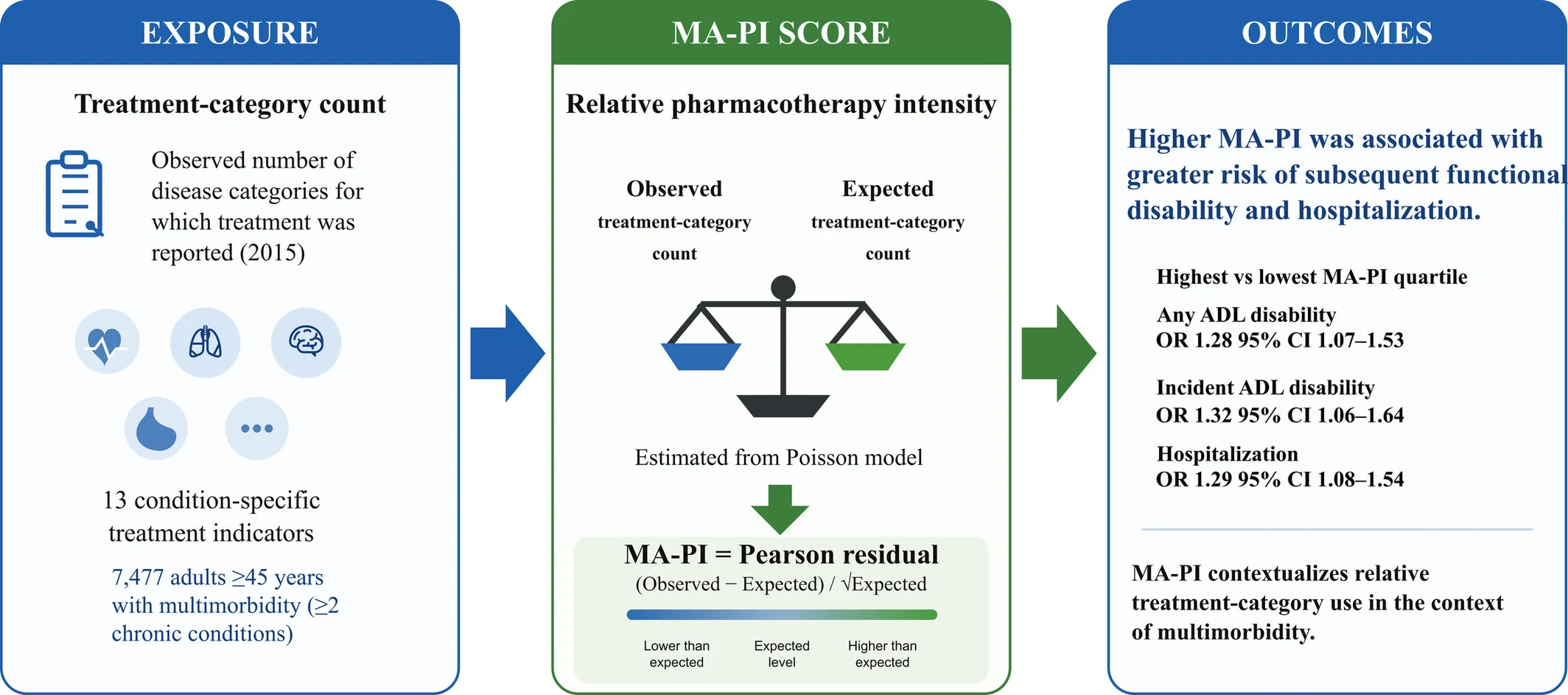
BACKGROUND: We aimed to derive a multimorbidity-adjusted pharmacotherapy intensity (MA-PI) score and explore its association with functional disability in adults with multimorbidity. METHODS: We analyzed longitudinal data (2015-2020) from 7477 CHARLS participants aged ≥ 45 years with ≥ 2 chronic conditions. MA-PI was defined as the Pearson residual from a Poisson regression model predicting expected treatment-category burden. Primary outcomes were any activity of daily living (ADL) disability and incident ADL disability in 2020. The secondary outcome was past-year hospitalization. Associations of MA-PI with outcomes were evaluated using multivariable logistic regression across quartiles and per 1-SD increase. RESULTS: In 2020, 33.5% reported any ADL disability, 22.8% developed incident ADL disability, and 26.3% reported hospitalization. In fully adjusted models, higher MA-PI (vs. Q1) was associated with greater odds of adverse outcomes. For any ADL disability, Q3 (OR, 1.21; 95% CI, 1.01-1.44) and Q4 (OR, 1.28; 95% CI, 1.07-1.53) remained significant. For participants without baseline disability, Q4 was significantly associated with incident ADL disability (OR, 1.32; 95% CI, 1.06-1.64). Q3 and Q4 also had higher hospitalization odds (OR, 1.24 and 1.29, respectively). Results remained similar in continuous and disease-composition-adjusted analyses. CONCLUSIONS: Higher MA-PI was associated with subsequent functional disability and hospitalization. MA-PI may serve as a valuable framework for population-level epidemiological assessment of relative treatment-category use in multimorbidity.
- Modelling and theory
- Multimorbidity
- Multimorbidity-adjusted pharmacotherapy intensity
- Activities of Daily Living
- Humans
The paper
Xiangya Hospital; the Second Xiangya Hospital of Central South University
Geriatrics & Gerontology International, 1 Oct 2026