Sensor-Based Reachable Workspace Assessment for Tracking Upper-Extremity Mobility Changes over Time Following the Spencer Technique in Older Adults
Abstract
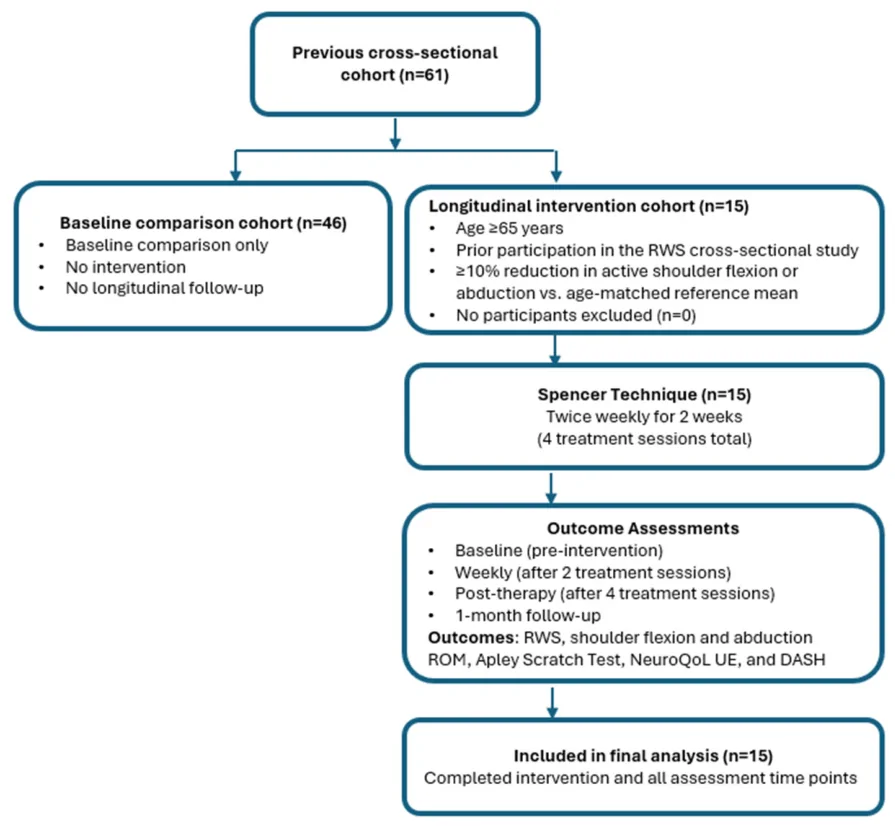
Age-related declines in upper-extremity mobility remain a challenge to assess in older adults. This study examined whether a sensor-based motion analysis of reachable workspace (RWS), quantified using relative surface area (RSA), could track longitudinal upper-extremity mobility changes in a cohort of community-dwelling older adults receiving the Spencer Technique, an established therapeutic intervention for the shoulder. Fifteen community-dwelling older adults ≥65 years with shoulder mobility limitations identified by reduced goniometric ROM received the Spencer Technique twice weekly for two weeks. Outcomes including RSA, shoulder flexion and abduction via goniometry, Apley scratch test, DASH and upper extremity NeuroQoL were assessed at baseline, weekly, post-therapy, and 1-month follow-up. Total RSA significantly increased from baseline to post-therapy and 1-month follow-up in both dominant and nondominant upper extremities and remained significant after Holm correction (adjusted p ≤ 0.030). Bilateral shoulder flexion and abduction along with Apley scratch tests demonstrated parallel improvements. DASH scores did not demonstrate significant change, whereas NeuroQoL UE scores increased significantly at 1-month follow-up after Holm correction (adjusted p = 0.031). Total RSA demonstrated responsiveness to longitudinal changes in upper-extremity reachability following the Spencer Technique that parallel changes observed with standard clinical assessments. These findings support the utility of sensor-based RWS as a quantitative measure for tracking longitudinal upper-extremity mobility over time in older adults.
- Spencer technique
- Digital and wearable data
- Shoulder mobility limitation
- Apley scratch test
- DASH score
- Humans
The paper
University of California, Irvine
Sensors, 6 Oct 2026, Open access