Finger-tapping patterns linked to motor reserve in adults
Three of five tapping measures remained linked to motor reserve questionnaire scores after accounting for age in 100 healthy younger and older adults.
Registered NCT07634055
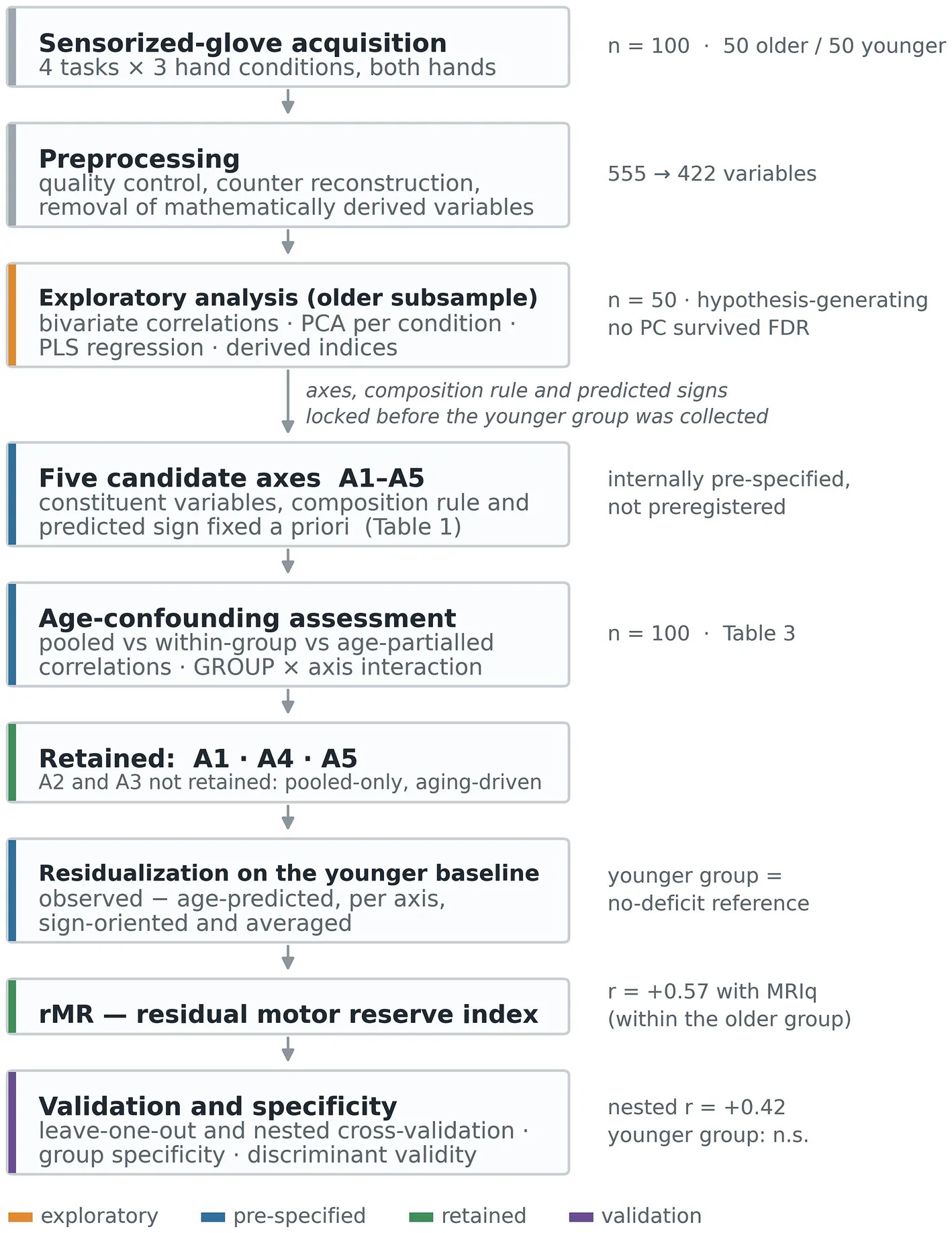
In an observational study, 100 healthy adults—50 older and 50 younger—performed four finger-tapping tasks while wearing a sensor-equipped glove. They tapped at their own pace, as fast as possible, to a metronome, and after it stopped. A questionnaire assessed motor reserve, the capacity to maintain movement despite aging-related or disease-related changes.
After accounting for age, three measures remained associated with questionnaire scores: timing stability without external cues, differences between hands in contact duration, and consistency across tasks. Speed during metronome-paced tapping tracked age rather than reserve. A combined index of the three retained measures predicted questionnaire scores in the older group in validation analyses.
Why it matters
The work addresses how to distinguish people's capacity to maintain movement during aging from the effects of chronological age or overall movement speed.
Caveats
This observational study linked tapping measures to a questionnaire, not to observed resilience against aging-related or disease-related changes. It included only 100 healthy adults in deliberately separate younger and older age groups.
- Digital and wearable data
- Bimanual coordination
- Cognitive reserve index
- Cross-context consistency
- Endogenous timing stability
- Humans
The paper
Behavioral markers of motor reserve: stability, lateralization, and consistency
Institute for Biomedical Research and Innovation; National Research Council
Frontiers in Aging Neuroscience, 30 Sep 2026, Open access