"There's No Magic Pill to Help Me, Right?": Sex After Early Midlife Bilateral Salpingo-Oophorectomy
Abstract
Women with risk-reducing bilateral salpingo-oophorectomy (RRBSO) report poorer sexual health than women of a similar age with intact ovaries. Since women with RRBSO lose the ability to make endogenous 17-β-estradiol (E2), open questions include whether: (1) poorer sexual function is associated with E2 loss and (2) exogenous estradiol therapy (ETBSO) is related to amelioration of objective decrements and subjective experiences. We combined online questionnaires with qualitative interviews to explore the sexual function of women with pathogenic variants in the BRCA1/2 genes and RRBSO not taking ETBSO (RRBSO) and those taking ETBSO (RRBSO + ETBSO). We compared their quantitative responses to those of age-matched women with intact ovaries (AMC) and women in spontaneous menopause (SM). RRBSO had lower total sexual function scores than AMC and more sexually related distress than AMC than SM. In terms of lived experience with RRBSO + /-ETBSO, qualitative interviews mirrored the quantitative data with reports of pain, loss of sexual desire, and dryness, in addition to concerns about identity, relational challenges, and lacking crucial information regarding sexual response after RRBSO. The combination of the objective and subjective reports details worse sexual function and experience of younger women with RRBSO regardless of ETBSO. Since ETBSO does not appear to ameliorate all aspects of sexual function and distress for many women with RRBSO, it is critical to consider other interventions including fully informed consent prior to RRBSO.
From the paper
- Participants
The online cohort comprised 103 participants: 17 RRBSO, 26 RRBSO + ETBSO, 38 AMC, and 22 SM (Tables 1 and 2).
- Result
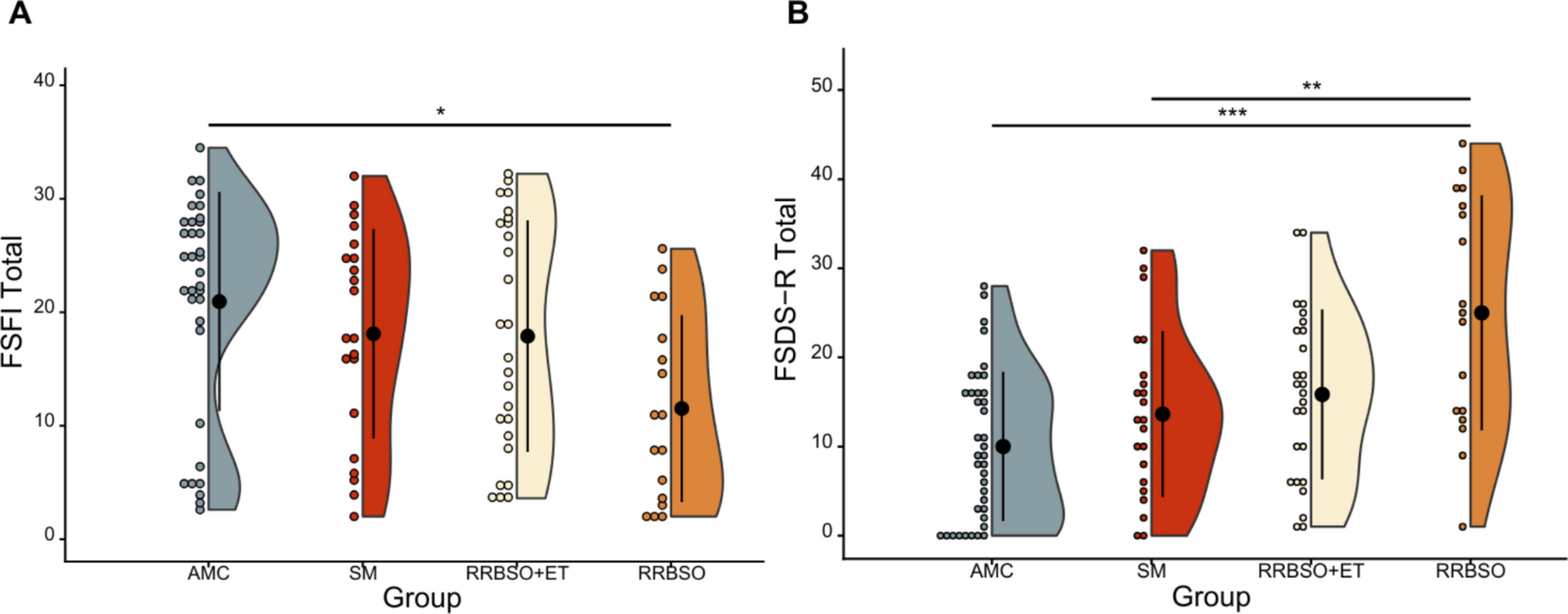
… where RRBSO had significantly lower FSFITOTAL scores than AMC (adjusted mean difference = − 7.75, SE = 2.81, t(92) = − 2.76, adjusted p =.042), with a large effect size, d = − 0.84, 95% CI [− 1.47, − 0.22] (Fig. 1A).
- Limitation
In particular, the FSFI has a dysfunction bias (Meston et al.,; Meyer-Bahlburg & Dolezal, ).
Quoted word for word from the full text on link.springer.com.
The paper
Archives of Sexual Behavior, 15 Oct 2026, Open access

