Social jetlag in a longitudinal Chinese wearable cohort: weekly variation, solar-time mismatch, and sleep-activity associations
Abstract
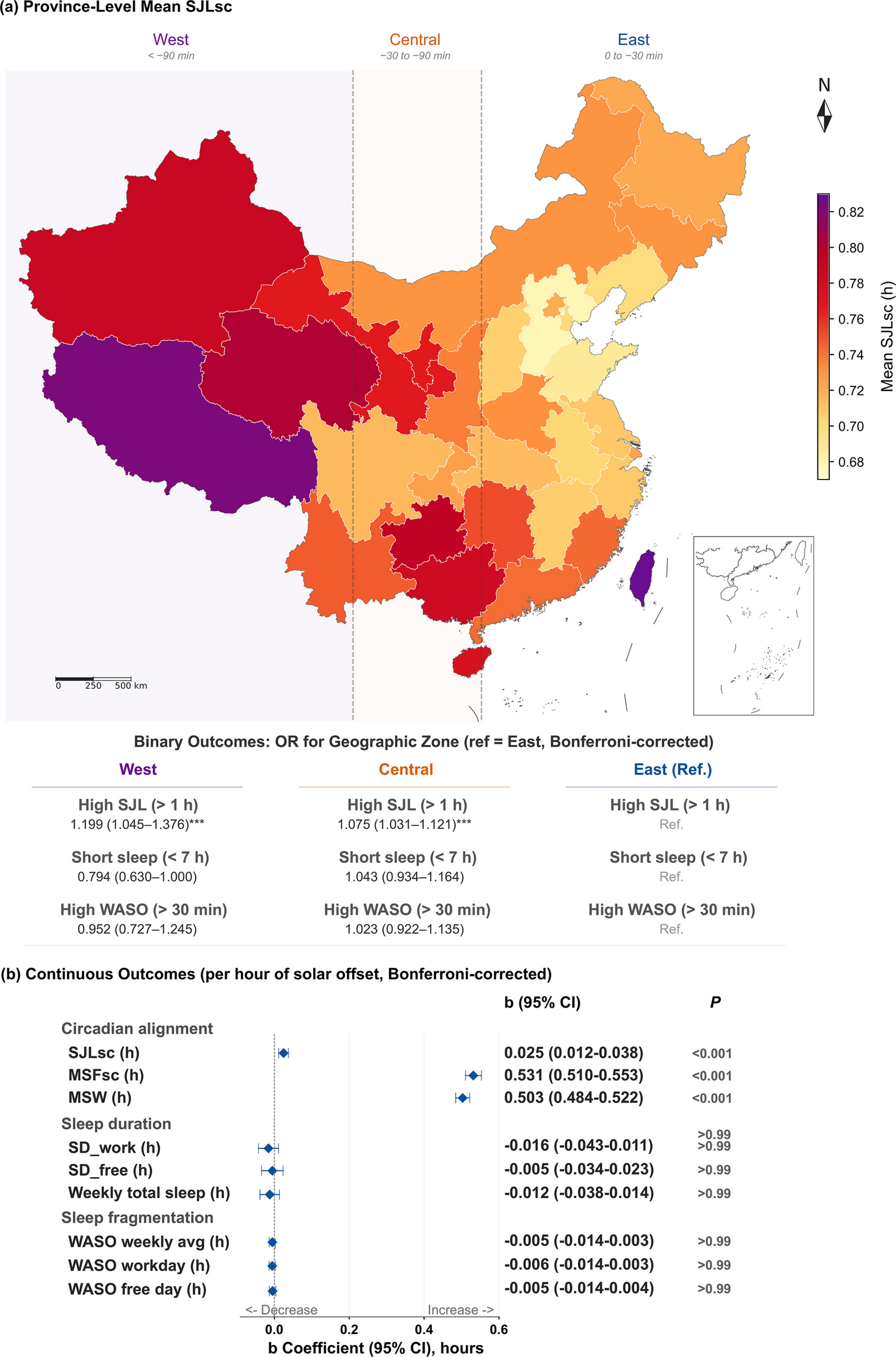
PURPOSE: To examine how sleep-corrected social jetlag (SJLsc) varied with work-rest schedules and solar time zone and how it was associated with sleep, physical activity, and nocturnal heart rate variability (HRV). METHODS: Wearable-device and questionnaire data from 63,752 adults contributing 2,037,507 person-weeks were analyzed. SJLsc was the difference in sleep midpoint between workdays and free days, corrected for sleep debt. High SJL was SJLsc > 1 h. Weeks were classified as normal, extended-rest (statutory holidays added), or extended-work (weekend days reassigned as workdays). Provinces were grouped as east, central, or west by solar time offset, the gap between local solar time and China Standard Time. Generalized linear mixed models tested week type and solar offset. Within-person centering was used to separate between- from within-person associations. RESULTS: Median SJLsc was 0.70 h. High SJL was more common by week than by person (25.02% of person-weeks vs 20.25% of participants). High SJL was less likely during extended-rest (OR = 0.844, 95% CI 0.830-0.859) and extended-work weeks (OR = 0.776, 95% CI 0.758-0.794), while short-sleep odds were higher in both. Locations farther west were associated with later sleep and greater SJLsc. Adverse associations of SJL with sleep and physical activity were stronger between people than within people, whereas HRV showed no robust association. CONCLUSION: Associations of social jetlag with sleep and physical activity were driven mainly by between-person differences. Lower social jetlag during extended-rest and extended-work weeks coexisted with higher odds of short sleep, suggesting that social jetlag should be interpreted alongside sleep duration and schedule context. CURRENT STUDY/STUDY RATIONALE: Social jetlag has been linked to adverse sleep and health outcomes, but prior studies have relied largely on cross-sectional or questionnaire-based measures. Large longitudinal wearable data can test how social jetlag varies across real-world schedules and examine associations between social jetlag and sleep, physical activity, and HRV, with stable person-level differences or week-to-week change clearly defined. STUDY IMPACT: In 63,752 Chinese adults, high social jetlag was more common at the week level than at the person level, and lower social jetlag during altered schedules did not necessarily indicate longer or more continuous sleep. Adverse associations with sleep and physical activity were driven mainly by between-person differences, supporting trait-state decomposition in clinical sleep research.
- Social jetlag
- Altered work-rest schedules
- Extended-rest schedules
- Short sleep
- Nocturnal heart rate variability
- Humans
The paper
Peking University School and Hospital of Stomatology
Journal of Clinical Sleep Medicine, 15 Oct 2026