Exercise Prescriptions for Cardiovascular Health in Adults: 2026 ACC Scientific Statement: A Report of the American College of Cardiology
Abstract
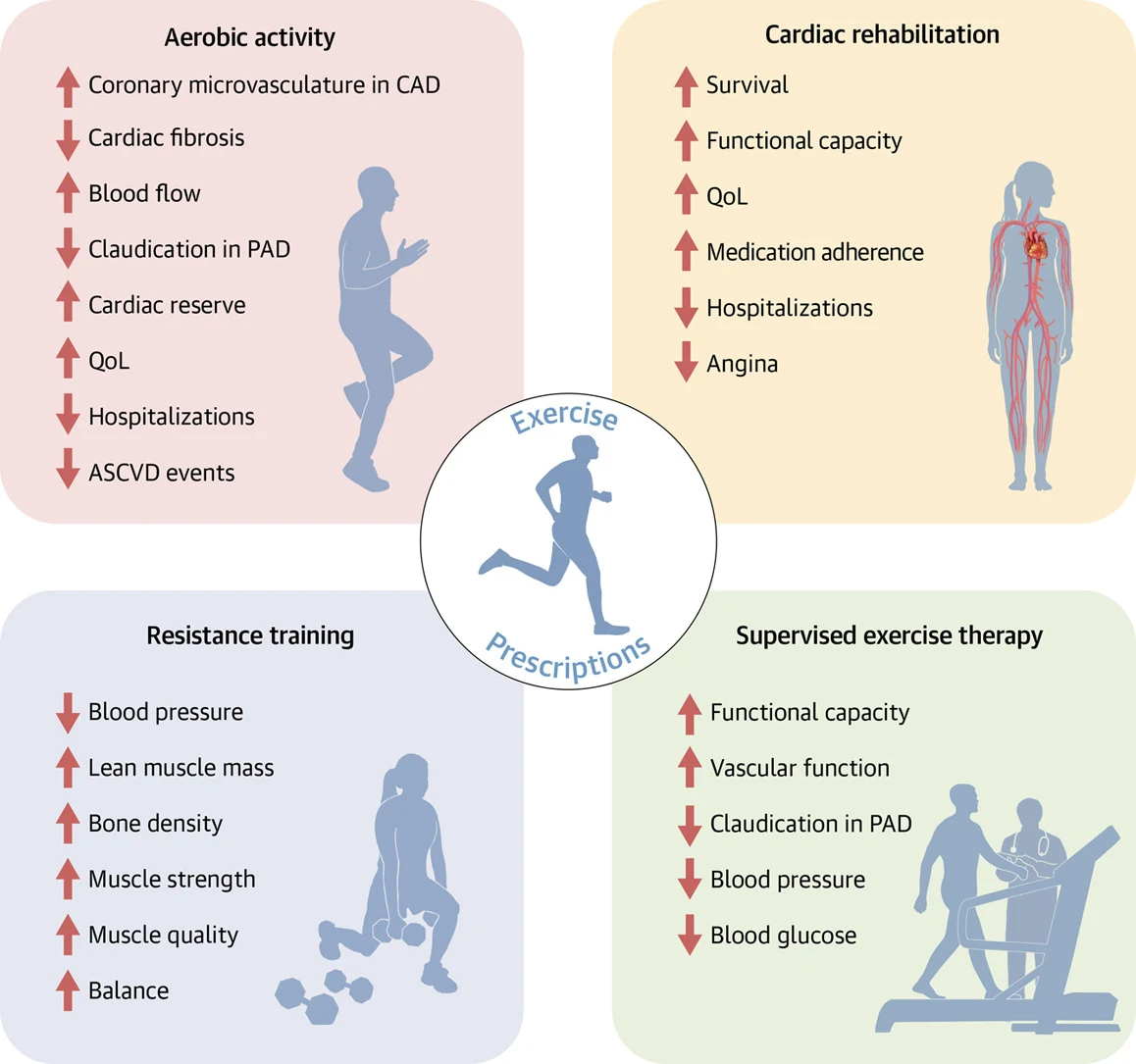
Regular physical activity and structured exercise are foundational for cardiovascular prevention and treatment, yet exercise prescription remains inconsistently integrated into routine cardiovascular care. This American College of Cardiology scientific statement provides contemporary, practical guidance for clinicians on prescribing exercise across the spectrum of cardiovascular health and disease. The statement reviews evidence supporting physical activity, exercise training, and cardiorespiratory fitness as powerful determinants of cardiovascular outcomes, emphasizing that the greatest absolute benefits occur when inactive individuals begin moving and that additional benefits accrue with higher volumes and intensity, within appropriate clinical limits. It summarizes approaches to aerobic, resistance, balance, and flexibility training; highlights the role of cardiac rehabilitation and supervised, home-based, hybrid, and virtual models; and addresses individualized exercise prescription for patients with coronary artery disease, peripheral artery disease, heart failure, cardiomyopathies, hypertension, overweight and obesity, adult congenital heart disease, and older age. The statement also discusses when exercise testing is useful to assess safety, guide intensity, establish baseline fitness, and monitor responses, while recognizing that routine preparticipation testing is not required for most asymptomatic individuals. Wearable devices and digital tools are reviewed as adjuncts to self-monitoring, goal setting, and cardiac rehabilitation extension, with attention to equity, access, and digital literacy. Key implementation priorities include improving clinician training, embedding physical activity counseling into cardiovascular care, tailoring prescriptions to patient goals and functional capacity, and expanding research on long-term adherence, clinical outcomes, diverse populations, and scalable delivery models. Exercise should be prescribed as a core component of cardiovascular prevention and disease management.
The paper
Journal of the American College of Cardiology, 15 Oct 2026