Genetic risk score linked to cognitive impairment in older adults
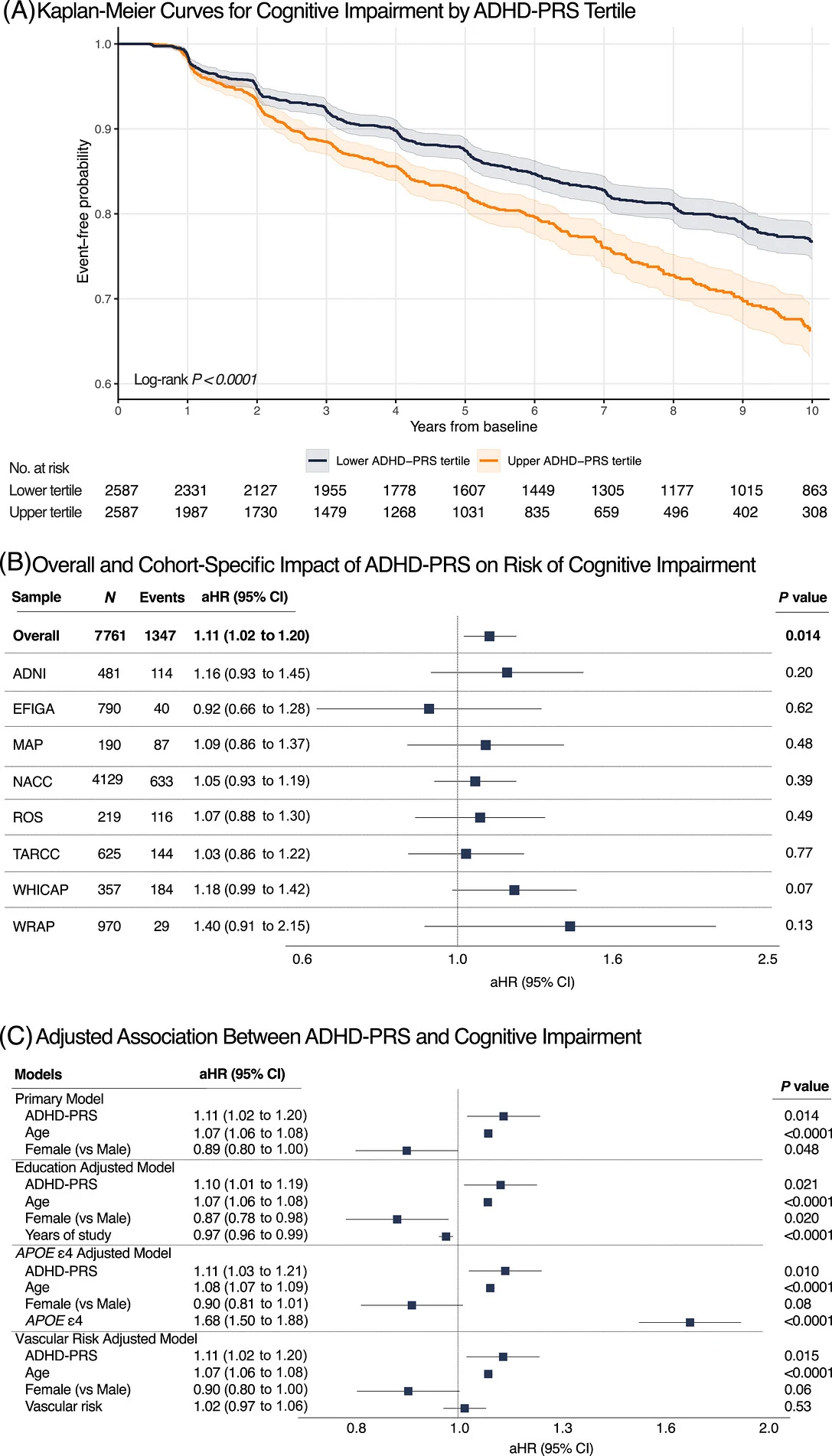
Ten-year cognitive impairment risk was 33.8% among participants in the highest third of attention-deficit/hyperactivity disorder genetic risk scores, versus 23.4% in the lowest third.
Limit: Overlapping ADHD symptoms may have been misdiagnosed as mild cognitive impairment
A prospective observational study followed 7,761 older adults without cognitive impairment from eight groups participating in the Alzheimer’s Disease Sequencing Project. Researchers calculated a genetic risk score for attention-deficit/hyperactivity disorder from participants’ DNA data. Such scores combine information from many genetic variants to estimate inherited risk.
During follow-up, 1,347 participants developed cognitive impairment, defined as mild cognitive impairment or Alzheimer’s disease dementia. Higher genetic risk scores remained associated with greater risk after accounting for education or risk factors affecting blood vessels. Genetic risk scores for other major psychiatric disorders were not associated with cognitive impairment in the same analysis.
Why it matters
The work addresses whether genetic susceptibility to attention-deficit/hyperactivity disorder could help identify vulnerability to cognitive impairment in aging.
Caveats
The observational design cannot establish cause and effect. The findings concern genetic risk, not a diagnosis of attention-deficit/hyperactivity disorder, in older adults who initially had no cognitive impairment.
From the paper
- Participants
A total of 1146 participants had available Aβ status (ADNI n = 411, NACC n = 436, WRAP n = 299).
- Result
In adjusted Cox models, higher ADHD-PRS was associated with greater risk of incident cognitive impairment per 1-SD increase in ADHD-PRS (hazard ratio [HR] = 1.11, 95% CI: 1.02 to 1.20, P = 0.014).
- Absolute difference
This corresponds to an absolute difference of 10.4 percentage points, or approximately 10 additional cases per 100 individuals over the course of 10 years.
Quoted word for word from the full text on alz-journals.onlinelibrary.wiley.com.
- Cognitive impairment
- Attention deficit hyperactivity disorder
- Mild cognitive impairment
- Alzheimer's disease dementia
- Incident cognitive impairment
- Humans
The paper
University of Pittsburgh
Alzheimer's & Dementia, 1 Oct 2026, Open access