Screening for Geriatric Problems in Older Adults Receiving Hemodialysis Using a Self-Administered Battery
Abstract
PURPOSE: Older adults receiving hemodialysis experience geriatric problems that affect quality of life and contribute to high healthcare utilization but are often underrecognized in dialysis care. Scalable approaches to identifying these problems are needed. This study evaluated the agreement between a self-administered screening battery and a geriatrician telehealth evaluation and assessed the feasibility of implementing the screening battery in dialysis clinics. PATIENTS AND METHODS: Participants aged ≥55 receiving hemodialysis completed the Geriatric screen for Older adults receiving Dialysis (GOLD), a screening battery assessing seven geriatric problems: depression, anxiety, functional impairment, cognitive impairment, falls risk, limited social support, and low nutritional status, followed by a blinded geriatrician telehealth evaluation. Intra-problem agreement between the GOLD and geriatrician evaluation was assessed using Cohen's κ, and analyses evaluated alternative screening thresholds. Acceptability and feasibility of the GOLD were evaluated through participant and staff surveys. RESULTS: The cohort included 50 participants [76% (n=38) Black race, 62% (n=31) male, 16% (n=8) Hispanic/Latino ethnicity] with a mean (SD) age of 68 (7.8) years and a median dialysis vintage of 3.5 [IQR (1, 12.5)] years. Geriatric problems were common, including fall risk (78% geriatrician; 90% GOLD), functional impairment (58% geriatrician; 44% GOLD), and low nutritional status (50% geriatrician; 40% GOLD). Agreement between the GOLD and geriatrician evaluation was substantial for anxiety (κ=0.74), functional impairment (κ=0.65), low nutritional status (κ=0.64), and limited social support (κ=0.65), but not for cognitive impairment, falls risk, or depression. Most participants (37 of 45) reported the GOLD was easy to complete, and a minority (16 of 50) required assistance. CONCLUSION: The GOLD demonstrated agreement with geriatrician evaluation for many geriatric problems and was feasible to implement in dialysis clinics. These findings suggest potential utility for scalable geriatric screening in dialysis care, although further work is needed to confirm these findings in larger cohorts and to refine screening for cognitive impairment and other domains.
From the paper
- Participants
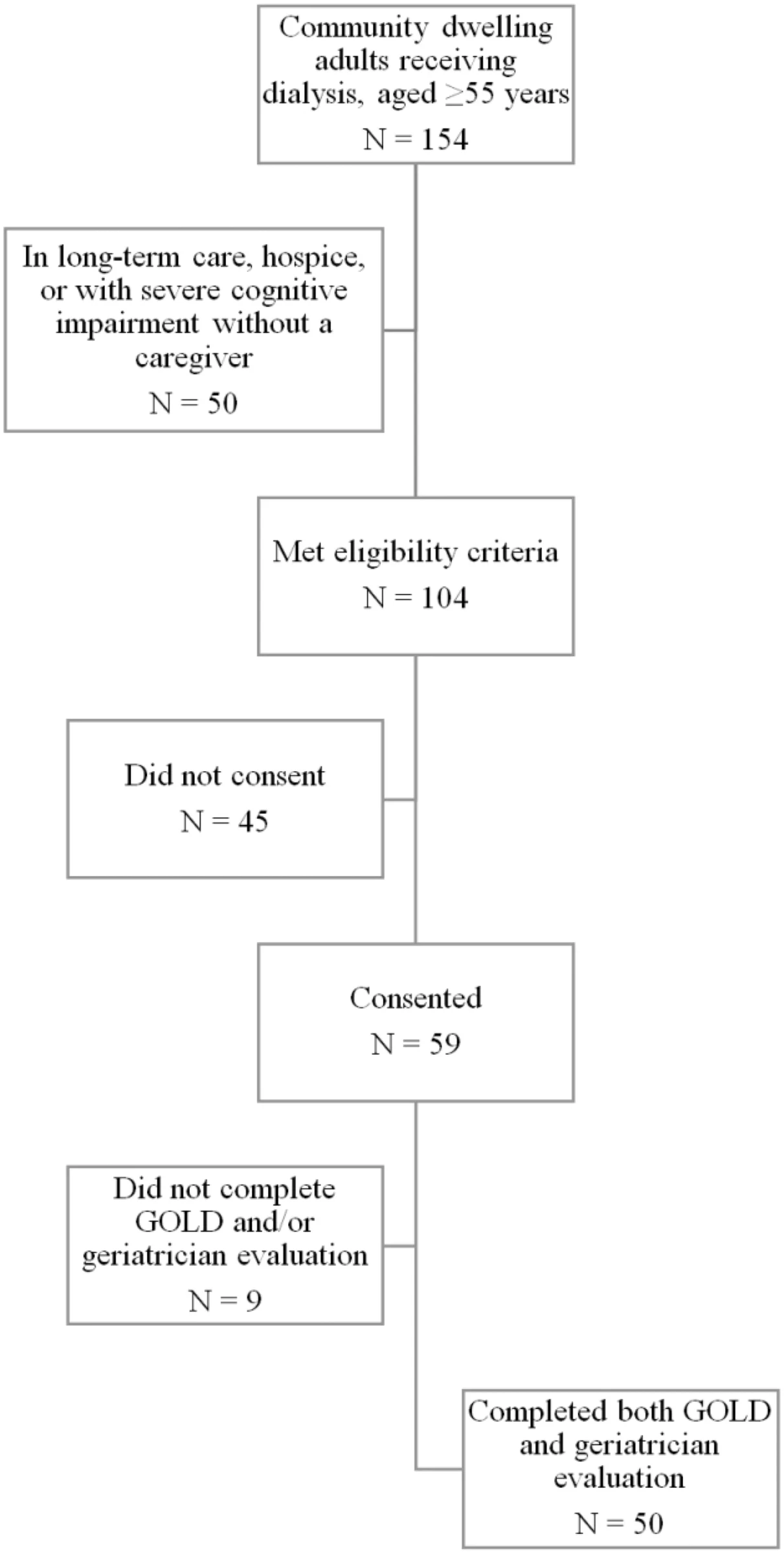
Among the 50 participants, the cohort was predominantly male (62%), Black or African American (76%), and not Hispanic or Latino (84%).
Quoted word for word from the full text on dovepress.com.
- Geriatric screen for older adults receiving dialysis
- Anxiety
- Cognitive impairment
- Depression
- Functional impairment
- Humans
The paper
Duke University
Clinical Interventions in Aging, 10 Oct 2026, Open access