Association of early-life caregiver mental health and education with incidence of mild cognitive impairment among the Chinese population: A longitudinal observational study
Abstract
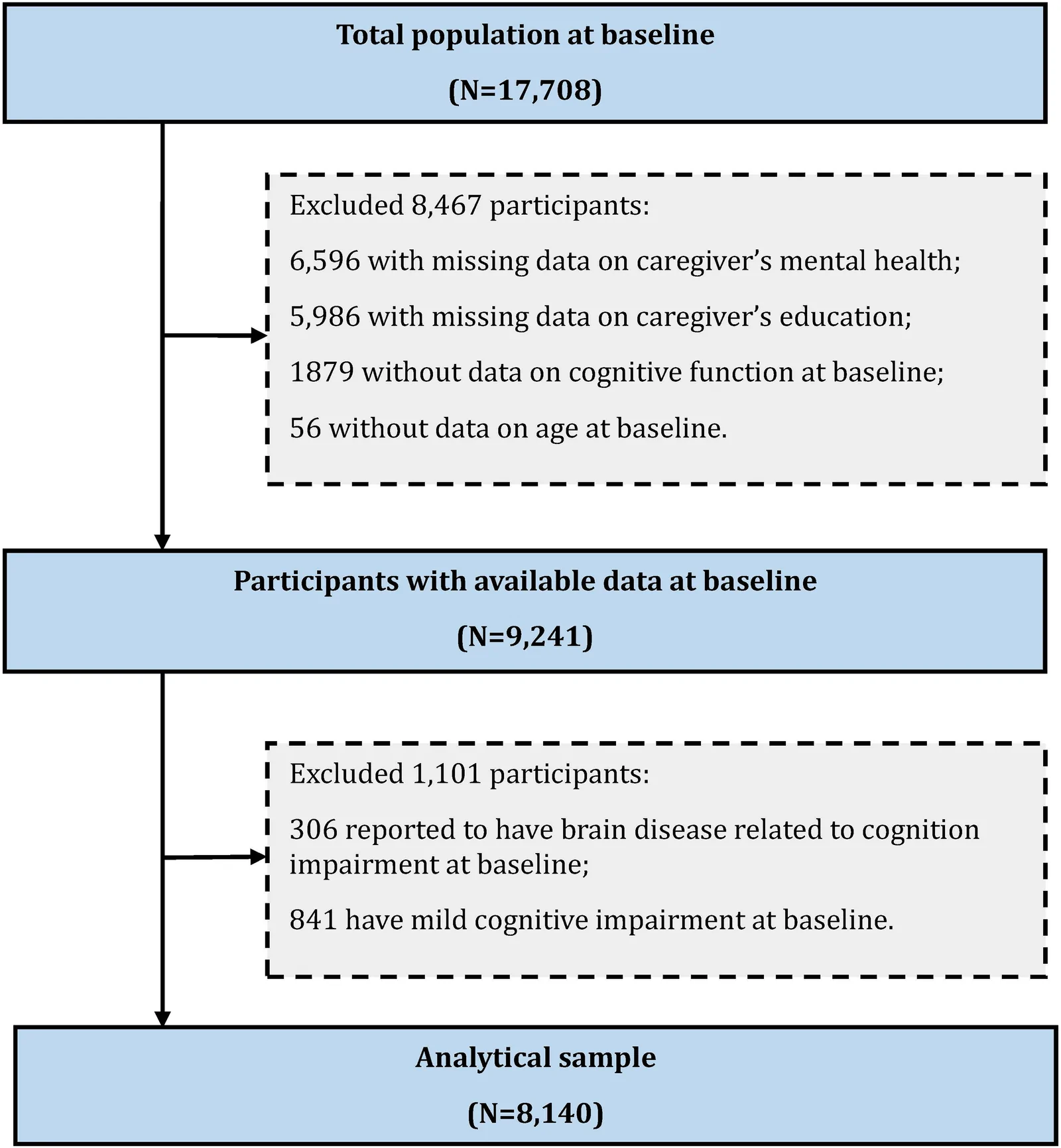
BACKGROUND: Mild cognitive impairment (MCI) is a critical prodromal stage of dementia, yet the role of early-life psychosocial determinants, particularly caregiver characteristics, remains underexplored. OBJECTIVE: To investigate the associations of caregiver mental health and education with offspring MCI incidence, and to examine their joint effects. METHODS: We utilized data from the China Health and Retirement Longitudinal Study (CHARLS), involving 8140 participants aged ≥45 years. The mental health (categorized as normal or abnormal) and educational level (categorized as illiterate, basic, or middle school and above) of the primary male and female caregivers were assessed retrospectively. MCI was diagnosed based on a comprehensive cognitive battery assessing orientation, episodic memory, and executive function, with scores standardized for age and education. Cox regressions were used to analysis. RESULTS: Over a median follow-up of 9.0 years, 873 (10.72%) participants developed MCI. Abnormal caregiver mental health was associated with an approximately 18% higher risk of incident MCI in offspring (HR [95% confidence interval]: female caregiver: 1.17 [1.02-1.35]; male caregiver: 1.18 [1.02-1.37]). Compared to having an illiterate caregiver, having a male caregiver with a basic education was associated with a 23% lower risk of MCI (HR = 0.78 [0.67-0.91]); this association was not significant for female caregivers. CONCLUSIONS: Caregiver mental health and educational attainment are independently associated with the risk of MCI in their offspring during mid-to-late life. Interventions supporting caregiver well-being and education may contribute to dementia prevention strategies. These findings were derived exclusively from the Chinese population; caution should be taken when generalizing to other populations.
- Caregiver mental health
- Caregiver education
- Mild cognitive impairment
- Comprehensive cognitive battery
- Humans
The paper
West China Hospital of Sichuan University
Journal of Alzheimer's Disease Reports, 9 May 2026, Open access