Association between the Dietary Index for Gut Microbiota and osteoporosis: a cross-sectional study from NHANES among individuals aged ≥ 50 years
Dose-response
Abstract
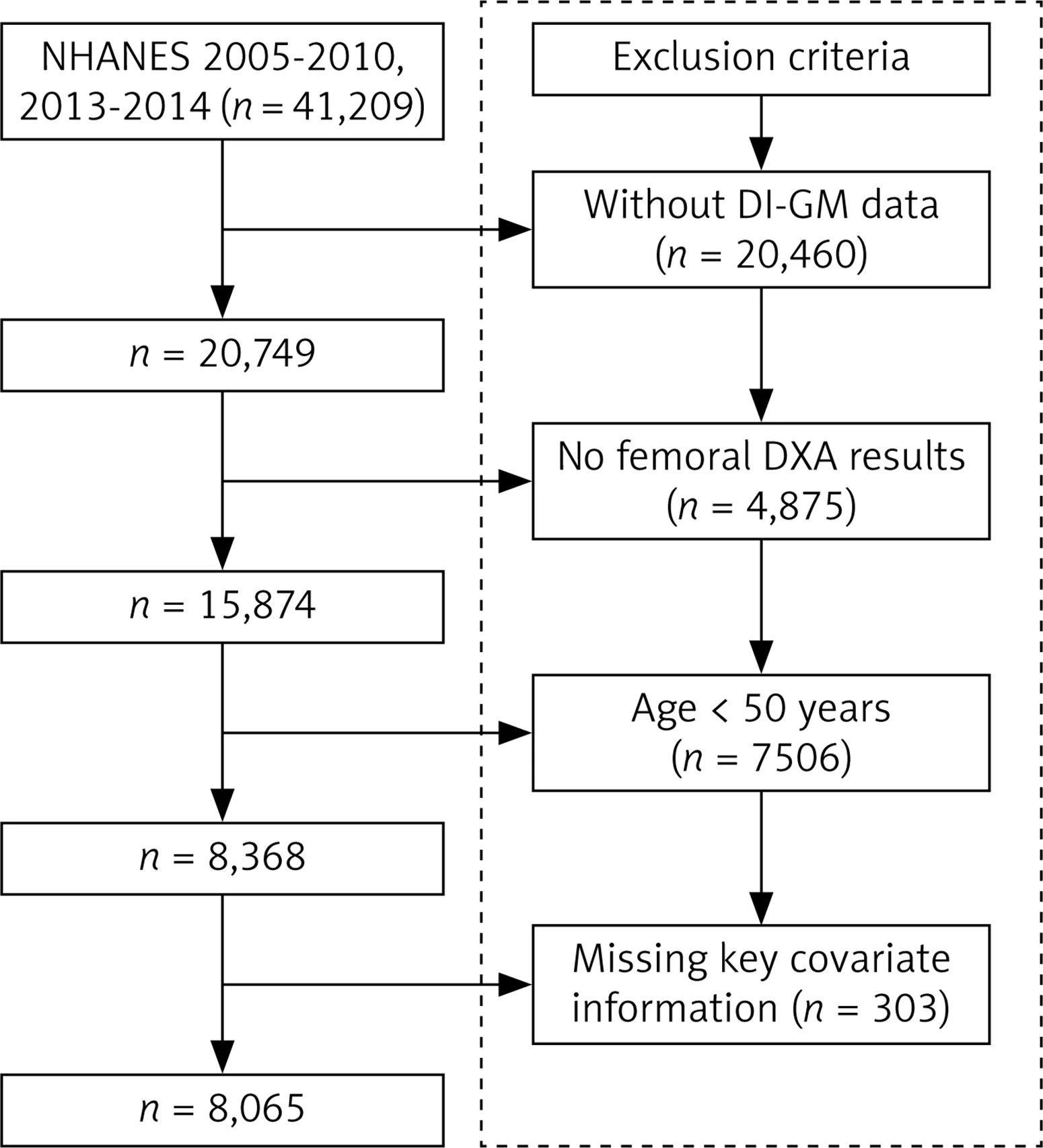
INTRODUCTION: The gut microbiota serves as a critical interface between the host's internal environment and external factors, influencing bone mass and quality by modulating immune homeostasis, mineral absorption, and the production of systemically active metabolites. In this context, the Dietary Index for Gut Microbiota (DI-GM) provides a valuable metric for quantifying diet quality in relation to microbiota health. Therefore, investigating the association between DI-GM and the risk of osteoporosis (OP) is important for developing evidence-based dietary prevention guidelines. MATERIAL AND METHODS: This cross-sectional study leveraged data from the U.S. National Health and Nutrition Examination Survey (NHANES) in 2005-2010 and 2013-2014. Multivariable weighted logistic regression (WLR) models were employed to ascertain the association between DI-GM and the prevalence of OP. Restricted cubic splines (RCS) were leveraged to explore the dose-response relationship between DI-GM and OP. Subgroup analyses and interaction tests were performed to validate the reliability of the findings. RESULTS: Our analysis included 8,065 U.S. adults aged ≥ 50 years. The multivariable WLR analysis revealed that the risk of OP significantly decreased with increasing DI-GM scores (OR = 0.929, 95% CI: 0.874-0.988, p = 0.021). Relative to the cohort with the lowest DI-GM scores, the highest DI-GM cohort exhibited a 36.1% lower risk of OP (OR = 0.639, 95% CI: 0.441-0.925, p = 0.019). RCS analysis indicated a negative linear correlation between DI-GM and OP (p non-linear = 0.281). CONCLUSIONS: Higher DI-GM scores were associated with lower risk of OP, indicating a protective role for diets that enhance GM diversity.
The paper
Qiannan Medical College for Nationalities; The People’s Hospital of Qiannan
Archives of Medical Science, 10 Apr 2026, Open access


