GLP-1 Receptor Agonist Therapy Is Associated With Lower Risk of Lower Extremity Amputation in Adults With Type 2 Diabetes and Foot Ulcer Without Coded Peripheral Arterial Disease: A Hypothesis-Generating Real-World Cohort Study
5 years
Abstract
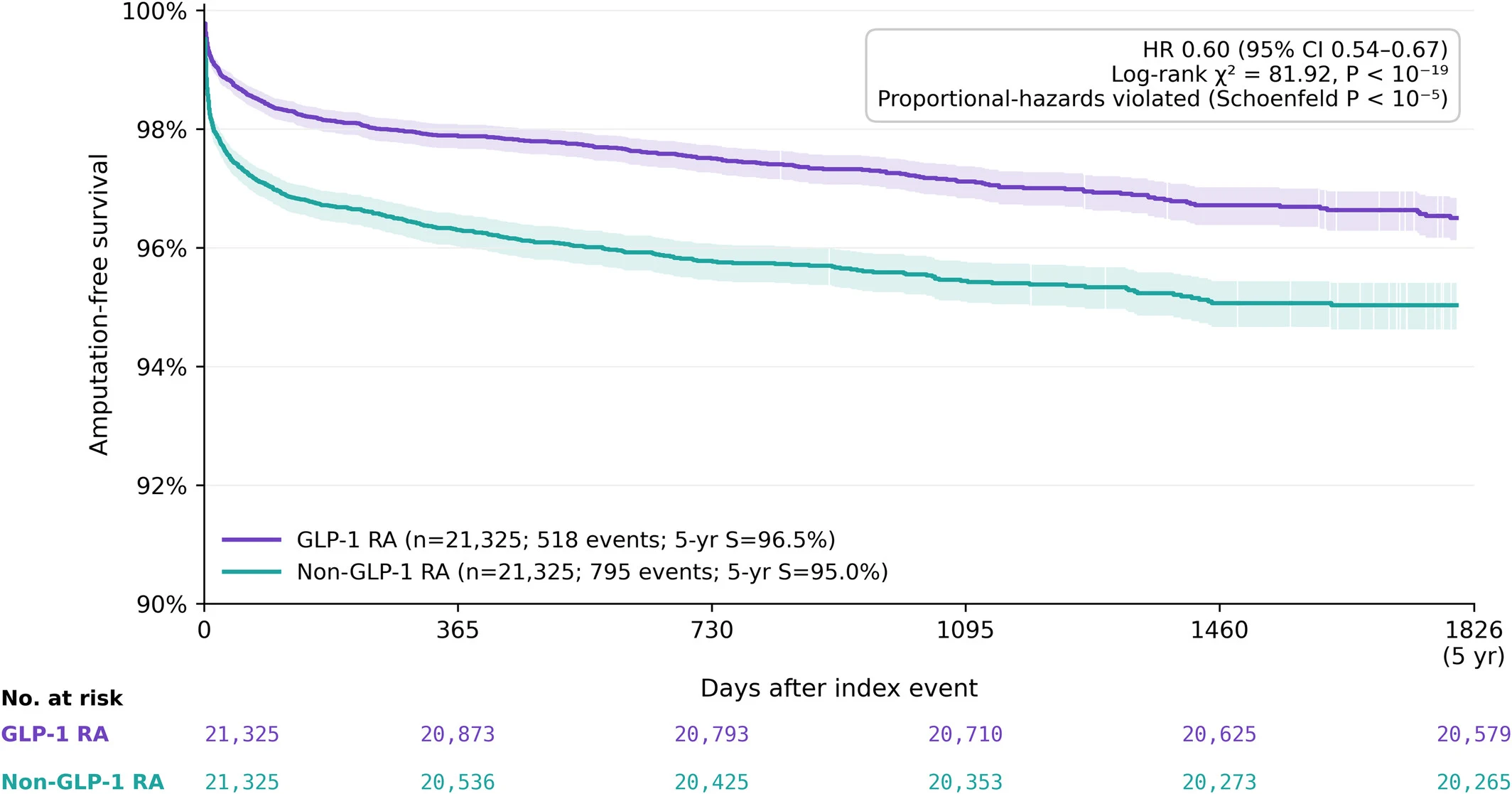
AIMS: To compare lower extremity amputation (LEA) risk in adults with Type 2 diabetes and diabetic foot ulcer (DFU) treated with glucagon-like peptide-1 receptor agonists (GLP-1 RAs) versus other glucose-lowering therapy, and to test whether coded peripheral arterial disease (PAD) modifies this association and replicates across comparator classes. MATERIALS AND METHODS: This new-user, active-comparator retrospective cohort study used the TriNetX Global Collaborative Network (queried 11 July 2026). Adults with Type 2 diabetes and DFU were propensity-score matched 1:1 on 22 covariates, giving 21 325 pairs for the primary comparison. Effect modification by coded PAD (ICD-10 I70.2) was examined in independently matched subgroups. Six sensitivity analyses were pre-specified: 30- and 180-day landmarks, all-cause mortality, background-therapy balancing, limb-severity adjustment and a broadened PAD definition. RESULTS: GLP-1 RA use was associated with lower 5-year LEA risk than all non-GLP-1 RA therapy (hazard ratio [HR]: 0.60, 95% CI: 0.54-0.67). The association was confined to the no-PAD stratum (HR: 0.21, 0.13-0.33) and absent where PAD was coded (HR: 0.97, 0.78-1.20); ratio of hazard ratios 0.21 (0.13-0.36; p < 0.001). All-cause mortality was also lower (HR: 0.48, 0.45-0.50). The insulin no-PAD estimate persisted under background-therapy balancing (0.14), limb-severity adjustment (0.16) and 30- and 180-day landmarks (0.28, 0.33). Broadening the PAD definition attenuated the no-PAD association without abolishing it (HR: 0.34, 0.17-0.65). CONCLUSIONS: In Type 2 diabetes with DFU, GLP-1 RA use was associated with lower LEA risk, surviving six pre-specified sensitivity analyses. These observational findings are hypothesis-generating and require prospective confirmation.
From the paper
- Participants
Under the 11 July 2026 refresh the GLP-1 RA cohort comprised 23 302 patients across 114 healthcare organisations, and the primary matched cohort contained 21 325 pairs.
- Primary outcome
GLP-1 RA use was associated with a lower 5-year risk of LEA than all non-GLP-1 RA drugs (HR: 0.60, 95% CI: 0.54–0.67; 518 vs. 795 events; 21 325 pairs; Figure 1).
- Limitation
Confounding by indication cannot be excluded, since users of insulin, insulin plus sulfonylurea and DPP-4 inhibitors probably represent more advanced disease despite matching.
Quoted word for word from the full text on dom-pubs.onlinelibrary.wiley.com.
The paper
Hadassah Medical Center; Rabin Medical Center
Diabetes, Obesity & Metabolism, 14 Oct 2026, Open access