Metabolic and oncological effects of metformin added to ADT in prostate cancer: systematic review and meta-analysis including STAMPEDE
Preregistered CRD420261384520
Abstract
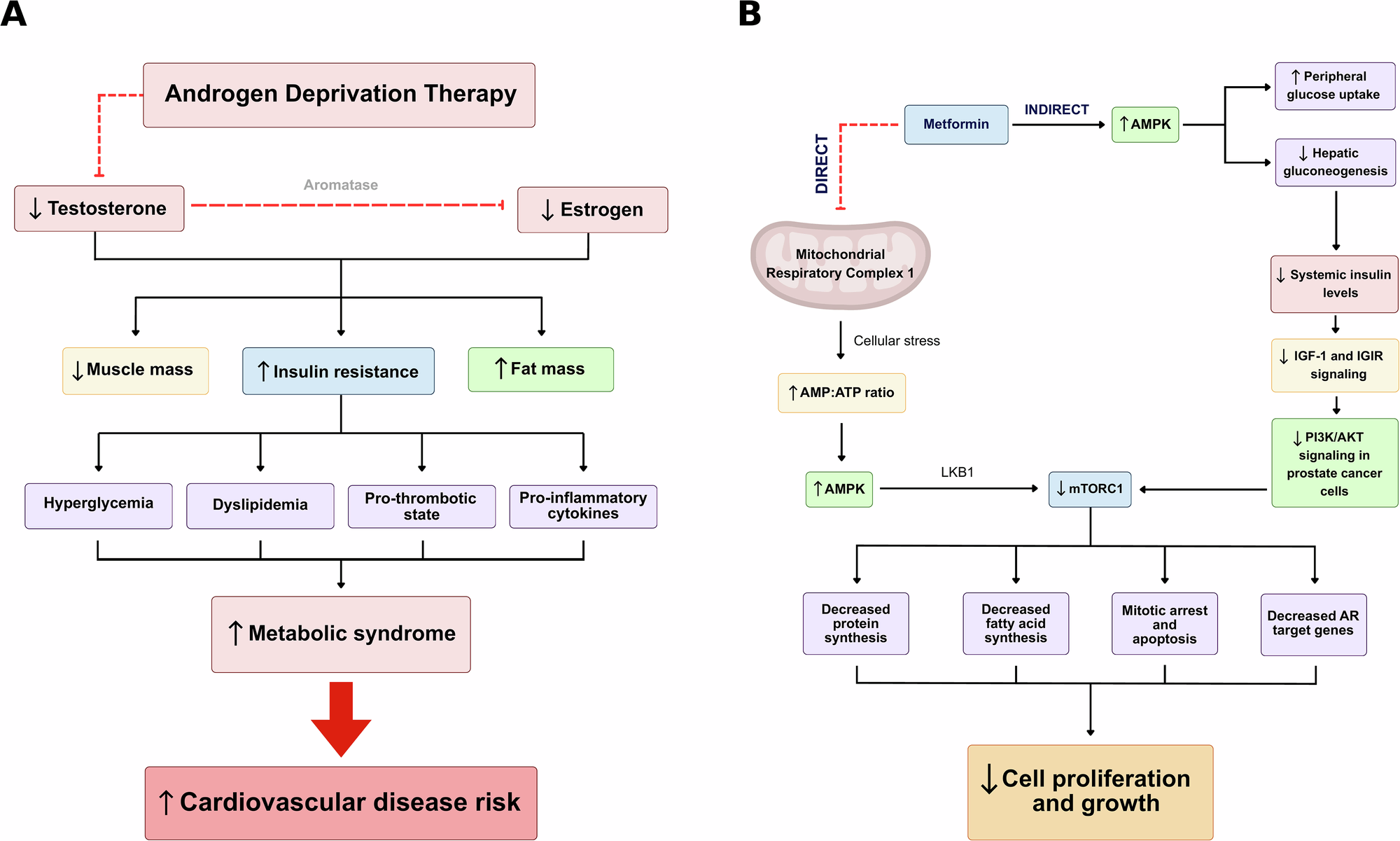
BACKGROUND: Androgen-deprivation therapy (ADT) is the cornerstone of advanced prostate cancer treatment but induces a metabolic syndrome phenotype that heightens cardiovascular risk. Metformin, an insulin-sensitising biguanide with emerging anticancer properties, is a rational ADT adjunct. Following STAMPEDE's 2025 publication, we aimed to quantify metformin's metabolic benefit and characterise its oncological signal by disease volume. METHODS: This PRISMA 2020-guided review (PROSPERO CRD420261384520) searched five databases through 12 May 2026. Eligible RCTs compared metformin plus ADT versus ADT alone in prostate cancer. Primary metabolic outcomes were body weight, waist circumference, HbA1c, fasting glucose, and LDL cholesterol. Secondary (exploratory) oncological outcomes were overall survival (OS) and castration-resistant prostate cancer-free survival (CRPC-FS), derived predominantly from a single trial. Random-effects models with Hartung-Knapp correction were used; GRADE assessed certainty. RESULTS: Six trials enroling 2415 participants (78% from STAMPEDE) were included: STAMPEDE (n = 1 874), PRIME (n = 166), PREMIUM (n = 83), MANSMED (n = 124), Mahalingam (n = 36), and Alagizy (n = 132). Disease status ranged from metastatic (STAMPEDE, Alagizy, majority MANSMED) to locally advanced or biochemically recurrent (PREMIUM, PRIME, Mahalingam); all excluded diabetes mellitus except MANSMED ( ~ 20%). At 12 months, metformin significantly reduced waist circumference (MD -1.12 cm; p = 0.014), HbA1c (MD -0.070%; p = 0.029), and fasting glucose (MD -0.100 mmol/L; p = 0.031). Body weight and LDL cholesterol reductions were non-significant (MD -1.60 kg; p = 0.090 and MD -0.130 mmol/L; p = 0.343, respectively). In STAMPEDE, metformin did not improve OS (HR 0.91; p = 0.15); the high-volume subgroup showed a survival benefit (HR 0.79; p = 0.007; volume interaction p = 0.12, non-significant). In MANSMED, CRPC-free survival was significantly prolonged (HR 0.50; p = 0.01), though this signal derives from a single small, open-label trial. CONCLUSIONS: Metformin added to ADT produces moderate-certainty reductions in waist circumference and HbA1c. Oncological benefit in unselected patients was not demonstrated; the hypothesis-generating STAMPEDE high-volume subgroup signal, derived from a single trial, warrants evaluation in a prospective, volume-stratified RCT.
The paper
Prostate Cancer and Prostatic Diseases, 14 Oct 2026