Real-World Metabolic Improvements in Women With and Without Polyendocrine Metabolic Syndrome via a Multidisciplinary Telehealth Care Platform
Abstract
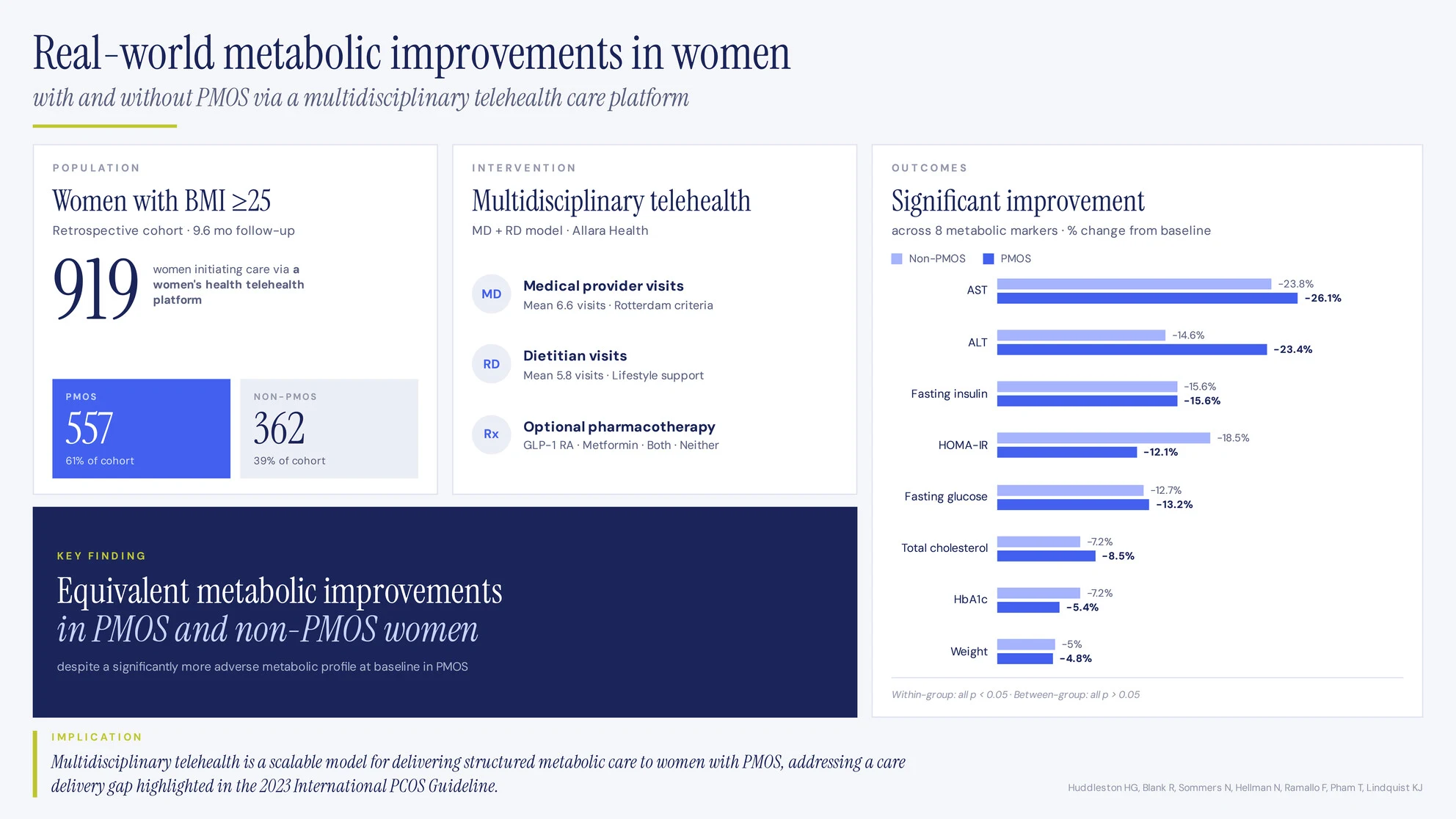
OBJECTIVE: To evaluate metabolic outcomes in women with and without Polyendocrine Metabolic Ovarian Syndrome (PMOS, formerly Polycystic Ovary Syndrome (PCOS))) receiving multidisciplinary care through a women's health telehealth platform that combines physician and registered dietitian support. METHODS: Retrospective cohort analysis of 919 women with BMI ≥ 25 initiating care in 2024, with ≥ 6 months follow-up (mean 9.6 months). Participants included 557 with PMOS and 362 without. Outcomes extracted from the electronic health record (EHR) included change in weight, HbA1c, HOMA-IR, fasting insulin, fasting glucose, ALT, AST and total cholesterol between baseline and last measured value. Linear regression models adjusted for baseline values of each outcome, age, BMI, race/ethnicity and follow-up time. RESULTS: Significant improvements were observed across all metabolic markers for the group overall: HOMA-IR (-14.0%), fasting insulin (-15.6%), fasting glucose (-13.0%), HbA1c (-6.2%), ALT (-21.2%), AST (-25.5%), total cholesterol (-8.0%) and weight (-4.9%). PCOS status was not associated with differential improvement in any outcome after adjustment. GLP-1 receptor agonist use was associated with greater weight loss; however, improvements were also observed in the no-medication group. CONCLUSIONS: Women with PCOS achieved metabolic improvements equivalent to those without PMOS through a multidisciplinary telehealth model despite presenting with a more adverse metabolic profile at baseline.
From the paper
- Participants
A total of 3117 women initiated care between 1 January and 31 December 2024.
- Follow-up
Retrospective cohort analysis of 919 women with BMI ≥ 25 initiating care in 2024, with ≥ 6 months follow-up (mean 9.6 months).
- Result
Compared to no pharmacologic weight loss support, GLP-1 RA use was significantly associated with greater weight loss in adjusted models, whether prescribed alone (−10.1 lbs, 95% CI −14.0, −6.2) or in combination with metformin (−7.1 lbs, 95% CI −10.4, −3.9).
Results, 3.3 Association Between Change in Outcome Values, Exposures and Covariates
- Limitation
With a retrospective observational design, causation cannot be assigned and unmeasured confounding cannot be excluded.
Quoted word for word from the full text on onlinelibrary.wiley.com.
The paper
University of California, San Francisco
Endocrinology, Diabetes & Metabolism, 14 Oct 2026, Open access