Trajectory-based associations between a structured acupressure protocol, blood pressure variability, and autonomic balance in patients with primary hypertension
4 weeks, sham-controlled
Abstract
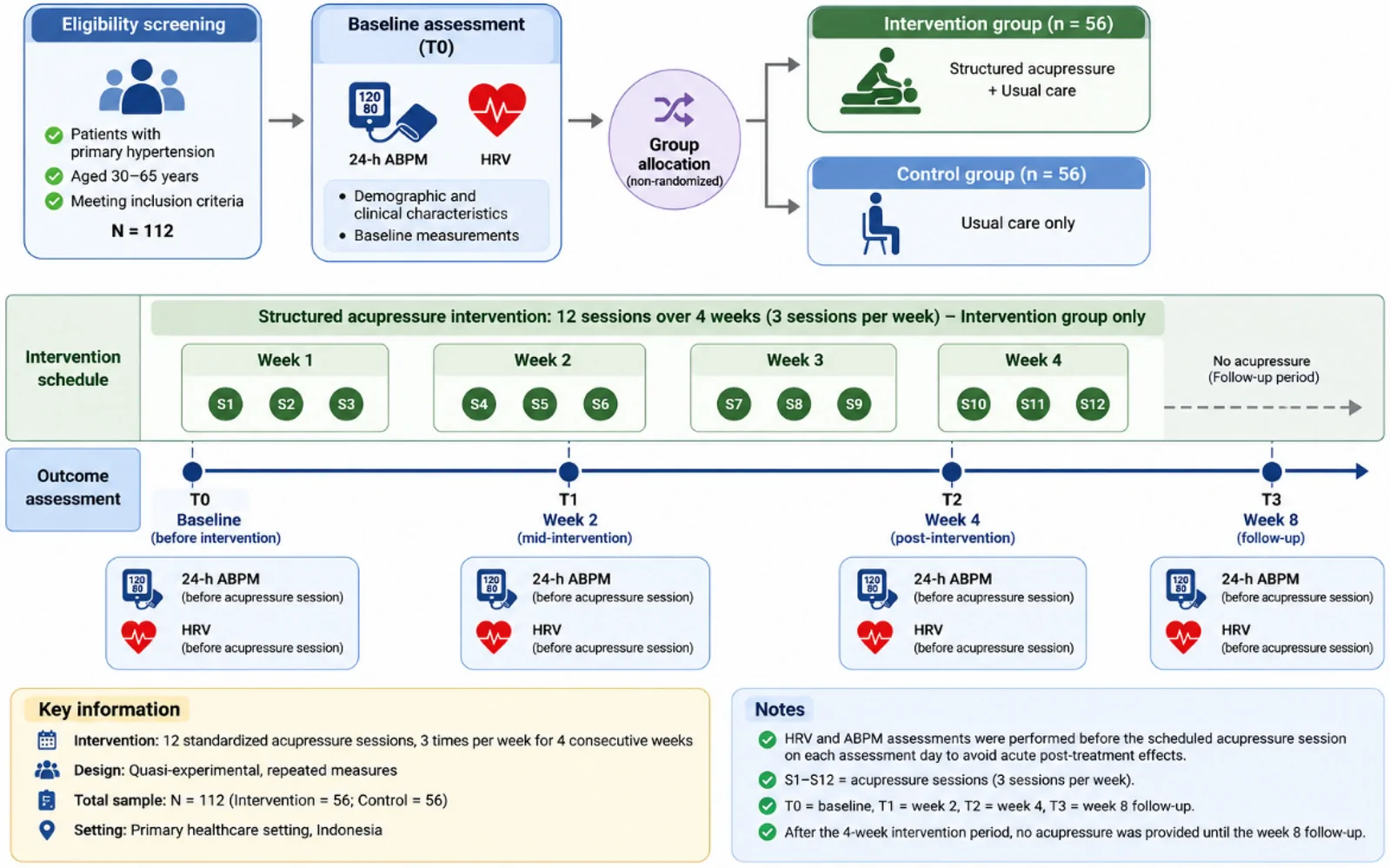
BACKGROUND: Hypertension remains a major global public health problem, with suboptimal rates of blood pressure control despite widespread pharmacological treatment. Beyond mean blood pressure levels, blood pressure variability (BPV) and autonomic nervous system imbalance, reflected by heart rate variability (HRV), have emerged as important predictors of cardiovascular risk. This study aimed to examine trajectory-based associations between a structured acupressure intervention, blood pressure variability, and autonomic balance in patients with primary hypertension. METHODS: Participants received either structured acupressure (12 sessions over 4 weeks) plus usual care or usual care alone. Blood pressure variability was assessed using 24-hour ambulatory monitoring. Autonomic balance was measured via heart rate variability indices. Linear mixed-effects models estimated longitudinal trajectories. Mediation was tested using structural equation modelling. RESULTS: Compared with controls, the intervention group showed greater reductions in systolic blood pressure variability (β = -1.92, 95% CI -2.78 to -1.06, p < .001). High-frequency heart rate variability increased (β = 84.60, 95% CI 47.60 to 121.60, p < .001), and the low/high-frequency ratio decreased (β = -0.42, 95% CI -0.60 to -0.24, p < .001). Exploratory mediation analysis identified a significant indirect association, suggesting that changes in autonomic balance may partially account for the observed relationship. CONCLUSION: Structured acupressure was associated with favorable longitudinal changes in blood pressure variability and autonomic function compared with usual care. Mediation analysis suggested that changes in autonomic balance may partially account for the observed association; however, these findings should be interpreted cautiously because the quasi-experimental design does not allow causal inference. Randomized sham-controlled studies are required to confirm these findings.
From the paper
- Participants
A total of 112 participants were enrolled at baseline, with 56 assigned to the structured acupressure group and 56 to the control group.
- Limitation
First, the quasi-experimental non-randomized design may have introduced selection bias and residual confounding despite comparable baseline characteristics between groups.
Quoted word for word from the full text on frontiersin.org.
The paper
Institut Citra Internasional
Frontiers in Medicine, 29 Sep 2026, Open access