Wildfire Air Pollution Exposure and Head and Neck Cancer Incidence
Abstract
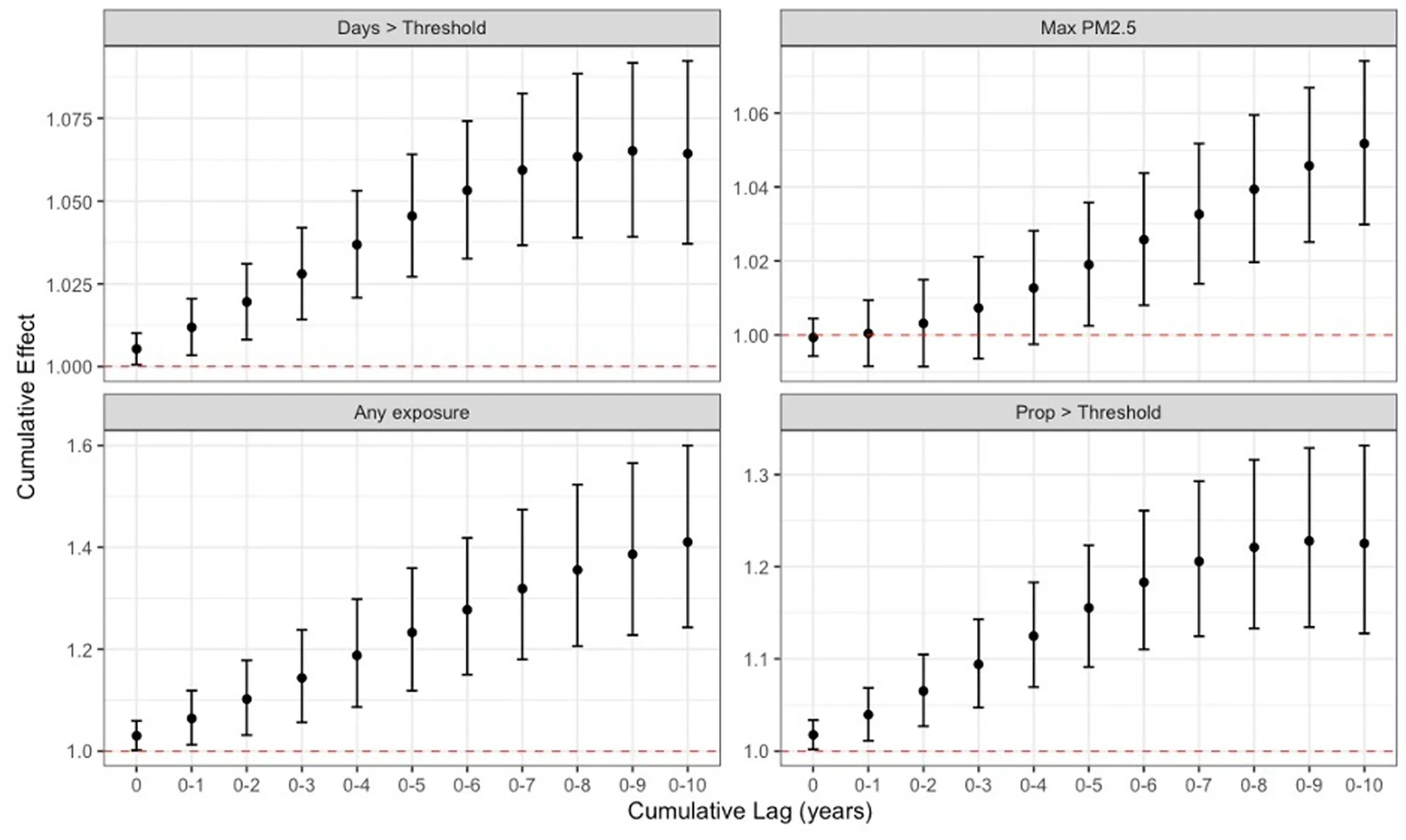
OBJECTIVES: To determine the association between wildfire-specific particulate matter 2.5 (wPM2.5) exposure and the overall and site-specific incidences of head and neck and aerodigestive cancer (HNC). STUDY DESIGN: Epidemiological retrospective cohort analysis. METHODS: HNC incidence data were derived from the Surveillance, Epidemiology, and End Results Program (2016-2022). The relationship between county-level wPM2.5 exposure metrics and HNC incidence rates were examined using a distributed lag non-linear model, adjusting for health behaviors (tobacco/alcohol use, diet, exercise, and sexual activity), demographics (age, sex, race/ethnicity), population size, and year, with county as a random effect. Lag effects were analyzed over 10 years. HNC subsites included nasal/sinus/ear, nasopharynx, oral cavity, oropharynx (stratified by p16 status), hypopharynx, and larynx. RESULTS: Higher wildfire-specific PM2.5 exposure was associated with increased cumulative HNC incidence over 0-10-year lags, with a cumulative relative risk (cRR) of 1.06 (95% CI: 1.04-1.09) per additional smoke exceedance day, 1.41 (1.24-1.60) for any annual exposure, and 1.23 (1.13-1.33) per percentage-point increase in days above 5 μg/m³. Among subsites, oral cavity cancer showed consistent increases (cRR 1.03, 95% CI: 1.00-1.06), oropharyngeal cancer risk increased to 1.09 (1.06-1.13), and laryngeal cancer exhibited the largest effect, with a cRR of 1.13 (1.07-1.19) per additional exceedance day over a 10-year lag period. When stratified by p16 status, significant associations were noted for p16-positive, p16-negative, and p16-unknown tumors. CONCLUSIONS: Higher frequency, intensity, or persistence of wildfire-smoke exposure is associated with increased HNC risk, with the strongest associations driven by long-term exposures.
- Wildfire-specific particulate matter 2.5
- Head and neck cancer
- Aerodigestive cancer
- Hypopharyngeal cancer
- Laryngeal cancer
- Humans
The paper
Harvard University; Brigham and Women's Hospital
The Laryngoscope, 13 Oct 2026