Intake of ultra-processed foods in Sweden and its association with diet quality and weight status: cross-sectional analyses from three national dietary surveys
Abstract
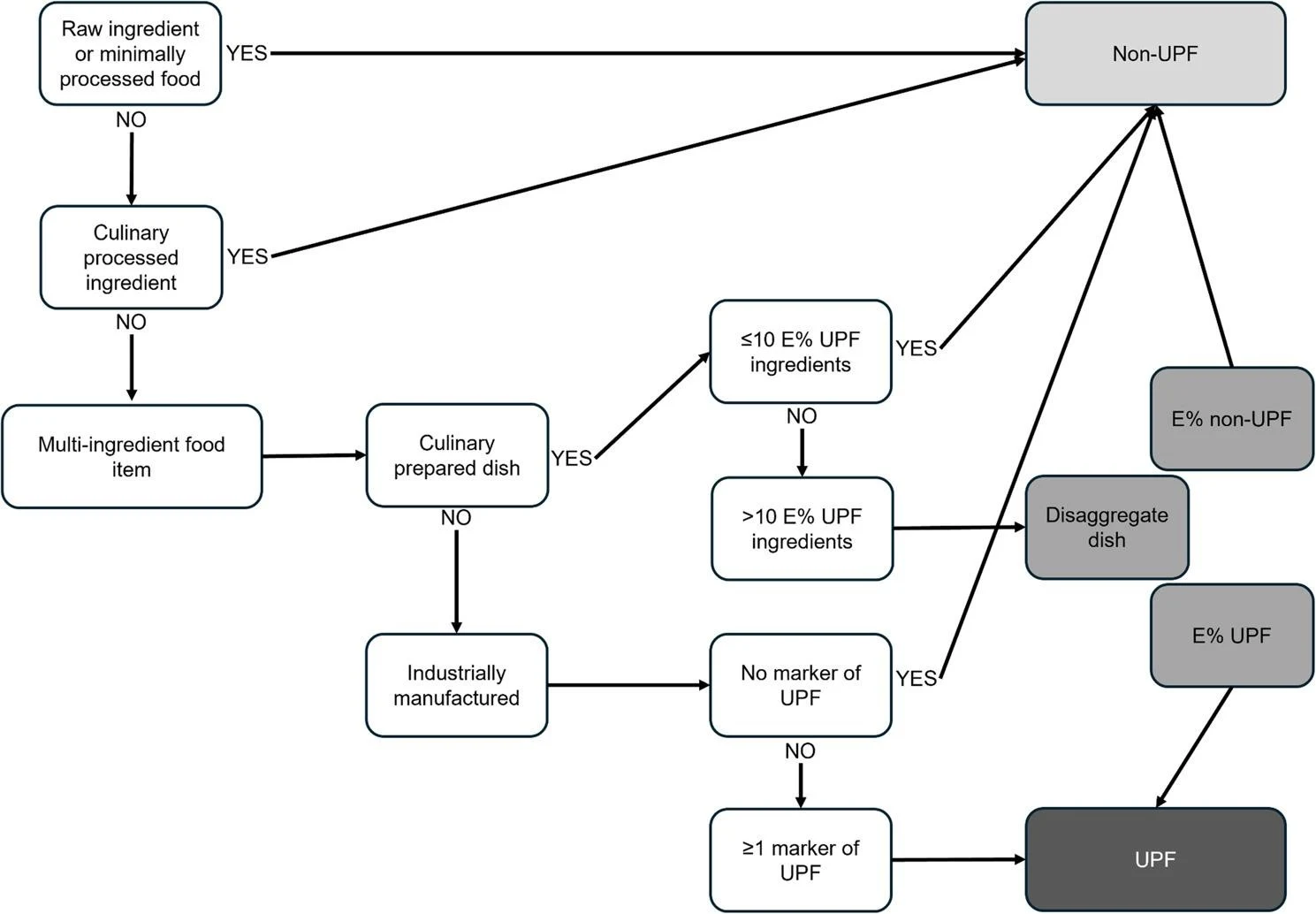
BACKGROUND: Ultra-processed foods (UPF) contribute substantially to energy intake in many countries and have been linked to poorer nutrient profiles and increased risk for excess body weight. Swedish data on UPF intake and its relation to diet quality and weight status are lacking. METHODS: Data were derived from the three most recent Swedish national dietary surveys: Riksmaten (RM)-Adults (2010-2011; n = 1797), RM-Adolescents (2016-2017; n = 3099), and RM-Young Children (2021-2024; n = 1820). Classification of UPFs was based on the Nova system using a transparent protocol incorporating recipe disaggregation, independent classification, and alternative classification scenarios to address uncertainty. Associations between energy percent (E%) from UPF and diet quality indicators and micronutrient intakes were examined using quantile regression. Associations between E% UPF and body mass index (BMI or BMI z-score) were assessed using linear regression, and prevalence ratios (PR) of overweight or obesity were estimated using Poisson regression with robust variance. Models were adjusted for sociodemographic factors, with additional adjustment for total energy intake and diet quality. RESULTS: According to the primary classification scenario, the mean dietary share of UPF was 45 E% among adults, 52 E% among adolescents, and 46 E% among young children. With stricter classification of ambiguous food items, estimates ranged between 23 and 29 E%. A higher dietary share of UPF was associated with less favourable diet quality across most indicators, except for salt and saturated fat in all age groups and iron and vitamin E in young children. Among adults, each 10 E% increment in UPF corresponded to 0.61% higher BMI (95% CI: 0.04-1.18; p = 0.036). The prevalence of overweight or obesity was higher in the top versus bottom tertiles of UPF intake after energy adjustment (PR = 1.16; 95% CI: 1.03-1.30; p = 0.018). No associations were observed among adolescents or young children. CONCLUSIONS: UPF contributed substantially to energy intake in all age groups, though estimates differed markedly depending on the classification scenario. UPF intake was inversely associated with diet quality across most, but not all, indicators. No robust relationships with BMI were observed. CLINICAL TRIAL NUMBER: Not applicable.
From the paper
- Participants
Among 18 months old children, Children’s cereal products were the main source of energy from UPF (10.5 E%).
- Result
The prevalence of overweight or obesity was higher in the top versus bottom tertiles of UPF intake after energy adjustment (PR = 1.16; 95% CI: 1.03–1.30; p = 0.018).
- Limitation
Misclassification of UPF cannot be ruled out, as brand-level information and preparation details were incomplete.
Quoted word for word from the full text on link.springer.com.
The paper
University of Gothenburg
Nutrition Journal, 13 Oct 2026