Association of alkaline phosphatase and segmented neutrophils count with low appendicular lean mass in middle-aged women: Evidence from an American cross-sectional survey
Dose-response
Abstract
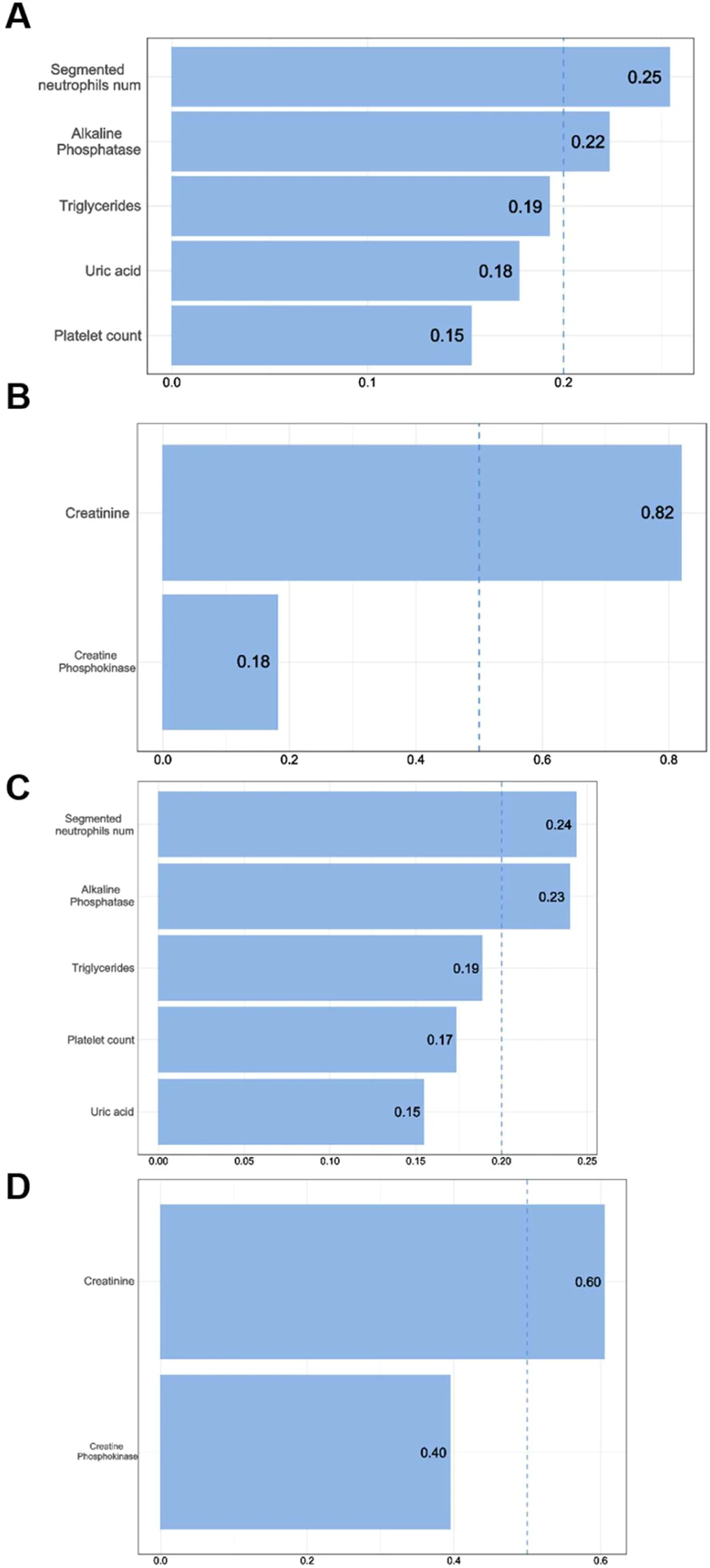
OBJECTIVES: Sarcopenia is associated with an increased risk of frailty, falls, and mortality. Women exhibit distinct characteristics in appendicular lean mass and metabolism compared with men, and hormonal changes may further accelerate appendicular lean mass. This study aimed to identify key blood biomarkers associated with appendicular lean muscle mass index adjusted by body mass index (ALMBMI) in women and to explore their potential relationship with chronic inflammation. METHODS: Based on NHANES 2015-2018 data from middle-aged women, the ALMBMI was calculated. A multimodal machine learning framework was constructed using elastic net logistic regression and generalized linear models (GLMs) to screen core variables affecting ALMBMI. Weighted quantile sum (WQS) regression and Bayesian kernel machine regression (BKMR) jointly determined variable weights and effect directions, and restricted cubic spline (RCS) models characterized dose-response curves to identify key blood indicators and their magnitudes of change associated with low appendicular lean mass risk. RESULTS: A total of 1,082 participants were included in this study. Following variable screening, 12 variables were identified as significantly associated with ALMBMI. WQS regression indicated that segmented neutrophil count (weight: 0.25) and alkaline phosphatase (ALP) (weight: 0.22) were the predominant factors associated with low ALMBMI. BKMR analysis, which assesses all variables jointly, identified segmented neutrophil count (36.0%), and ALP (27.6%) as the core variables. RCS analysis revealed that segmented neutrophil count and alkaline phosphatase showed an L-shaped trend with ALMBMI, with inflection points at 4.00 (1000 cells/μL) and 76.00 IU/L, respectively. In each case, the curves plateaued to the right of the inflection point. Relative to participants classified as having low ALMBMI according to FNIH criteria, those with normal ALMBMI exhibited reductions of 16.01% in ALP and 11.17% in segmented neutrophil count, respectively. CONCLUSION: Among middle-aged women, higher segmented neutrophil count and ALP levels were identified as positive correlates of low ALMBMI, with both biomarkers demonstrating threshold phenomena. Such hematological alterations are consistent with chronic low-grade inflammation, underscoring their potential utility in early sarcopenia screening and prevention.
- Machine learning
- Inflammation
- Alkaline phosphatase
- Sarcopenia
- Appendicular lean muscle mass index adjusted by body mass index
- Humans
The paper
Huadong Hospital
The Journal of Frailty & Aging, 13 Oct 2026