Life history evolution and uninvadable mortality schedules with and without intergenerational energy transfers
Abstract
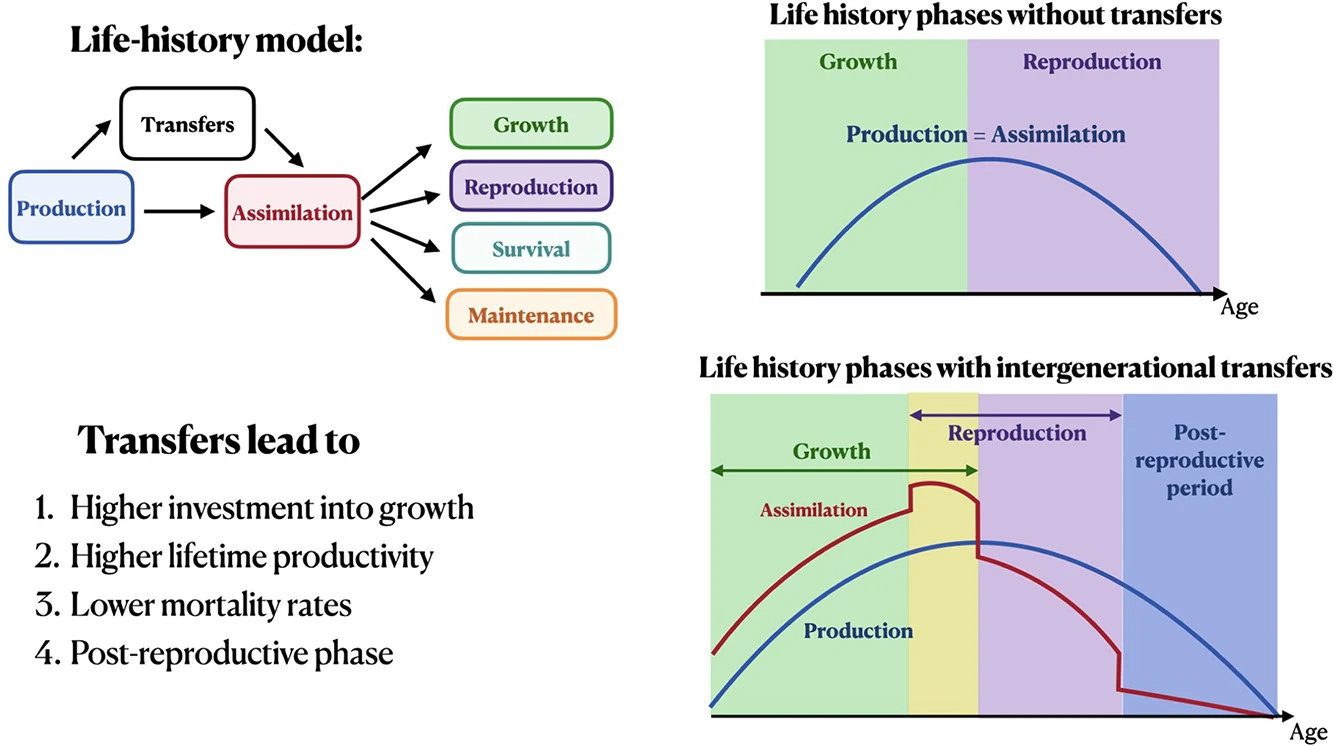
Intergenerational energy transfers are widespread in nature, yet most life history theory assumes that organisms balance energy production and consumption at each age, leaving the evolutionary consequences of transfers underexplored. We develop a life history evolution model under two energy budget constraints: (i) no transfers, where production equals consumption at each age, and (ii) transfers, where energy is balanced over the lifetime. Using optimal control theory, we derive the necessary conditions for uninvadable life histories in age-structured populations, yielding several general results. In particular, at any age in the uninvadable life history, the current fitness gains (from current reproduction, somatic investments, and transfers) are exactly offset by mortality, weighted by the value of life (marginal contribution of future reproduction and energy transfers to fitness). This implies that the uninvadable mortality schedule is not necessarily senescent and that transfers lead to longer lifespans and a post-reproductive phase, consistent with previous work. We apply our results to human life history evolution by extending the model of Kaplan and Robson (2009) to compare scenarios with and without transfers. The comparison makes explicit that the shift to transfers extends the juvenile growth phase, characterised by substantial early-life energy deficits, which are compensated by enhanced lifetime productivity through somatic capital accumulation and longer lifespans. These results are shown to be robust to imposing metabolic capacity constraints based on Kleiber's law, confirming that simultaneous extensions in juvenile growth phase, somatic capital, lifespan, and post-reproductive survival can all emerge as a response to kin-based intergenerational resource sharing.
The paper
University of Helsinki; University of Lausanne
Theoretical Population Biology, 12 Oct 2026