The role of immune aging in rheumatoid arthritis and its clinical and therapeutic significance
Abstract
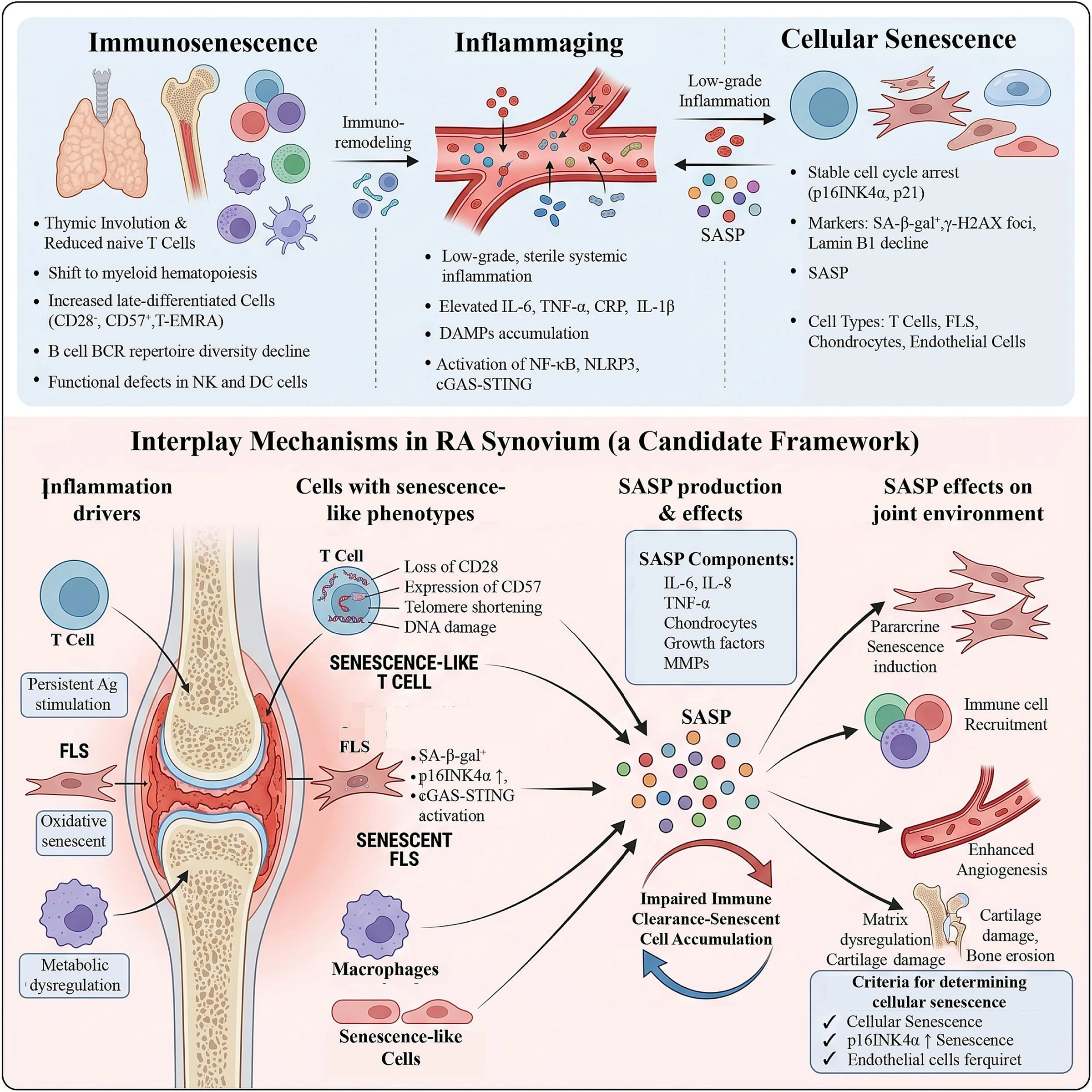
Rheumatoid arthritis (RA) is a chronic autoimmune disease, and its onset and progression are closely related to age-related remodeling of the immune system. Immunosenescence refers to age-related changes in the overall structure and function of the immune system; inflammaging is a persistent, low-grade, systemic inflammatory state; cellular senescence refers to a relatively stable cell cycle arrest and functional remodeling of cells under continuous stress. These three are interrelated but correspond to the immune system, systemic inflammatory environment, and cellular state, respectively; therefore, they should not be used interchangeably. In RA, especially elderly-onset RA (EORA), immune age-related changes may occur earlier or be more severe. Human studies on RA mainly support that immune cell lineage remodeling, senescence-associated cell phenotypes, and changes in inflammatory mediators are associated with disease activity, structural damage, and some extra-articular comorbidities. Immunosenescence may compromise T-cell, B-cell, and innate immune functions; concurrently, local cellular senescence and the senescence-associated secretory phenotype (SASP) may drive synovial and bone marrow microenvironment remodeling, while inflammaging may further amplify systemic inflammation. Impaired immune clearance, accumulation of senescent cells, and SASP release may establish a self-perpetuating cycle and are associated with autoantibody production, bone loss, cartilage damage, and cardiovascular and neuropsychiatric comorbidities. However, causal evidence for SASP-driven RA synovitis and the efficacy of senolytic interventions is still primarily derived from experimental arthritis, osteoarthritis, and other non-RA disease models. This article clarifies the definitions and delineates the applicable boundaries of these three terms, reviews their systemic phenotypes, cell lineage characteristics, and molecular basis in RA, especially EORA, analyzes the links between immune age and disease activity, autoantibodies, synovial microenvironment, bone and cartilage damage, and extra-articular manifestations, and evaluates the potential benefits, risks, and evidence limitations of traditional disease-modifying antirheumatic drugs (DMARDs), biologic agents, and emerging senescence-targeting strategies. By constructing an integrated framework covering immune system remodeling, local cellular senescence, inflammatory amplification, and clinical outcomes, this article aims to provide a theoretical basis for further research on EORA risk stratification and immunosenescence-related interventions, rather than directly translating unverified mechanisms into clinical conclusions.
The paper
College of Integrated Traditional Chinese and Western Medicine; the Affiliated Hospital of Gansu University of Tranditional Chinese Medicine
International Immunopharmacology, 12 Oct 2026