Association between overall dietary antioxidant capacity and lung cancer risk: findings from two observational studies
Independent replication
Abstract
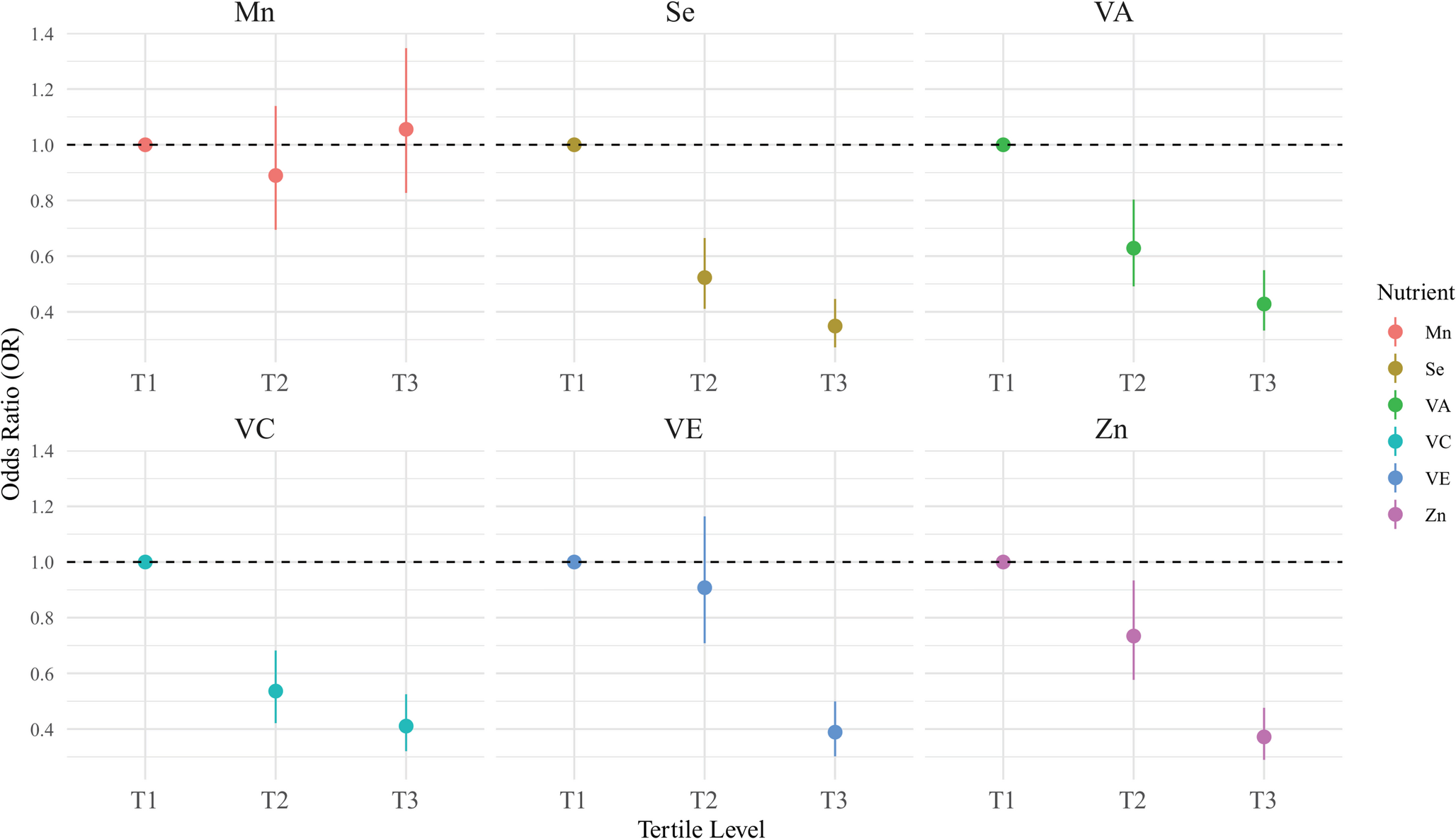
While individual antioxidants such vitamins A, C, and E have shown potential advantages in cancer prevention, the comprehensive impact of combined dietary antioxidant consumption on the development and progression of lung cancer requires additional clarification. In this research, we looked at the relationship between the risk of lung cancer in independent populations and the use of composite antioxidants. A case-control study including lung cancer patients and control participants from the Healthy Zhejiang One Million People (HOPE) study (enrolled between 2022 and 2024), as well as a prospective cohort study involving participants from the UK Biobank, were conducted. From the UK Biobank, baseline data was gathered between 2009 and 2010, and follow-up was prolonged until December 19, 2022. Intakes of six minerals and vitamins assessed using a food frequency questionnaire were used to develop a composite dietary antioxidant index (CDAI) and a dietary antioxidant quality score (DAQS). The relationships were quantified using Logistic regression for the case-control study and Cox proportional hazards models for the cohort study. Additional sensitivity and subgroup analysis were conducted. After multivariable adjustment, high dietary antioxidant intake (highest vs. lowest tertile) was consistently associated with a marked reduction in lung cancer risk across both the HOPE study (CDAI: OR = 0.43, 95% CI: 0.28-0.65, p < 0.001; DAQS: OR = 0.54, 95% CI: 0.36-0.82, p = 0.003) and the UK Biobank (CDAI: HR = 0.59, 95% CI: 0.41-0.84, p = 0.004; DAQS: HR = 0.56, 95% CI: 0.39-0.82, p = 0.003). These associations were consistent across all subgroup and sensitivity analyses. These findings reinforce the role of elevated dietary antioxidant consumption as a protective factor against lung cancer, offering valuable insights for dietary prevention strategies in at-risk individuals.
- Dietary antioxidant intake
- Lung cancer
- Composite dietary antioxidant index
- Dietary antioxidant quality score
- Humans
The paper
Center of Clinical Big Data and Analytics of the Second Affiliated Hospital
European Journal of Epidemiology, 12 Oct 2026