The polycentric aging framework: epigenetic regulation as a dominant lifespan-limiting center in human aging
Abstract
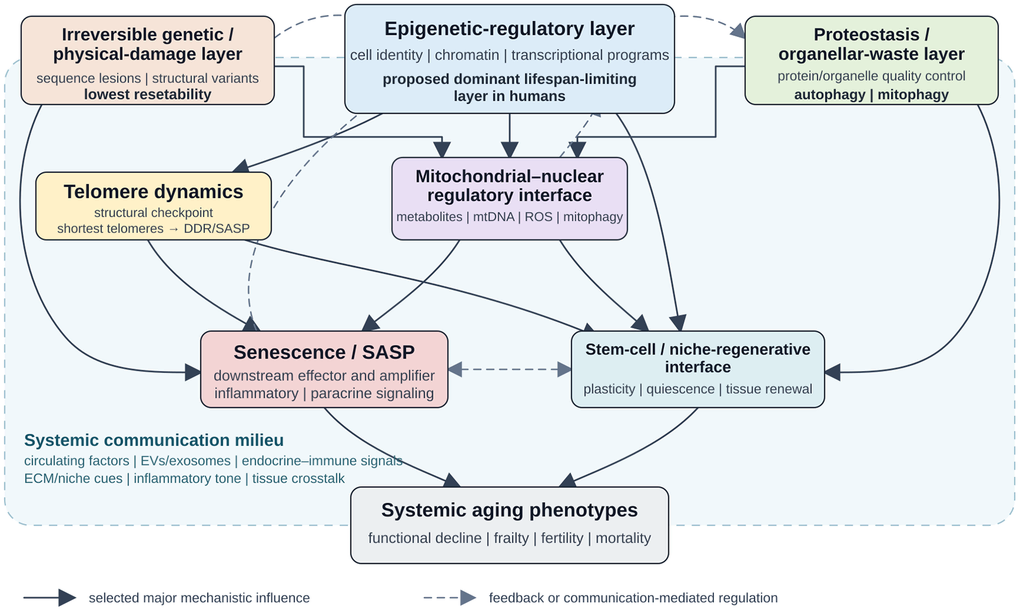
Age-related dysfunction is unlikely to arise from a single universal mechanism. This review develops the Polycentric Aging Framework (PAF) by integrating evidence from somatic cell nuclear transfer (SCNT), DNA methylation (DNAm) clocks, nutrient-sensing pathways, cellular senescence, systemic signaling, and human intervention studies. PAF organizes aging into partially independent, interacting centers that differ in timing, causal status, resettability, reversibility, systemic influence, regenerative impact, interventional accessibility, and lifespan-limiting potential. SCNT is interpreted not as rejuvenation of an existing organism but as a reset-hierarchy model: selected epigenetic and developmental states can be extensively reconfigured; telomere dynamics, mitochondrial state, proteostasis, stem-cell/niche capacity, and senescence/SASP phenotypes show context-dependent reset, redevelopment, or recurrence; and nuclear DNA sequence and structural damage remain least resettable. In humans, PAF proposes epigenetic regulation as a dominant, but not exclusive, lifespan-limiting center because it coordinates cell identity, developmental-program persistence, nutrient sensing, inflammatory and endocrine signaling, repair, and tissue regeneration. DNAm clocks are useful but incomplete biomarkers and may conflate pathological or causal Type 1 changes with adaptive or compensatory Type 2 responses. Clock shifts should therefore be interpreted against tissue-specific function, healthspan, morbidity, and mortality rather than as stand-alone evidence of rejuvenation. PAF predicts that intervention efficacy will depend on whether the targeted center is functionally limiting for a given tissue, disease context, and life stage, and whether another center subsequently becomes limiting. This provides a testable basis for center-specific geroprotective interventions combining controlled epigenetic reprogramming, metabolic modulation, senescence/SASP targeting, and systemic signaling modulation, with rigorous safety monitoring and tissue-context stratification.
From the paper
- Participants
It involved 120 participants with abdominal obesity (110 male, avg. age 48.3 years; 10 female, avg. age 51.5 years), meeting waist circumference criteria (>102 cm for males, >88 cm for females).
Methods, Clinical, pharmacological, and lifestyle interventions
Quoted word for word from the full text on aging-us.com.
- Somatic cell nuclear transfer
- Modelling and theory
- Epigenetic regulation of gene expression
- DNA methylation clock
- Humans
The paper
Independent Researcher; Medical University of Warsaw
Aging, 9 Oct 2026