The association between albuminuria and coronary atherosclerotic burden in the general population
Abstract
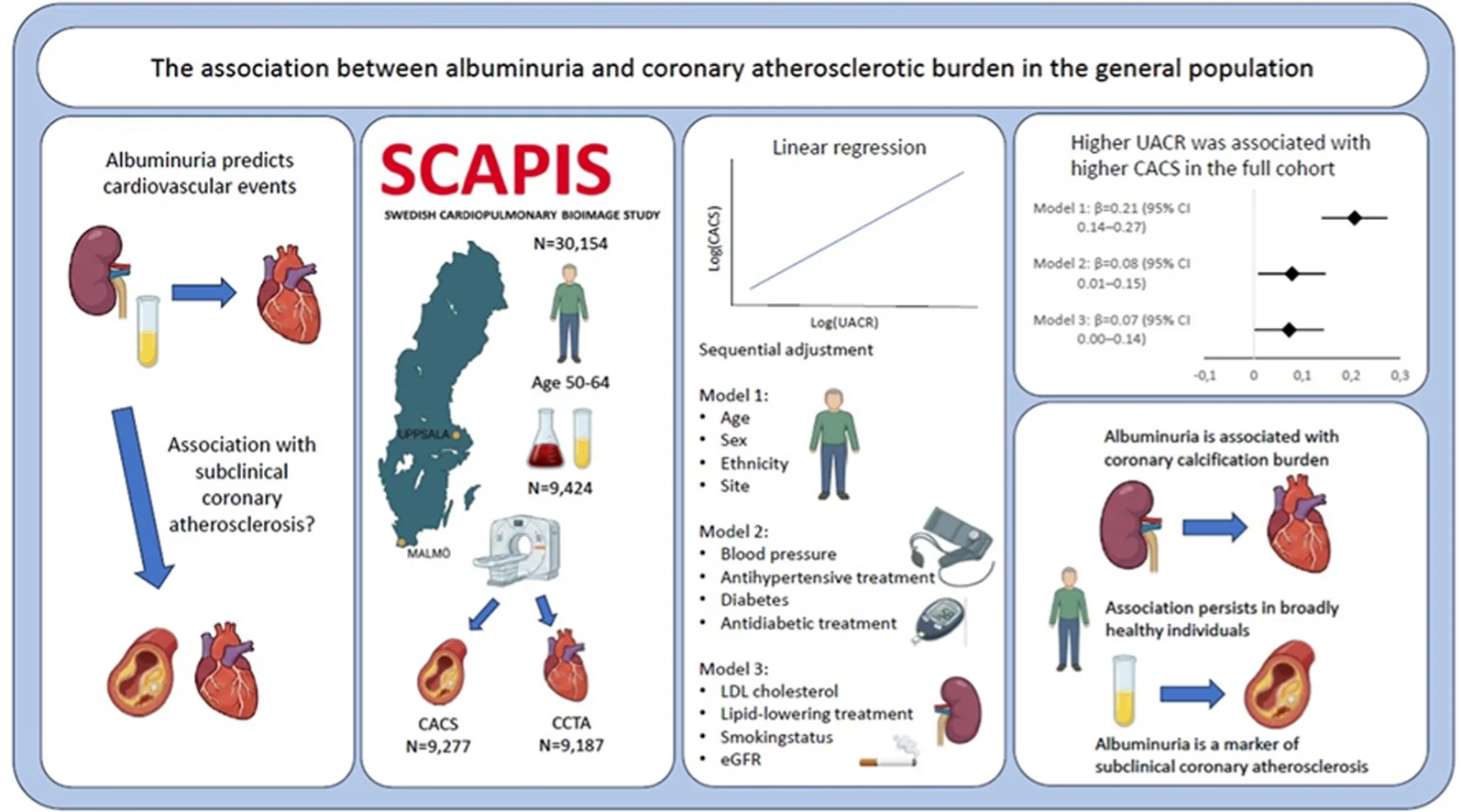
BACKGROUND: Albuminuria predicts cardiovascular events, but its association with prevalent subclinical coronary atherosclerosis is less well defined. We examined the cross-sectional relationship between urinary albumin-creatinine ratio (UACR) and coronary atherosclerotic burden in middle-aged adults from Sweden nationwide. METHODS: UACR was measured in fasting spot urine in 9424 SCAPIS participants from Uppsala and Malmö. Coronary atherosclerosis was quantified by coronary artery calcium score (CACS; n = 9277) and coronary computed tomography angiography (CCTA; n = 9187) for stenosis. Linear regression related log(UACR) to log(CACS) with sequential adjustment: Model 1 (age, sex, ethnicity, site), Model 2 (+blood pressure, antihypertensive treatment, diabetes and antidiabetic treatment), and Model 3 (+LDL cholesterol, lipid-lowering treatment, smoking status, and eGFR). Logistic regression examined prevalent calcification (CACS>0) and stenosis; subgroup analyses excluded CKD, cardiovascular disease, hypertension, and diabetes stepwise. RESULTS: Higher UACR was associated with higher CACS in the full cohort: β = 0.21 (95% CI 0.14-0.27), 0.08 (0.01-0.15), and 0.07 (0.00-0.14) in Models 1-3, respectively. Associations persisted after excluding CKD and cardiovascular disease (n = 8448): β = 0.20 (0.13-0.27), 0.19 (0.12-0.26), and 0.07 (0.00-0.15). With further exclusions, Model 3 estimates attenuated and were non-significant (no CKD/cardiovascular disease/hypertension: β = 0.06 [-0.02 to 0.14]; additionally no diabetes: β = 0.05 [-0.03 to 0.14]). In Model 1, each log-increase in UACR was associated with higher odds of CACS>0 (OR 1.08, 95% CI 1.05-1.12) and stenosis (OR 1.04, 95% CI 1.01-1.08), but associations attenuated and were non-significant in Models 2-3. CONCLUSIONS: Albuminuria is associated with greater coronary calcification burden, including in broadly healthy individuals, supporting the concept that albuminuria may reflect vascular disease early in the cardiovascular disease continuum.
- Albuminuria
- Coronary atherosclerosis
- Coronary stenosis
- Coronary artery calcium score
- Coronary computed tomography angiography
- Humans
The paper
Center for Clinical Research Dalarna; Dalarna University
Atherosclerosis Plus, 21 Sep 2026