Blood lead exposure, renal hyperfiltration, and accelerated kidney function decline among people living with HIV in northern Tanzania: A longitudinal cohort study
Abstract
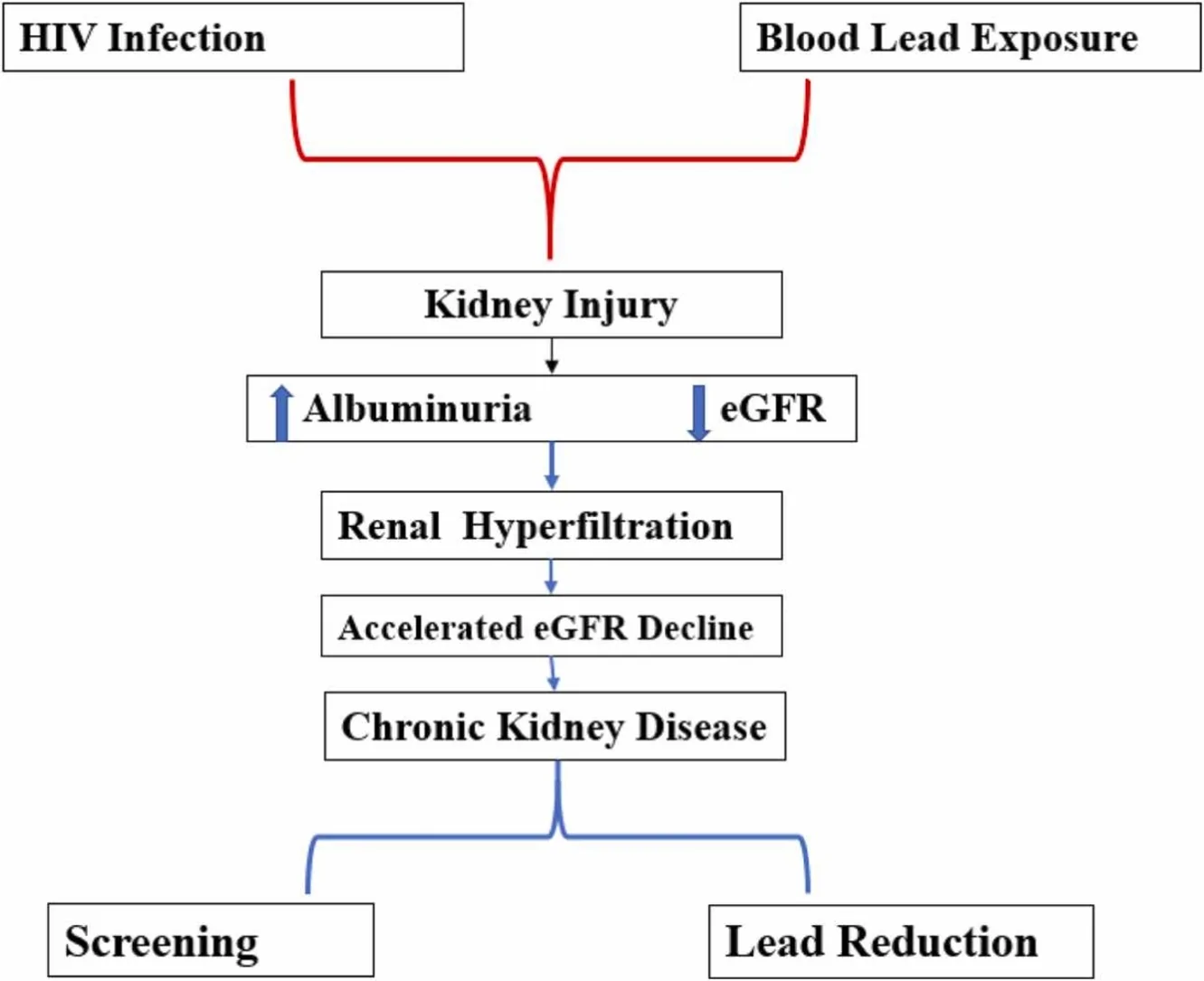
INTRODUCTION: People living with HIV (PLWH) face a high burden of kidney disease from HIV-related injury, antiretroviral toxicity, and environmental lead exposure. Renal hyperfiltration, an early compensatory state, may precede accelerated kidney function decline, yet its relationship with lead exposure remains understudied in sub-Saharan Africa. METHODS: We analyzed prospective longitudinal data from the Mwanza HIV and Cardiovascular Disease cohort in northern Tanzania (baseline analytic sample N = 943; 467 PLWH and 476 HIV-uninfected partners). Linear mixed-effects models used all available repeated eGFR measurements over four years; parent-cohort retention was 93.9% at 36 months. Blood lead levels were measured from dried blood spots using ICP-MS. eGFR was calculated using the CKD-EPI 2021 equation at baseline and over four years. Hyperfiltration was defined using sex-specific thresholds (>130 mL/min/1.73 m² for males, >125 mL/min/1.73 m² for females). Associations were evaluated using multivariable linear regression and linear mixed-effects models, adjusting for age, sex, BMI, hypertension, smoking, and HIV status. RESULTS: Baseline eGFR: Higher log₁₀ blood lead levels were independently associated with lower baseline eGFR (fully adjusted β = -1.3; 95% CI: -2.5 to -0.17; p = 0.025), indicating an inverse cross-sectional association between lead exposure and kidney function at baseline. Longitudinal eGFR decline: Baseline hyperfiltration was strongly associated with subsequent eGFR decline over the four-year follow-up. Compared with participants with normal baseline filtration, those with hyperfiltration experienced an additional annual reduction of -9.5 to -9.9 mL/min/1.73 m² compared with normal filtration (p < 0.001) over four years follow-up. Consequently, participants with baseline hyperfiltration experienced the steepest declines over four years (approximately -25 to -26 mL/min/1.73 m²). Higher lead exposure was also associated with progressively worsening eGFR trajectories, with the greatest deterioration observed among participants with baseline hyperfiltration. Sensitivity analyses using an age-adjusted hyperfiltration definition and excluding extreme blood-lead values produced results consistent with the primary models. CONCLUSION: Baseline renal hyperfiltration was strongly associated with subsequent kidney decline among people living with HIV, with greater declines observed among those with higher blood lead levels. These findings highlight the potential importance of lead exposure and kidney function monitoring in PLWH, particularly in resource-limited settings, while recognizing that the observed associations do not establish causality.
The paper
Catholic University of Health and Allied Sciences; Mwanza Intervention Trials Unit
Toxicology Reports, 25 Sep 2026