Higher biological age linked to worsening disease stages
Over a median 13.48 years, 2,567 UK Biobank participants progressed from stage 0 or 1 to stage 2 or 3 of the syndrome.
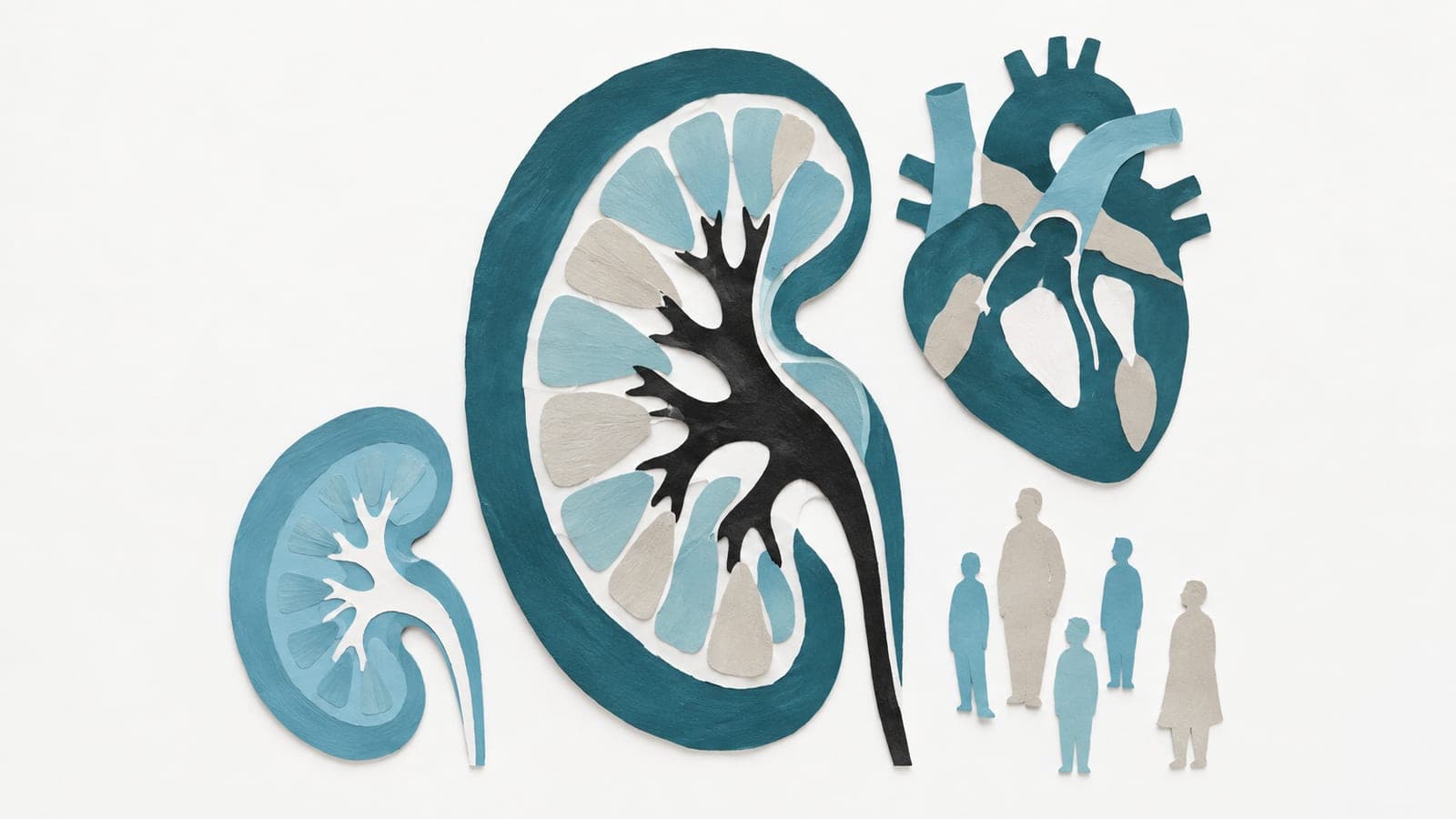
Researchers conducted an observational study of 326,218 UK Biobank participants and a cross-sectional analysis of 5,228 adults in a US health survey. They studied cardiovascular-kidney-metabolic syndrome, which covers heart and kidney disease and problems with how the body uses energy. They assessed two biological age estimates, PhenoAge and KDMAge. Acceleration meant a biological age higher than expected for someone’s age in years.
In UK Biobank, both measures were associated with progression to more advanced stages. For each standard deviation increase, PhenoAge acceleration had a hazard ratio of 1.234 for progression from stage 0 or 1 to stage 2 or 3. A standard deviation describes variation across participants. A hazard ratio compares rates over time. Both measures were also linked to progression to stage 4. In the US snapshot, both were associated with higher stages.
Why it matters
The syndrome encompasses conditions relevant to health in later life. The work bears on whether biological age measures might help assess the course of these linked conditions.
Caveats
These observational analyses could not establish cause and effect. The researchers did not test whether the measures improved prediction or clinical care, and KDMAge’s comparability remained uncertain.
From the paper
- Participants
In NHANES, the multiple-imputation analysis included 6,031 participants, compared with 5,228 in the survey-weighted complete-case analysis.
- Follow-up
In the UK Biobank, the median follow-up time was 13.48 years (IQR, 12.74–14.09).
Results, Biological aging measures and CKM burden or progression
- Result
Per 1-SD increment, PhenoAge acceleration was associated with both transitions [hazard ratios (HRs) 1.234, 95% confidence interval (CI) 1.189–1.281; HR 1.208, 95% CI 1.197–1.218].
- Limitation
Firstly, biological age was measured only at baseline; therefore, temporal changes in biological aging and their relationship with CKM progression could not be assessed.
Quoted word for word from the full text on tandfonline.com.
- Cardiovascular-kidney-metabolic syndrome
- PhenoAge
- KDMAge
- KDMAge acceleration
- Cardiovascular-kidney-metabolic syndrome baseline stage burden
- Humans
The paper
The First Hospital of Shanxi Medical University
Renal Failure, 11 Oct 2026