Compositional associations of 24-hour movement behaviors with metabolic syndrome in Korean older adults: a nationwide cross-sectional study using KNHANES 2022-2024
Abstract
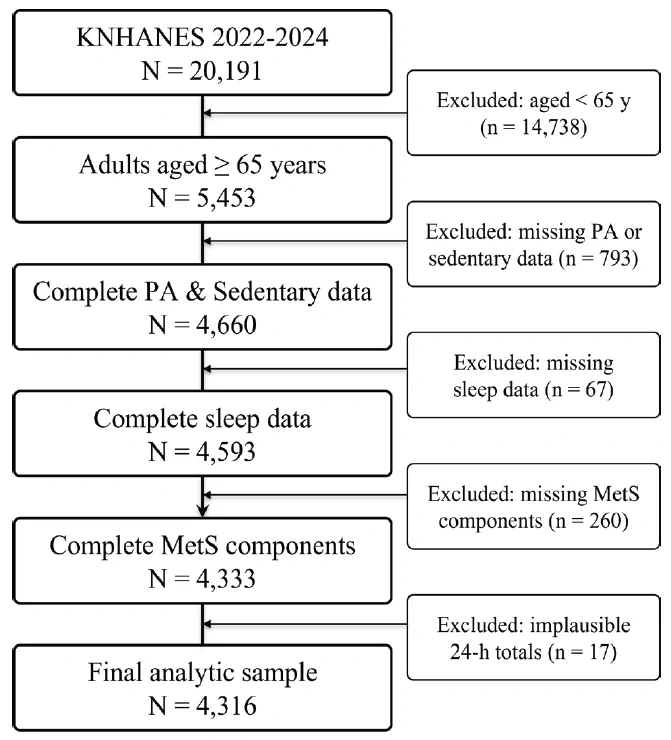
PURPOSE: Movement behaviors over 24 hours-sleep, sedentary time, and physical activity-are temporally interdependent, but most Korean studies in older adults have analyzed them in isolation. We examined how the 24-hour movement composition relates to metabolic syndrome (MetS) in adults aged ≥ 65 years. METHODS: We pooled data from the 9th Korea National Health and Nutrition Examination Survey (KNHANES; 2022-2024) and analyzed 4,316 community-dwelling older adults. Daily time in sleep, sedentary behavior, light physical activity (LIPA), and moderate-to-vigorous physical activity (MVPA) was rescaled to 1,440 min/day. Isometric log-ratio (ilr) coordinates were entered into weighted logistic regression that accounted for the complex survey design, and 30-min isotemporal substitutions were estimated. RESULTS: Weighted MetS prevalence was 40.4%. Greater relative time in MVPA (ilr1) and LIPA (ilr2) was inversely associated with MetS (OR 0.93, 95% CI 0.89-0.96; OR 0.80, 0.70-0.91), whereas a higher sedentary-to-sleep ratio (ilr3) showed a positive association (OR 1.28, 1.02-1.62). Reallocating 30 min from sedentary time to MVPA was associated with about 13% lower predicted odds of MetS (OR 0.87, 0.82-0.93), and even a shift to LIPA showed a small but significant association (OR 0.97, 0.96-0.98). Sex-stratified analyses showed broadly consistent patterns in men and women. CONCLUSION: In Korean older adults, replacing sedentary time with any form of activity-especially MVPA- was associated with lower predicted odds of MetS, supporting a 24-hour movement perspective for metabolic-health promotion.
- Light physical activity
- Moderate-to-vigorous physical activity
- Sedentary behavior
- Sleep
- Metabolic syndrome
- Humans
The paper
Dongseo University
Physical Activity and Nutrition, 30 Sep 2026