Biomarkers and Risk Prediction in Cardiovascular-Kidney-Metabolic Syndrome: A Comprehensive Review
Abstract
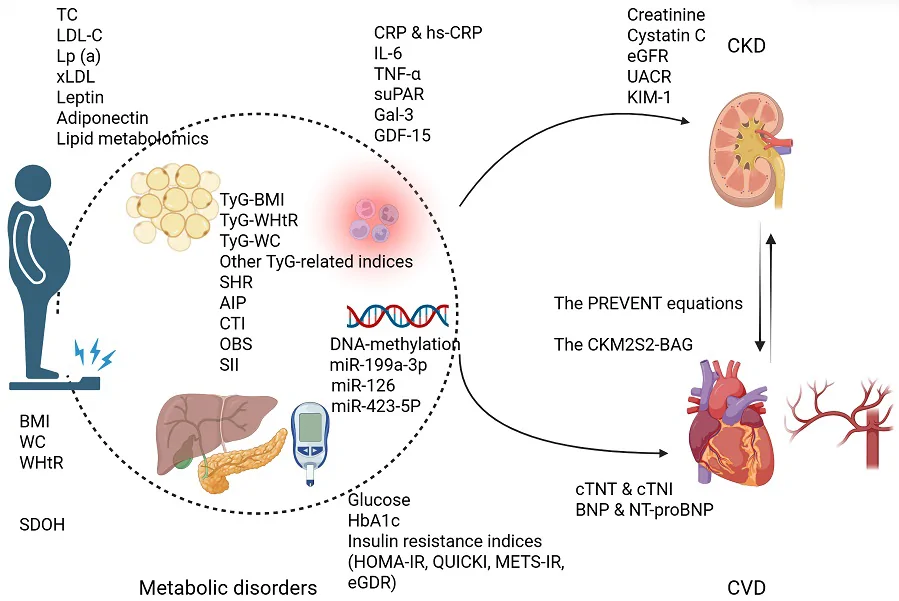
Cardiovascular-kidney-metabolic (CKM) syndrome represents a complex interplay among cardiovascular disease, chronic kidney disease, and metabolic disorders; meanwhile, CKM syndrome affects a significant proportion of adults and increases the risk of heart failure, end-stage renal disease, and premature death. This review examines traditional and emerging biomarkers in CKM syndrome, focusing on the clinical utility and predictive value of these markers for disease progression and outcomes. Traditional markers include cardiovascular, renal, metabolic and inflammatory biomarkers. Meanwhile, emerging biomarkers include novel lipid biomarkers, epigenetic and microRNA markers, and metabolic and inflammatory markers. Composite tools integrating traditional and emerging biomarkers have shown promise for improving risk stratification and clinical decision-making. Moreover, the Predicting Risk of cardiovascular disease (CVD) Events (PREVENT) and Cardiovascular-Kidney-Metabolic 2-Stage 2-Biomarker Assessment Group (CKM₂S₂-BAG) equations have been developed for CKM syndrome risk stratification. Additionally, machine learning approaches are increasingly being applied in CKM syndrome research. Future research priorities include large-scale validation studies, standardization of biomarker measurement and interpretation, and the development of advanced technologies. The integration and validation of reliable biomarkers for CKM syndrome represent a critical step toward improving risk stratification and enabling personalized management strategies.
- Cardiovascular-kidney-metabolic syndrome
- Cardiovascular disease
- Chronic kidney disease
- Metabolic disorders
- End-stage renal disease
- Humans
The paper
Shanghai Medical College of Fudan University
Reviews in Cardiovascular Medicine, 16 Sep 2026