Comparing tobacco use estimates in the U.S. from two large national surveys: the tobacco use supplement to the Current Population Survey and the National Health Interview Survey
Abstract
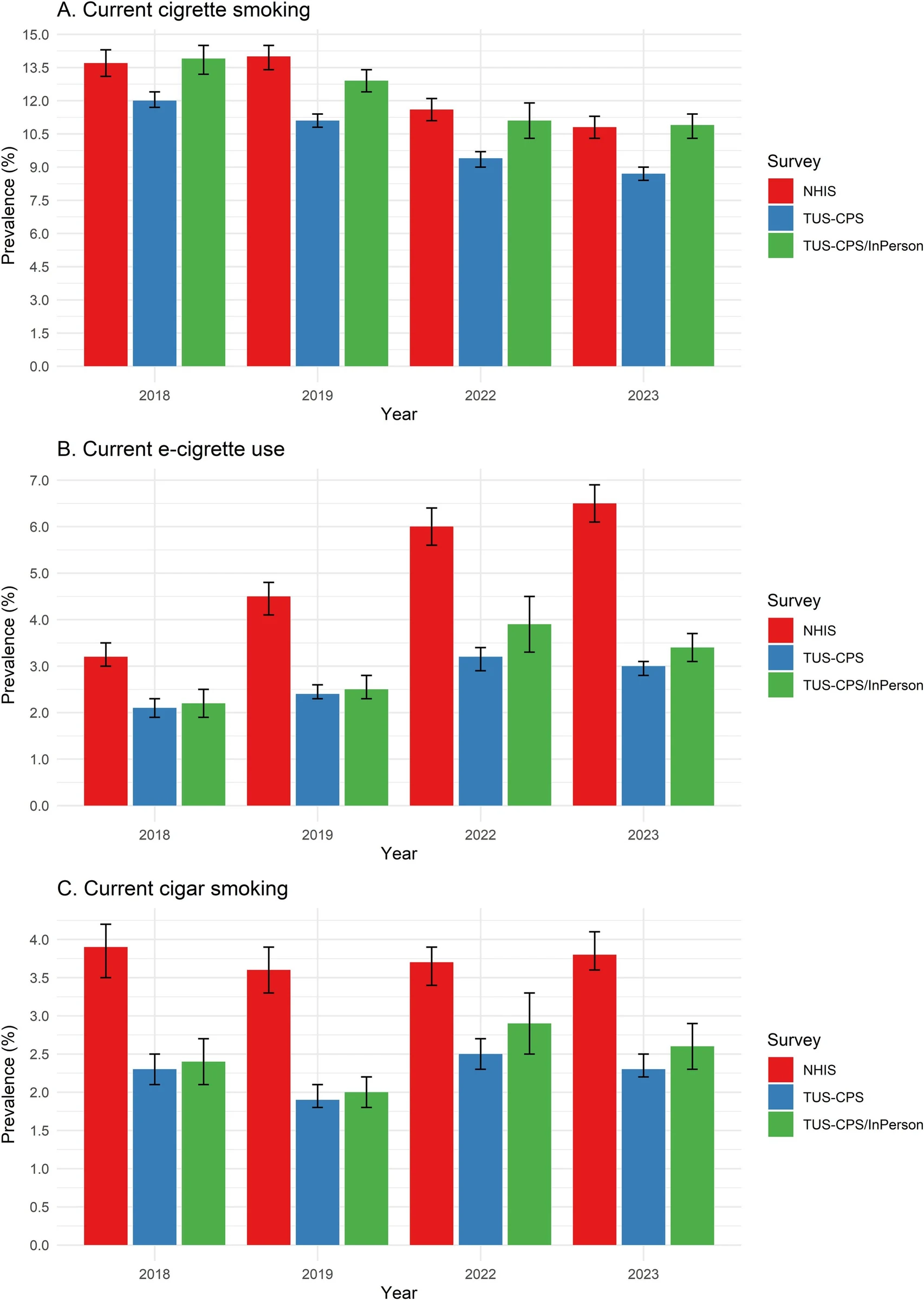
OBJECTIVE: To compare tobacco use estimates in the U.S. from the Tobacco Use Supplement to the Current Population Survey (TUS-CPS) and the National Health Interview Survey (NHIS). METHODS: We analyzed TUS-CPS cycles 2018/2019 and 2022/2023 and corresponding NHIS years. We compared current cigarette, e-cigarette, and cigar use using descriptive and multivariable logistic regression analyses and examined potential explanations for differences, including interview mode. RESULTS: Current cigarette smoking declined from 13.7% to 10.8% in NHIS and from 12.0% to 8.7% in TUS-CPS. Adjusted odds of cigarette smoking in 2023 versus 2018 declined similarly (NHIS OR = 0.76, 95% CI: 0.71,0.82; TUS-CPS OR = 0.69, 95% CI: 0.65,0.72). Restricting TUS-CPS to in-person respondents yielded prevalence similar to NHIS. Larger discrepancies were observed for e-cigarette use (NHIS: 3.2% to 6.5%; TUS-CPS in-person: 2.2% to 3.4%), with adjusted odds increasing more in NHIS (OR = 2.25, 95% CI: 2.01,2.52) than TUS-CPS (OR = 1.46, 95% CI: 1.31,1.63). Differences also remained for cigar use (NHIS average: 3.8%; TUS-CPS in-person average: 2.5%). CONCLUSIONS: The surveys yielded differing prevalence estimates but largely comparable sociodemographic associations. Interview mode may partially explain differences, particularly for cigarette smoking. Understanding methodological differences is important when comparing and selecting data sources.
The paper
National Cancer Institute
Preventive Medicine, 9 Oct 2026