Association between intention to improve lifestyle and habitual exercise: a cross-sectional study of Japanese adults
Declared no competing interests
Abstract
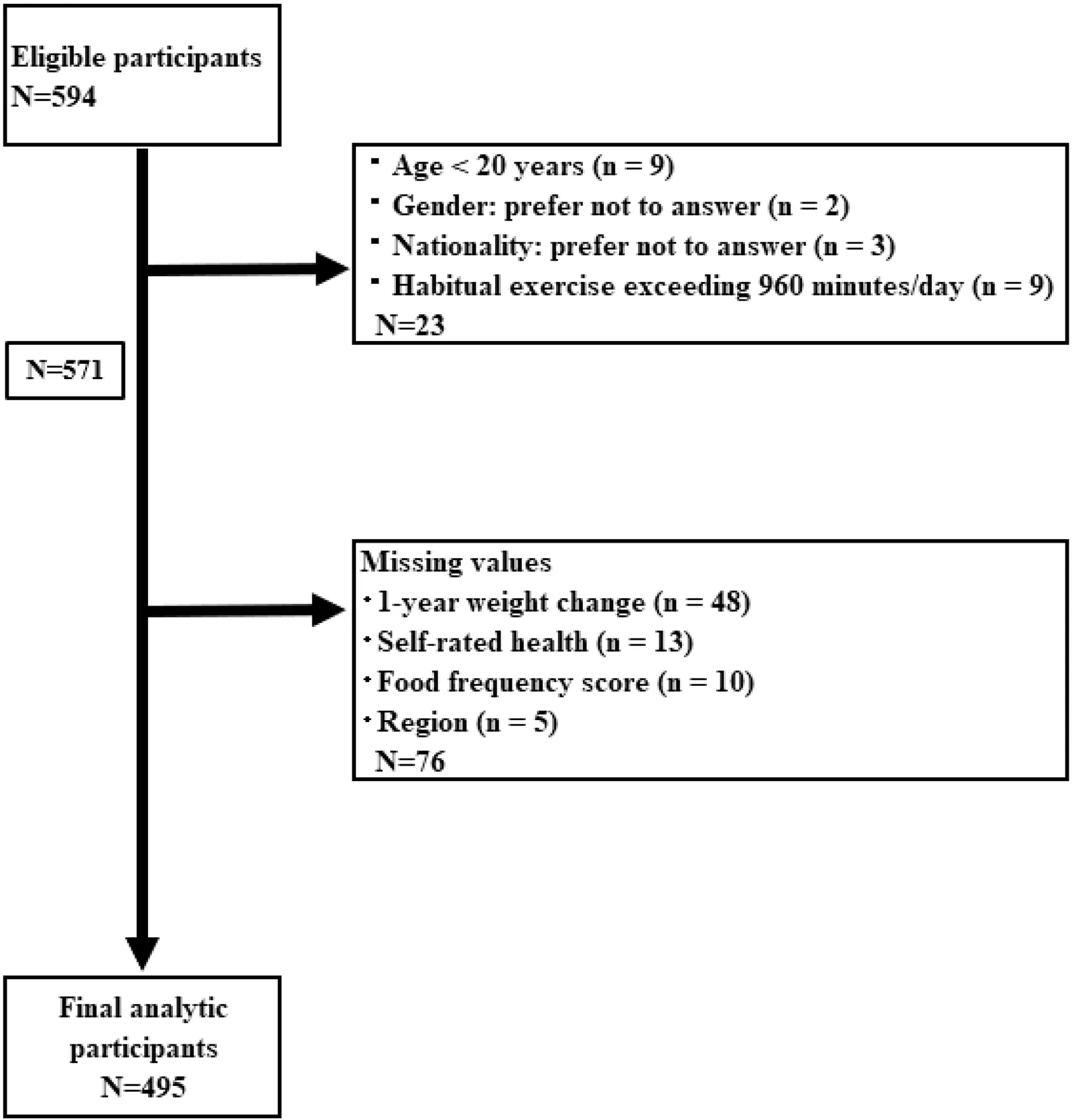
Objective: Preliminary cross-sectional evidence suggests a positive association between the intention to improve lifestyle and habitual exercise. However, whether this association persists in subsequent survey phases remains unclear. This study examined this relationship among community-dwelling adults in Japan, most of whom lived in Kagoshima prefecture. Methods: Data were collected through an online survey conducted between November 30, 2021, and September 5, 2025. The analytical sample comprised 495 Japanese adults (174 men and 321 women) who completed the questionnaire. Participants' intentions to improve lifestyle were defined as those in the preparation, action, or maintenance stages of the Transtheoretical model. Habitual exercise was defined as ≥600 MET-minutes per week, based on the International Physical Activity Questionnaire. Odds ratios (ORs) and 95% confidence intervals (CIs) were estimated using multiple logistic regression. Mediation analysis evaluated the direct and indirect effects of food consumption frequency, with coefficients and 95% CIs reported. Results: The intention to improve lifestyle was significantly associated with habitual exercise (OR=2.49, 95% CI: 1.65-3.75) after adjustment for potential confounders. In the mediation analysis, the pathway not mediated by food frequency showed a coefficient of 1.50 (95% CI: 0.48-2.52). Conclusion: The intention to improve lifestyle is positively associated with habitual exercise. Promoting lifestyle improvement intentions may help develop and maintain regular exercise habits, consistent with the trends observed in our preliminary study.
The paper
Kagoshima University
Journal of Rural Medicine, 1 Oct 2026