Epigenetic memory and allostatic integrity: a theoretical integration of the hierarchical-circular model using a longitudinal methylation signature of dementia
Abstract
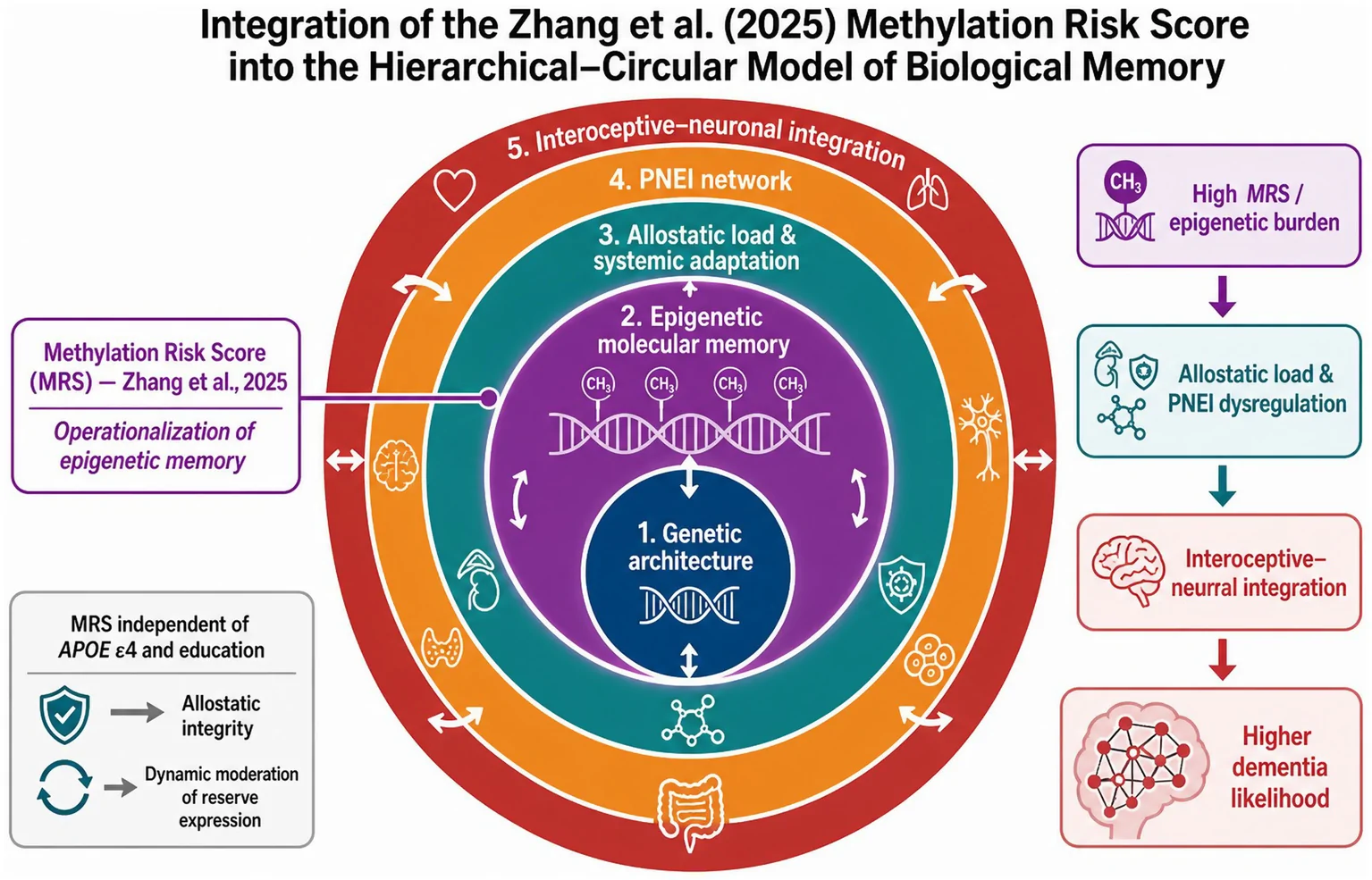
INTRODUCTION: The Hierarchical-Circular Model of Biological Memory (HCM) proposes that dementia results from disrupted circular information flow across five levels: genetic, epigenetic, allostatic, PNEI network, and interoceptive. Allostatic integrity-the adaptive capacity for circular flow-determines whether pathology translates into dementia. OBJECTIVE: To evaluate whether a recently published blood DNA methylation signature for incident dementia is consistent with the predictions of the HCM. METHODS: We systematically mapped Zhang et al.'s findings (44 CpGs, 44 DMRs, pathway enrichments, methylation risk score) to HCM levels and predictions. We interpreted these findings as providing indirect and conceptual support for the model rather than direct empirical validation. RESULTS: The 44 CpGs/DMRs linked to dementia were enriched in immune and metabolic pathways. Their methylation risk score predicted cognitive decline independently of age, sex, APOEε4, education, and MMSE. These findings are consistent with the HCM's Level 2 (epigenetic memory), Levels 3-4 (allostatic load/PNEI), and Predictions 1 (composite biomarkers outperform single) and 4 (allostatic integrity moderates reserve). DISCUSSION: Epigenetic changes precede dementia, supporting Level 2 as an early event. Immune/metabolic pathways link to allostatic load. Independence from APOEε4/education is consistent with allostatic integrity being distinct from genetic risk and reserve. CONCLUSION: Zhang et al.'s study provides large-scale evidence that blood DNA methylation may serve as a peripheral biomarker of lost allostatic integrity, consistent with the HCM and supporting a shift from linear to circular, multilevel frameworks for dementia.
- Modelling and theory
- DNA methylation
- Epigenetic regulation of gene expression
- Immune response
- Dementia
- Blood DNA methylation signature
The paper
Mexican Social Security Institute
Frontiers in Aging Neuroscience, 22 Sep 2026