Wearable movement data links to hundreds of human diseases
In 70,473 adults followed for up to 10 years, 210 wearable activity phenotypes were linked to 406 diseases, with step intensity and circadian rhythm showing prominent ties.
Science Bulletin
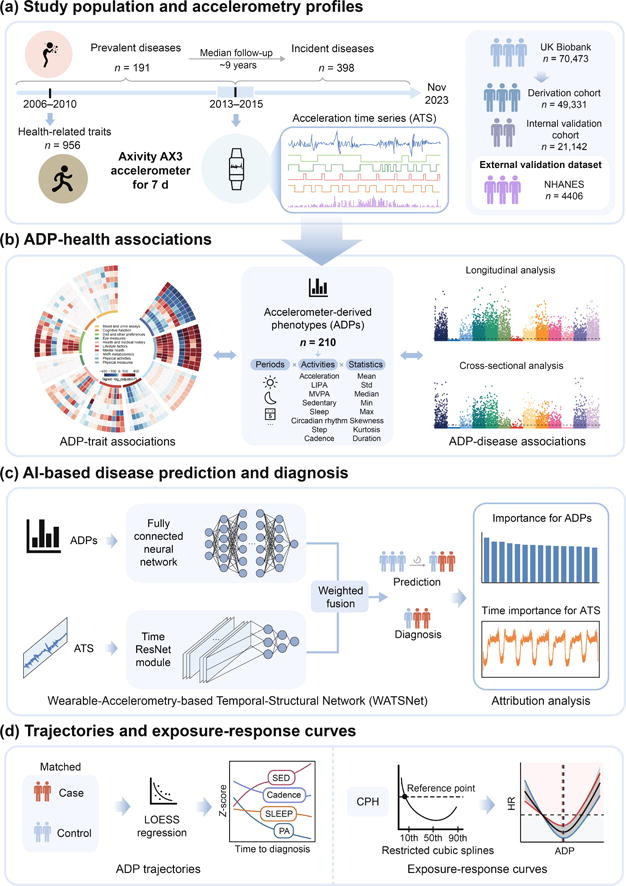
In a cohort of 70,473 human participants followed for up to 10 years, researchers analyzed 11.8 million person-hours of wearable accelerometer data. The team derived 210 digital phenotypes covering physical activity, sedentary behavior, sleep, circadian rhythms, step counts, and step intensity. They identified 8,149 associations between these phenotypes and 406 diseases, along with 36,614 associations across 956 health-related traits. Step intensity and circadian rhythm emerged as the domains most prominently associated with diseases. An artificial intelligence framework trained on the data discriminated 112 incident diseases with an AUC above 0.7, including incident Parkinson's disease (AUC = 0.873) and dementia (AUC = 0.841). Lower disease risks were linked to benchmarks of at least 0.8 hours daily of moderate-to-vigorous physical activity, 10,000 steps daily, and 7.8 hours of daily sleep.
Why it matters
Continuous wearable tracking may offer objective digital markers for age-related neurodegenerative conditions like dementia and Parkinson's disease. These findings also help outline behavioral targets for studies focused on healthspan and physical resilience in aging populations.
Caveats
The findings come from observational data, meaning the reported phenotype-disease links and behavioral benchmarks represent associations rather than causal relationships. Generalizability also remains to be further evaluated beyond the primary cohort and the 4,406-participant external validation set.
The paper
A wearable accelerometry landscape of human health and disease
Show 11 more authors
Yuzhu Li, Yueming Xu, Yilin Chen, Xihan Cui, Zeyu Li, Yanting Wu, Barbara Jacquelyn Sahakian, Wanting He, Jianfeng Feng, Jintai Yu, Jia You,Fudan University · Zhejiang Normal University
Science Bulletin · 22 Sep 2026