Carotid thickness partly mediates cardiovascular health benefits
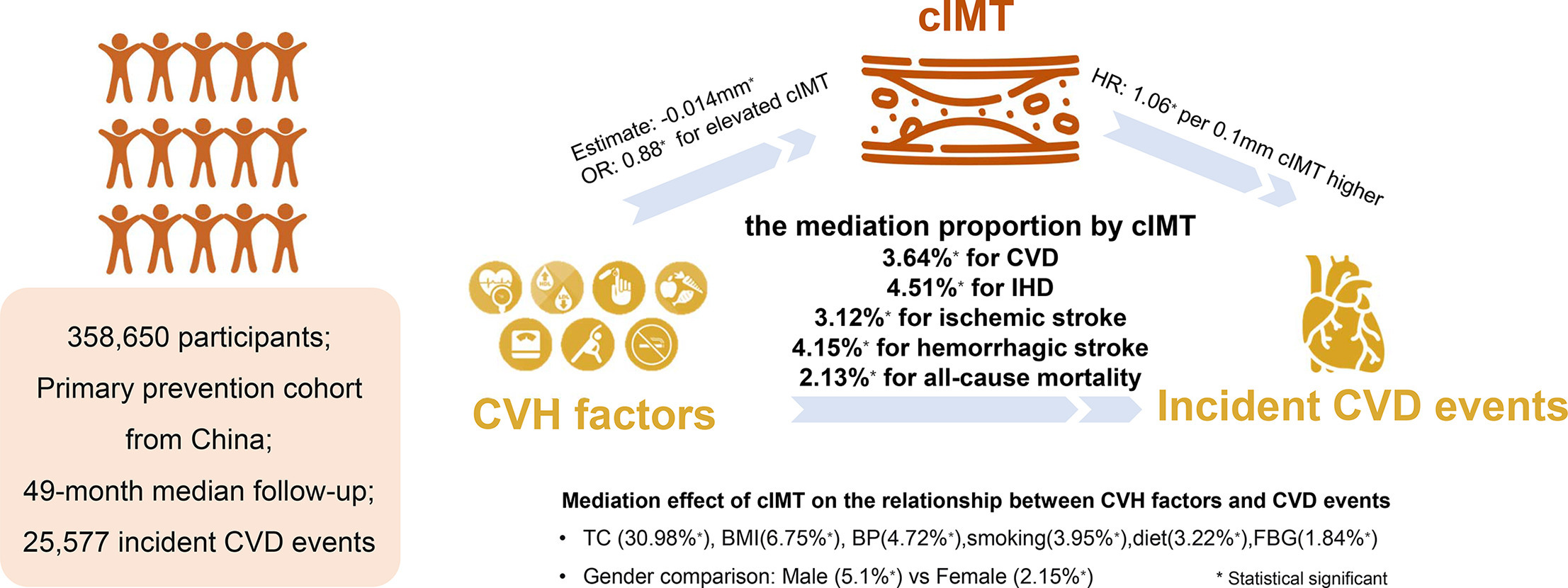
Carotid intima-media thickness mediated 3.64% of the link between cardiovascular health metrics and disease events in 358,650 adults.
American Journal of Preventive Cardiology
A study evaluated 358,650 adults aged 35 to 75 years without baseline cardiovascular disease from a national cohort in China. Researchers tracked cardiovascular health using Life's Simple 7 metrics to evaluate its relationship with carotid intima-media thickness and new-onset cardiovascular events. Participants in the highest quartile of cardiovascular health had a 0.014 mm lower mean-max carotid intima-media thickness and a 12% lower risk of elevated thickness compared to those in the lowest quartile. Each 0.1 mm increase in mean-max thickness was linked to a 6% higher risk of cardiovascular events. Mediation analysis showed that carotid wall thickness accounted for 3.64% of the overall relationship between cardiovascular health and incident disease, with stronger mediation observed in male participants.
Why it matters
Arterial wall thickening reflects structural vascular aging and preclinical damage. Determining how much arterial remodeling mediates disease outcomes helps clarify the structural pathways through which lifestyle and metabolic factors influence cardiovascular aging.
Caveats
The observational design prevents establishing causal relationships. Findings from this Chinese cohort may also not generalize to populations of different ancestral or geographic backgrounds.
The paper
Show 10 more authors
Jiapeng Lu, Yang Yang, Jianlan Cui, Lijuan Song, Wei Xu, Yan Zhang, Wenyan He, Hao Yang, D J Y Sun, Xi Li,Chinese Academy of Medical Sciences & Peking Union Medical College · Peking University
American Journal of Preventive Cardiology · 6 Mar 2026