Bispecific T cell engager eliminates senescent cells in mice and nonhuman primates
Monitored by serum transaminase levels, low doses of the drug alleviated age-related pathologies without causing the hepatotoxicity seen at higher doses.
Aging Cell
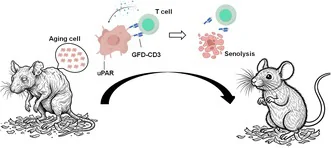
In aged mice and non-human primates, a newly designed bispecific T-cell engager safely eliminated senescent cells and improved age-related pathologies. While CAR-T cells targeting uPAR cause unpredictable toxicities, bispecific T-cell engagers offer better dose control. Researchers developed GFD-CD3, an engager using the natural uPA ligand domain to target uPAR-positive senescent cells. In dose-finding tests, high doses caused hepatotoxicity via T cell-mediated damage to hepatic endothelial cells. Guiding treatment with serum transaminase monitoring allowed researchers to identify a safe low dose. At this lower dose, GFD-CD3 cleared senescent cells and alleviated age-related pathologies in both species without inducing adverse effects.
Why it matters
Clearing senescent cells can alleviate age-related dysfunctions, but immunotherapies often trigger severe off-target toxicities. Demonstrating that titratable T-cell engagers can safely remove senescent cells in non-human primates offers a potential path toward clinical senolytic immunotherapies.
Caveats
The findings remain restricted to animal models, and clinical translation requires confirming the safety and efficacy of transaminase-guided dosing in humans.
The paper
Show 10 more authors
Lihong Li, Shirui Zou, Nan Liu, Shuai He, Lanzhen Yan, Qiong Wang, Yongjie Zhu, Ben Wang, Dong Yang, Longbao Lv,Cancer Center and State Key Laboratory of Respiratory Health and Multimorbidity and National Clinical Research Center for Geriatrics and Frontiers Science Cente
Aging Cell · 29 Sep 2026 · CC BY