Peak-time training showed no clear edge in older adults
Peak-time training differed from low-point training by 0.06 newtons per kilogram in pulling strength after 12 weeks; the uncertainty range included no difference.
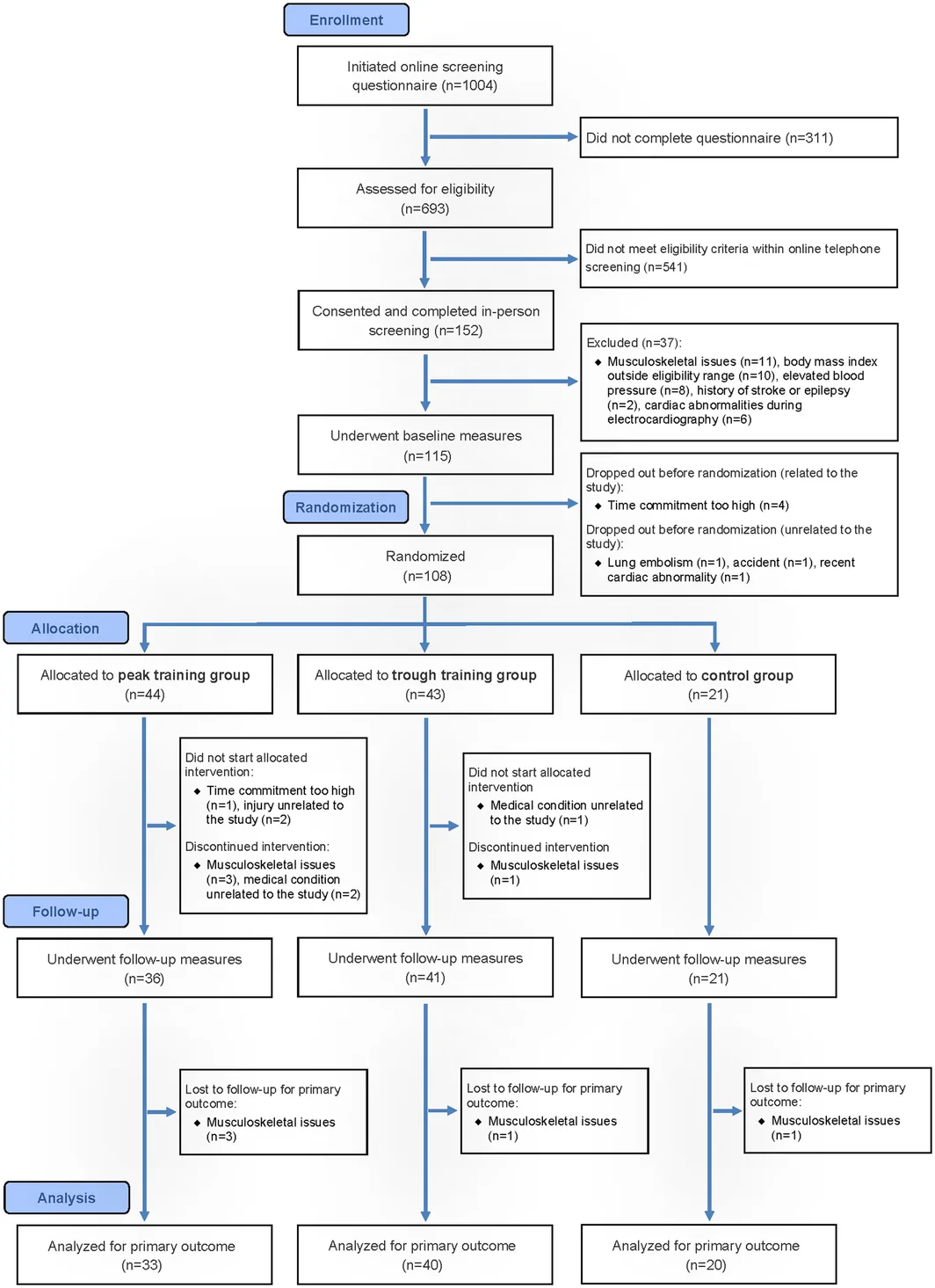
108 randomized participants, double-blind, registered NCT06063135
Limit: Peak and trough times were estimated from a single profiling period despite daily strength variability
Edited by Boris Djordjevic · AgingResearch.News
In a randomized controlled trial, 108 adults aged 60–80 (average 67; 41% female) were assigned to train at their strongest or weakest time of day, or maintain their usual lifestyle. Researchers identified these times with strength tests at four times on separate days. Over 12 weeks, exercise groups completed two supervised strength sessions and one 30-minute cycling session weekly. After two introductory weeks, strength sessions used three sets of five exercises, targeting 8–15 repetitions; cycling used 60% of peak oxygen uptake.
Analyses included 93 participants. Peak-time training showed no clear advantage over low-point training in pulling strength, grip strength or nonfat soft tissue in arms and legs, adjusted for height. No intervention-related serious adverse events were reported. Nine participants withdrew with muscle, joint or bone complaints, five with unrelated medical conditions or injuries, and one because of time demands.
Why it matters
Age-related declines in muscle mass and strength can impair everyday function. The trial addressed whether tailoring exercise schedules to daily performance rhythms adds value to strength training for older adults.
Caveats
Analyses excluded participants with missing measurements, and more participants withdrew from the peak-time group. The results may not apply outside ages 60–80 or to people taking insulin or metformin, who were excluded.
From the paper
- Participants
Of the 115 participants who underwent baseline assessments, 108 were randomized, of whom 93 were included in the outcome analyses.
- Ages
Eligible participants were males and females aged 60–80 years with a body mass index between 18.5 and 30 kg·m⁻².
- Duration
Both exercise intervention groups underwent a structured, supervised exercise program three times per week for 12 weeks at the Department of Sport, Exercise and Health in Basel, Switzerland.
- Result
Mean relative IMTP strength differed between peak and trough times of day (mean: 25.9 (standard deviation: 4.0) and 23.3 (3.6) N·kg⁻¹, respectively), with a mean difference of 2.6 (1.4) N·kg⁻¹ [95% confidence interval: 2.3–2.9].
- Harms
No intervention‐related serious adverse events were reported.
- Isometric midthigh pull strength
In adjusted post‐intervention comparisons, differences between the peak and trough groups were small, with effect sizes close to zero across all models for relative mean daily IMTP strength (≈ 0.07 N·kg⁻¹), relative mean daily HGS (≈ − 0.20 kg·m⁻²), and ALMI (≈ 0.04 kg·m⁻²) (Figure and Table ).
Quoted word for word from the full text on PubMed Central.
- Resistance training
- Circadian clock
- Appendicular lean mass index
- Handgrip strength
- Isometric midthigh pull strength
- Humans
The paper
University of Basel
Journal of Cachexia, Sarcopenia and Muscle, Sep 26, 2026, Open access, CC BY