Brain scan model maps diverging aging and Alzheimer’s paths
A model trained on repeated brain scans from 551 participants mapped two branches linked to different cognitive and dementia outcomes.
Our read
Biomarkers- Studied:
- Preprint: cohort study of 1,066 participants from ADNI, against those on the aging branch (Independent replication)
- What changed:
- Participants assigned to the AD-related branch showed faster memory decline compared to those on the aging branch
- The catch:
- Only white and non-Hispanic participants were included for the analysis
- In the record:
- The 48th paper on Amyloid PET with results in people; 402 on record in all.
Editor of record: Boris Djordjevic · AgingResearch.News
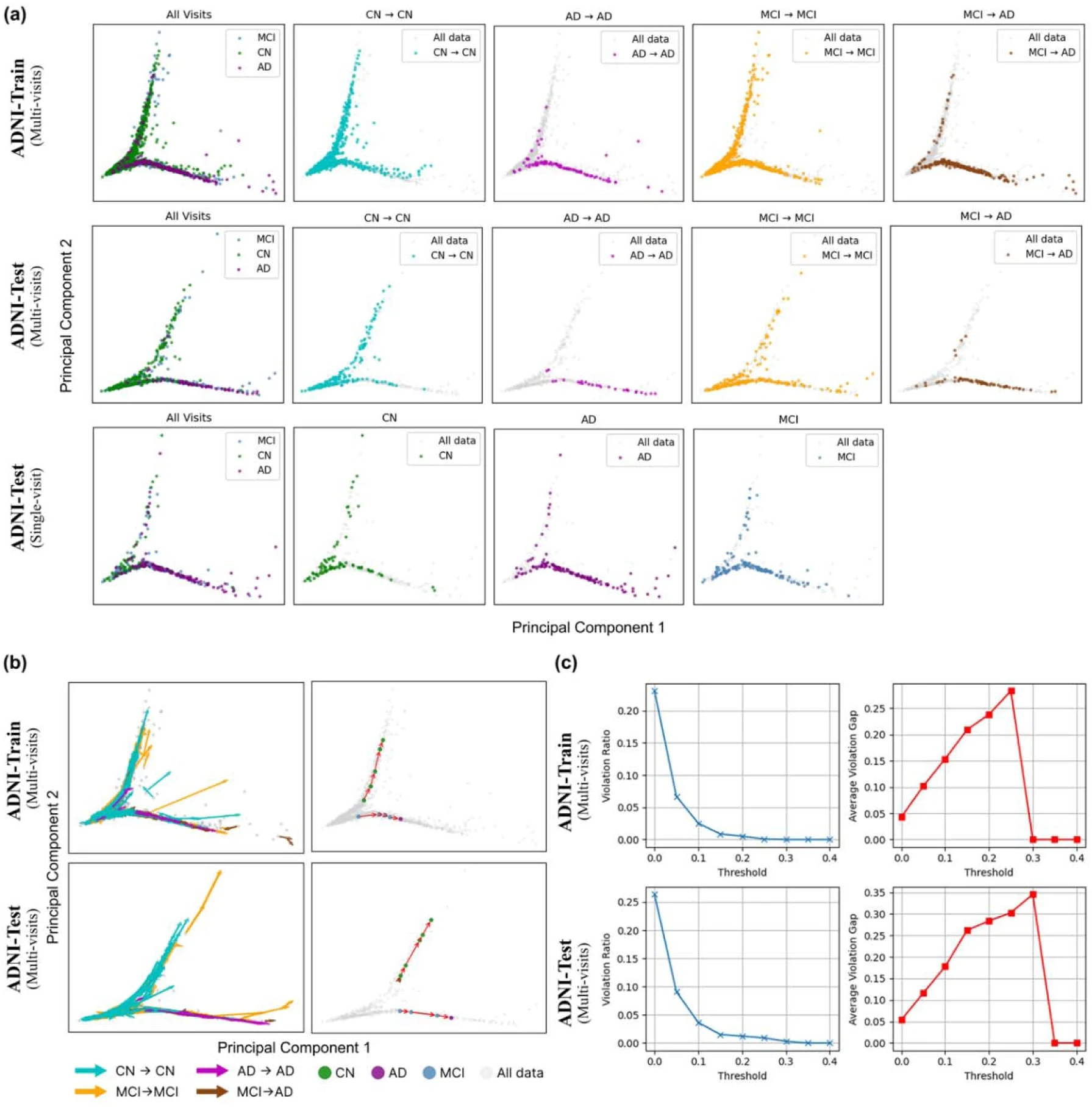
In an observational modeling study, researchers analyzed brain scans from white, non-Hispanic participants with normal cognition, mild cognitive impairment or Alzheimer’s disease. The scans measured amyloid, a protein that can form deposits in the brain. The model learned from repeated scans of 551 participants in the Alzheimer’s Disease Neuroimaging Initiative. Researchers tested it on separate participants, including 154 with repeated scans.
The model mapped a shared early path that split into an aging branch and an Alzheimer’s-related branch. Among participants initially without dementia, the Alzheimer’s-related branch was linked to faster cognitive decline and a higher risk of Alzheimer’s dementia than the aging branch. Applying the model without retraining to a second cohort reproduced differences in amyloid levels, cognitive scores and genetic risk.
Why it matters
Distinguishing Alzheimer’s progression from aging is particularly difficult early on. The authors propose that these paths could help assess risk beyond a positive or negative amyloid result.
Caveats
The paths came from an observational model, and the second cohort did not validate future cognitive decline or dementia risk. The preprint has not been peer-reviewed, and the analyses included only white, non-Hispanic participants.
From the paper
- Participants
In this study, a total of 1066 participants from ADNI were included.
Quoted word for word from the full text on bioRxiv.
The paper
Divergent amyloid trajectories distinguish normal aging from Alzheimer's disease progression
Indiana University Indianapolis
bioRxiv, Sep 14, 2026, Open access, Preprint, not yet peer-reviewed

Comments
Be the first to comment.