Efficacy and safety of GLP-1RAs, SGLT2is, and nsMRAs for cardiovascular and renal outcomes in T2DM with CKD: a systematic review and network meta-analysis
Preregistered CRD420251150683, declared no competing interests
Abstract
OBJECTIVE: To compare cardiovascular and renal benefits and safety of GLP-1RAs, SGLT2is, and nsMRAs in T2D-CKD using network meta-analysis. METHODS: RCTs published through 7 August 2026 were systematically identified. A frequentist random-effects network meta-analysis was performed. Evidence certainty was assessed with CINeMA. RESULTS: A total of 21 RCTs involving 51,899 patients were included. Compared with placebo, nsMRAs were associated with lower risks of the major kidney composite outcome and hospitalization for heart failure (HHF), whereas SGLT2is were associated with lower risks of major adverse cardiovascular events (MACE), the major kidney composite outcome, and HHF. GLP-1RAs were associated with lower risks of MACE, the major kidney composite outcome, HHF, all-cause mortality, and cardiovascular death. Between-class indirect comparisons suggested a lower estimated risk of the major kidney composite outcome with SGLT2is than with GLP-1RAs (RR 0.77, 95% CI 0.64-0.91) or nsMRAs (nsMRAs versus SGLT2is: RR 1.28, 95% CI 1.10-1.50). The estimated risk of HHF was also lower with SGLT2is than with nsMRAs (nsMRAs versus SGLT2is: RR 1.28, 95% CI 1.01-1.63). For cardiovascular death, the indirect estimate suggested a lower risk with GLP-1RAs than with SGLT2is (SGLT2is versus GLP-1RAs: RR 1.28, 95% CI 1.03-1.58), whereas the comparison between nsMRAs and GLP-1RAs did not reach statistical significance (RR 1.24, 95% CI 0.99-1.56). No statistically significant between-class differences were identified for MACE or all-cause mortality. All between-class comparisons were based exclusively on indirect evidence. Safety analyses showed higher risks of hyperkalemia with nsMRAs and genital infections with SGLT2is than with placebo. Sensitivity analyses broadly supported the main findings. Confidence in the evidence was mostly low to moderate, primarily because of indirectness. CONCLUSION: In patients with T2D-CKD, all three drug classes reduced several cardiorenal outcomes versus placebo. Between-class indirect comparisons suggested more favorable relative-effect estimates for SGLT2is on major kidney outcomes and HHF in selected comparisons, and for GLP-1RAs on cardiovascular death. No clear between-class difference was observed for MACE. Because the network lacked head-to-head comparisons between active drug classes, these findings and treatment rankings should be interpreted cautiously. Direct comparative and combination-therapy trials are needed to guide individualized treatment selection. SYSTEMATIC REVIEW REGISTRATION: https://www.crd.york.ac.uk/PROSPERO/view/CRD420251150683, identifier CRD420251150683.
From the paper
- Studies
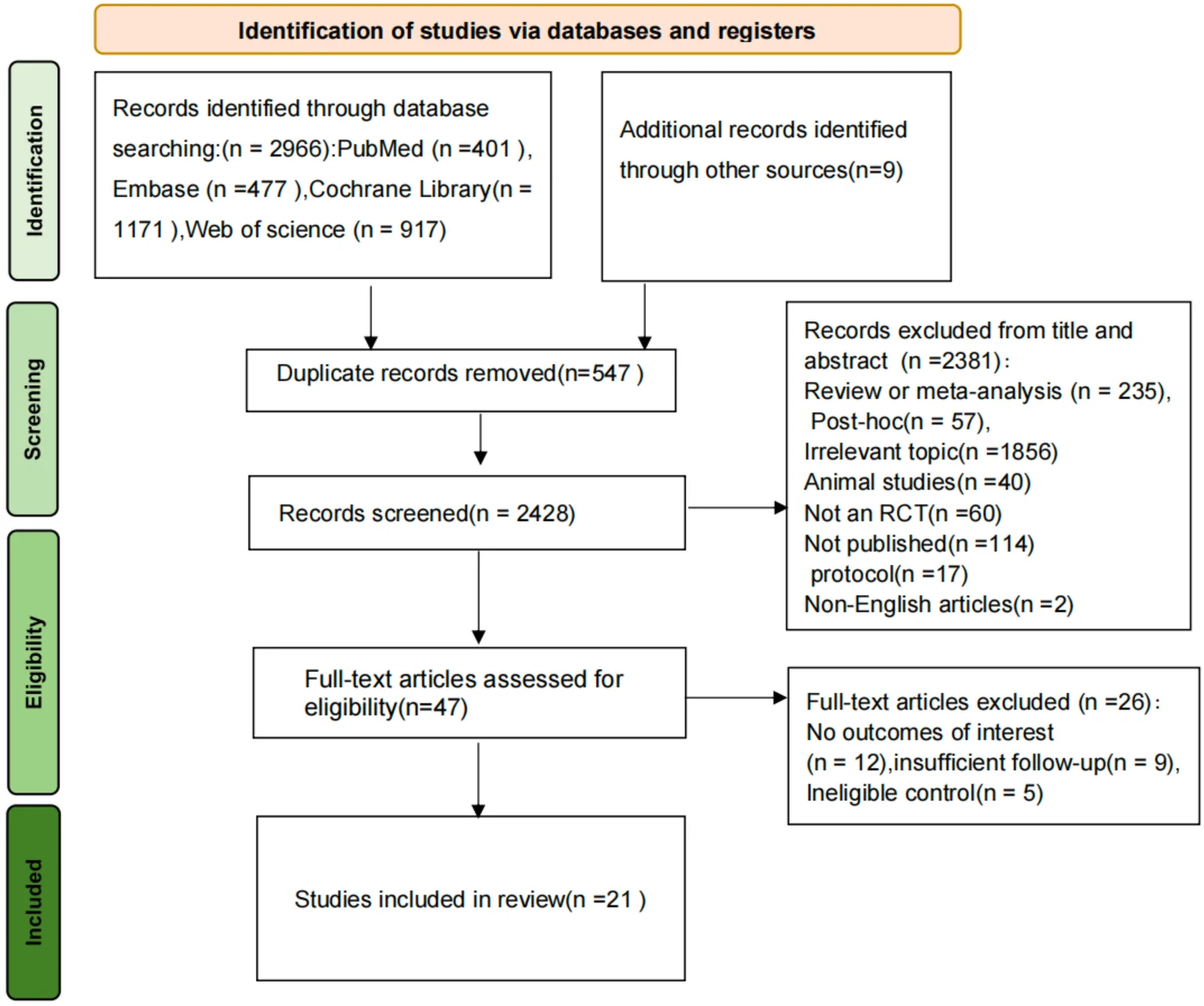
A total of 21 RCTs were included, covering three classes of targeted therapies: SGLT2is, GLP-1RAs, and nsMRAs.
- Result
For MACE, GLP-1RAs and SGLT2is were associated with lower risks than placebo (GLP-1RAs: RR = 0.86, 95% CI 0.75–0.98; SGLT2is: RR = 0.87, 95% CI 0.78–0.97), whereas the estimate for nsMRAs was less precise and its 95% CI included the null (RR = 0.88, 95% CI 0.75–1.02; ).
- Limitation
First, all between-class comparisons were based on indirect evidence through a common placebo comparator, and the network contained no closed loops.
Quoted word for word from the full text on PubMed Central.
- GLP-1 receptor agonists
- SGLT2 inhibitors
- GLP-1 and incretin signalling
- Type 2 diabetes
- Chronic kidney disease
- Humans
The paper
China Academy of Chinese Medical Sciences
Frontiers in Endocrinology, 8 Sep 2026