Drug–dementia link in type 2 diabetes with mild cognitive impairment
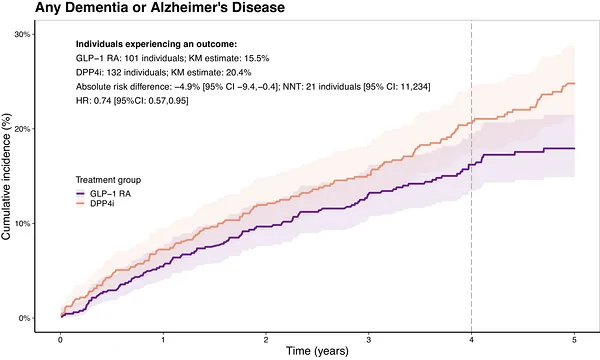
In adults with type 2 diabetes and mild cognitive impairment, estimated dementia rates over a mean 3.9 years were 15.5% for one drug class versus 20.4% for another.
Limit: Differences in socioeconomic status and disease duration could explain the dementia association
Stake: Authors work for Regeneron.
Edited by Boris Djordjevic · AgingResearch.News
An observational study analyzed health records from 1,320 adults with type 2 diabetes and mild cognitive impairment, meaning problems with memory or thinking. None had dementia when they started the drugs. Their mean age was 67.2 years; 702 were women. Researchers matched the groups on baseline characteristics to mimic a randomized trial.
They compared new users of glucagon-like peptide-1 (GLP-1) receptor agonists, a diabetes drug class, with new users of dipeptidyl peptidase-4 inhibitors, another diabetes drug class. Over up to five years, 101 people in the GLP-1 group and 132 in the comparison group received a dementia diagnosis, including Alzheimer's disease. Estimated dementia rates at a mean 3.9 years were 15.5% and 20.4%, respectively. Starting GLP-1 drugs was associated with a lower dementia risk.
Why it matters
For people with type 2 diabetes and mild cognitive impairment, the authors said the results support a dedicated randomized trial testing these drugs for dementia outcomes.
Caveats
This observational comparison cannot establish cause and effect, and some baseline differences remained after matching. The study excluded people with existing dementia, type 1 diabetes or severely uncontrolled type 2 diabetes.
From the paper
- Participants
After applying the inclusion and exclusion criteria and propensity‐score matching, we included 1320 individuals (702 women) who initiated GLP‐1 RAs or DPP4i, with a mean age of 67.2 years and a mean HbA1c of 7.6%.
- Follow-up
Individuals had a mean follow‐up of 3.9 years and a total follow‐up of 5159 person‐years.
- Result
The main composite outcome of onset of dementia or AD occurred among 101 and 132 of the participants in the GLP‐1 RA and DPP4i groups, respectively (HR of 0.74 [95% CI: 0.57 to 0.95]; E value of 2.06 [lower CI limit 1.28]).
- Absolute difference
These values represent an absolute risk difference of −4.9% [95% CI: −9.4 to −0.4] with GLP‐1 RAs compared with DPP4i and a number needed to treat of 21 [11 to 234] individuals to prevent one event of dementia or AD diagnosis over 3.9 years of follow‐up.
Quoted word for word from the full text on PubMed Central.
- GLP-1 receptor agonists
- GLP-1 and incretin signaling
- Dementia
- Type 2 diabetes
- Mild cognitive impairment
- Humans
The paper
Reichman University; Hebrew University of Jerusalem
Alzheimer's & Dementia, Sep 20, 2026, Open access
Presented at ADA Scientific Sessions 2026 as an abstract