Some diabetes drugs linked to fewer Alzheimer’s diagnoses
Compared with other diabetes medicines, the drug group had a hazard ratio of 0.46 for first recorded Alzheimer’s diagnoses.
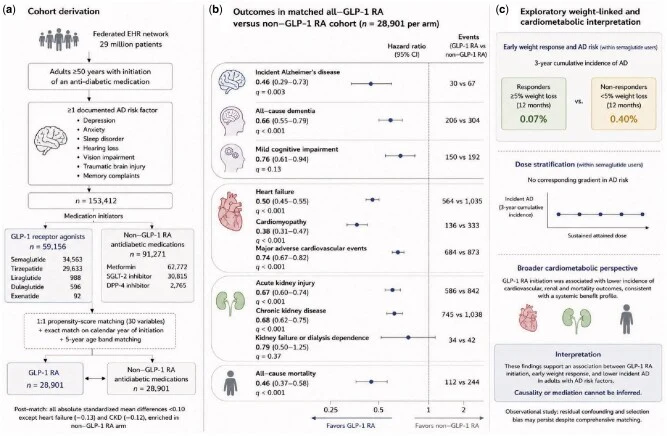
153,412 adults
Limit: Recorded diagnoses do not necessarily identify when disease began
Edited by Boris Djordjevic · AgingResearch.News
An observational health-record study compared 28,901 adults aged 50 or older starting a group of diabetes medicines with 28,901 starting other diabetes drugs. Most in the first group started semaglutide or tirzepatide. All had a documented Alzheimer’s risk factor, such as depression, hearing loss or memory complaints, and no prior dementia diagnosis. Average age was 63.5 years; women made up 63.5% and 60.5% of the respective groups. Researchers matched patients on baseline characteristics, drug-start year and age band.
Over follow-up extending up to five years, first recorded Alzheimer’s diagnoses numbered 30 versus 67. The hazard ratio was 0.46; values below one indicate a lower rate over time. Starting the drugs was also associated with fewer dementia diagnoses, deaths, and several heart and kidney outcomes.
Why it matters
Alzheimer’s develops over years, leaving time to address modifiable risks before dementia begins. The authors suggest that earlier use of these medicines may help modify Alzheimer’s risk through effects on heart health and metabolism.
Caveats
This observational analysis cannot establish causation, and recorded diagnoses do not necessarily identify when disease began. Alzheimer’s events were few, and the findings do not cover people under 50 or those with prior dementia.
The paper
Nference (United States)
Biology Methods & Protocols, Aug 3, 2026, Open access

