Short and long sleep linked to dementia risk in older adults
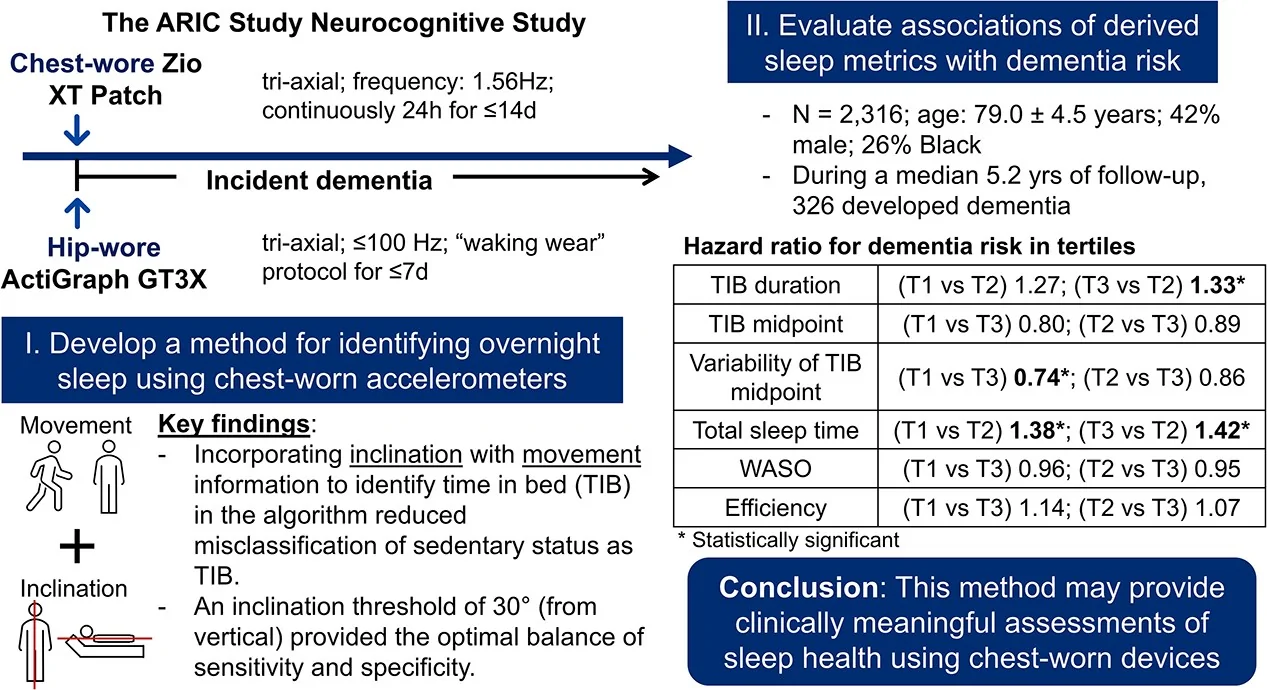
The shortest and longest thirds of estimated sleep duration were associated with 38% and 42% higher relative dementia risk over time, respectively, than the middle third.
Our read
Populations- Studied:
- Cohort study of 2,316 older adults without dementia, against adults with intermediate sleep duration
- What changed:
- Dementia risk was 42 per cent higher with longest sleep and 38 per cent higher with shortest sleep, versus intermediate sleep
- The catch:
- Sleep apnea could partly explain the association between sleep duration and dementia
- Why it’s aging research:
- A leading disease of aging, its risks or menopause.
Editor of record: Boris Djordjevic · AgingResearch.News
In an observational cohort study, 2,316 adults without dementia, averaging 79 years old, wore chest-mounted movement sensors for up to 14 days; 58% were women. Researchers combined movement and posture data to estimate time in bed and sleep. They calibrated the method against hip-worn sensor data from 405 participants.
Over a median 5.2 years, 326 participants (14.1%) developed dementia. Both shorter and longer estimated sleep and time in bed were associated with higher dementia risk than mid-range durations. For shorter time in bed, however, the range of likely values included no difference. Participants with the most regular timing of time in bed had lower dementia risk than those with the least regular timing. Sleep timing, time awake after falling asleep and the share of time in bed spent asleep showed no significant associations.
Why it matters
The authors described chest-worn sensors as a promising way to estimate sleep, offering a tool for studying how sleep patterns relate to dementia in later life.
Caveats
The observational design cannot show that changing sleep would alter dementia risk, and time-in-bed estimates were calibrated against hip-sensor removal rather than measured sleep. The findings concern older adults without dementia; people with prior cardiac device implantation or skin reactions were excluded.
From the paper
- Participants
We used data from 405 participants with 3 275 545 min (across 2491 days) to develop the TIB algorithm.
- Follow-up
During a median follow-up of 5.2 years (Q1:Q3: 4.5, 5.7), 326 (14.1 per cent) participants developed dementia.
- Result
In contrast, Zio XT using an inclination threshold of 30° or 45° identified TIB durations that were 35 min (95% CI: 25, 45) and 79 min (67, 91) shorter, respectively.
Quoted word for word from the full text on PubMed Central.
The paper
Johns Hopkins University
Sleep Advances, Aug 19, 2026, Open access
Comments
Be the first to comment.