Exercise eased depressive symptoms in a midlife trial
Exercise reduced depressive symptom scores versus usual routines over 12 weeks, with an estimated effect of minus 1.18; the primary memory outcome showed no clear benefit.
3 months, registered NCT05397990
Limit: Unmasked participants rated their own depressive symptoms, allowing expectations to influence scores
Edited by Boris Djordjevic · AgingResearch.News
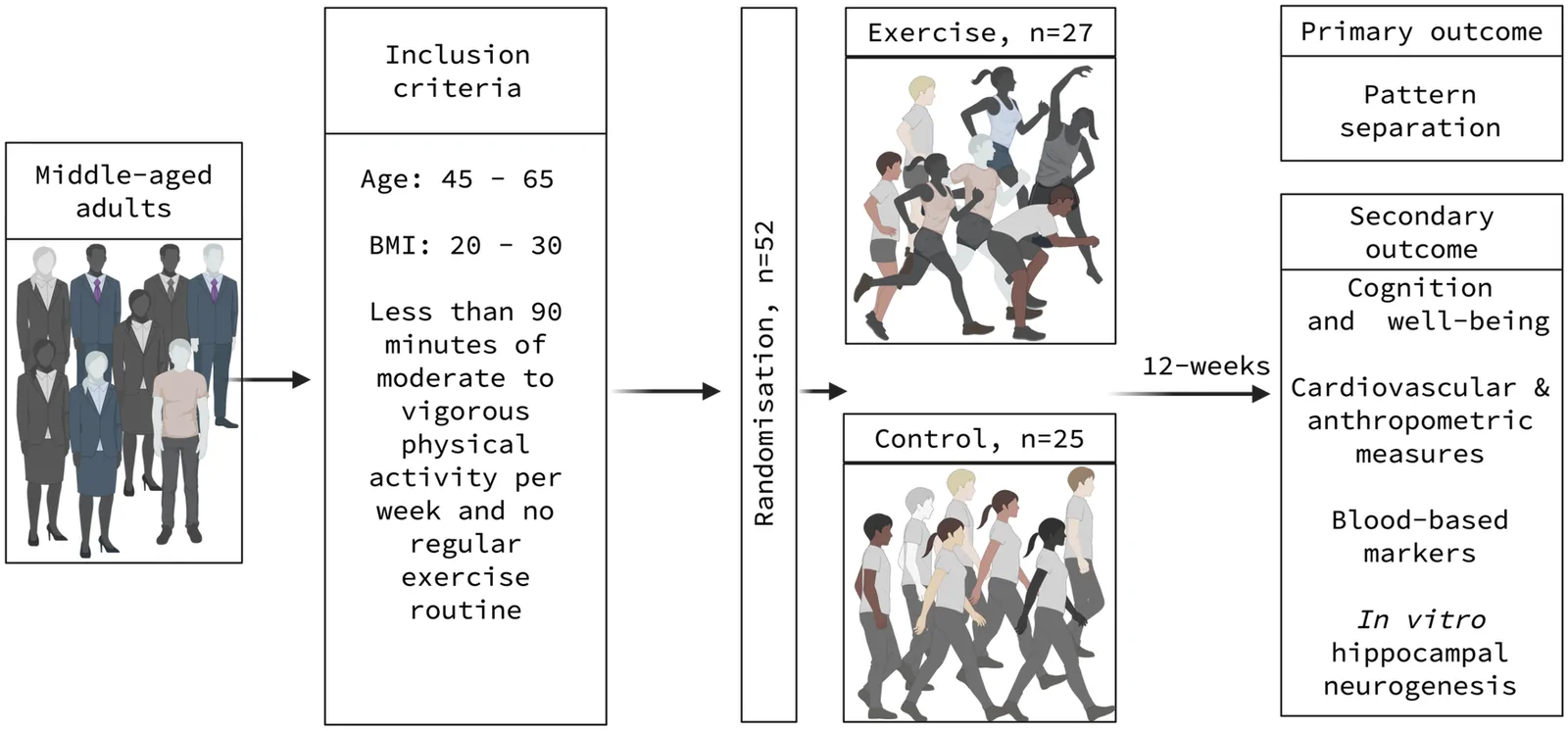
The randomized trial enrolled 52 healthy UK adults aged 45–65: 37 women and 15 men. They reported less than 90 minutes of moderate-to-vigorous activity weekly. The exercise group took 30-minute, instructor-led live online classes three times weekly for 12 weeks. Classes combined aerobic and resistance exercise. Controls continued their usual routines.
Exercise reduced self-reported depressive symptoms compared with controls. It produced no clear benefit on the primary outcome, a test of distinguishing similar memories, or on other thinking tests. In a separate experiment, researchers applied participants’ blood serum to lab-grown human cells that can develop into nerve cells in the hippocampus, a memory-related brain region. The share of dividing cells decreased more with exercise-group serum than control-group serum. The supplied excerpts did not report adverse-event results.
Why it matters
Midlife remains an understudied window for preventive lifestyle changes. The authors suggest that cognitive benefits from exercise may require longer exposure to emerge.
Caveats
Participants and researchers knew group assignments, and mood outcomes were self-reported; the trial excluded people with current or recent psychiatric disorders. The cell experiment did not measure new nerve-cell growth in participants’ brains.
From the paper
- Who took part
NeuroFit was an open label, two-arm, parallel group, randomised controlled trial including healthy middle-aged adults in the UK.
- Ages
Mean age of the 52 participants in the study was 55.1 years (SD 6.1), of whom 37 (71%) were female and 15 (29%) males.
- Duration
Participants in the exercise group completed 30-minute group-based online exercise classes three times per week over a 12-week period.
- Analyzed for depressive symptoms
Among the secondary outcomes, we observed a significant effect of intervention by time on the PHQ-9 score in the intention-to-treat analysis population (n = 52, β = −1.18, SE = 0.40, 95% CI −1.95 to −0.41, adjusted p = 0.011; Fig. ), however this effect was weakened in the per-protocol-population (n = 35, β = −1.21, SE = 0.48, 95% CI −2.14 to −0.27, adjusted p = 0.047; Supplementary Table …
- Analyzed for proliferative cells
We observed a small but statistically significant intervention-by-time interaction in the percentage of cells expressing Ki67, a marker of cell proliferation (n = 52, β = −0.23, SE = 0.09, 95% CI −0.41 to −0.06, adjusted p = 0.02; Fig. ).
Results, Secondary neurogenesis outcomes during proliferation
- Primary outcome
Intention-to-treat analysis revealed no significant interaction of intervention by time on the primary outcome, LDI (n = 52, β = 0.33, SE = 0.29, 95% CI −0.24 to 0.89, p = 0.26, Fig. ).
- Harms
No serious adverse events were observed during the trial, and no withdrawals were considered related to the exercise intervention.
Quoted word for word from the full text on PubMed Central.
Exercise is part of Bryan Johnson's Blueprint
The paper
King's College London
npj Aging, Sep 17, 2026, Open access
