Real-World Body Composition and Blood Pressure Changes Following Glucagon-Like Peptide 1 Receptor Agonist Initiation: A Causal Inference Study of Connected Device Data
Declared ties to: Withings
Abstract
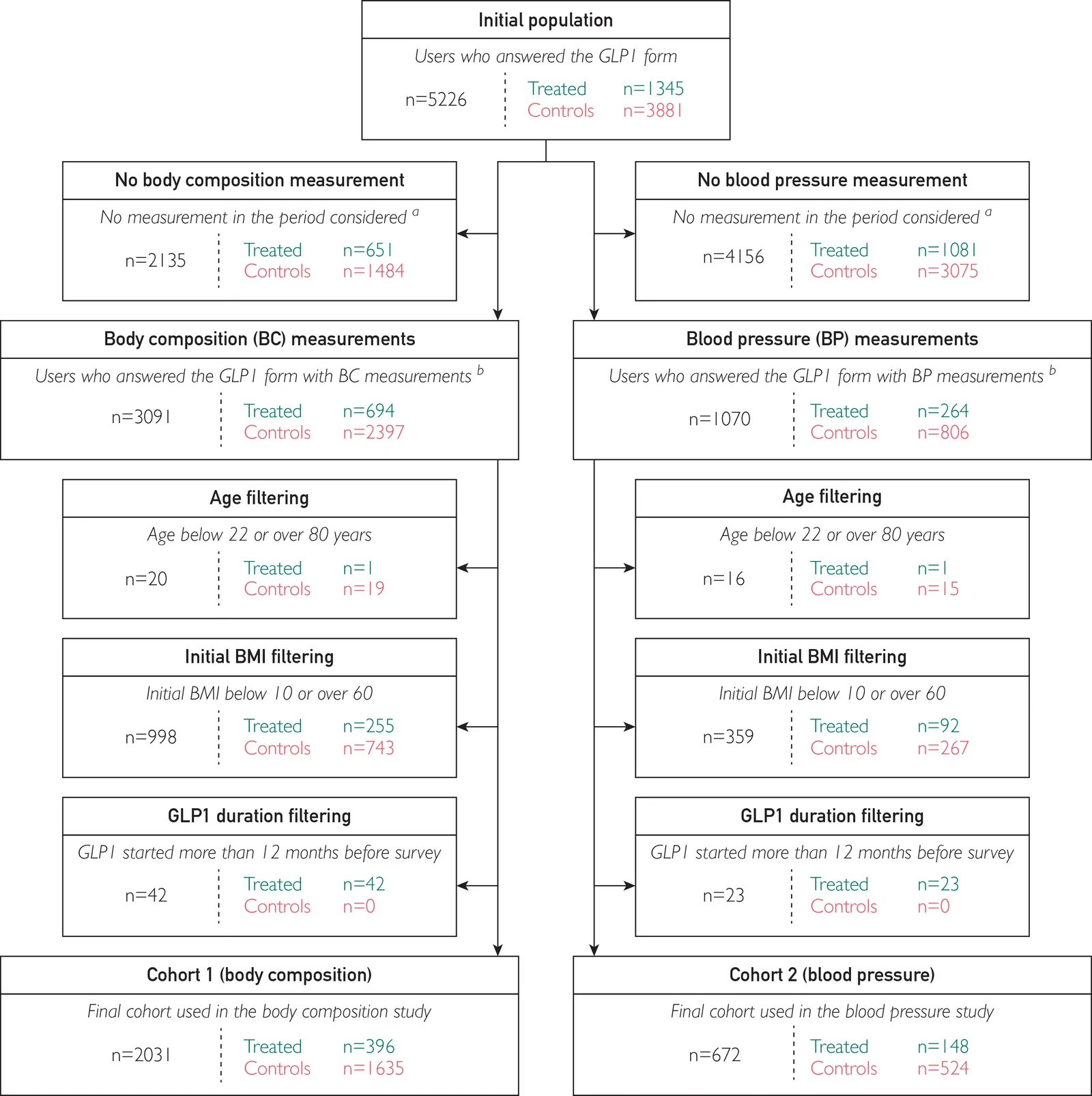
OBJECTIVE: To characterize real-world body composition and blood pressure changes following glucagon-like peptide (GLP)-1 receptor agonist (RA) initiation and identify predictors of weight loss quality using connected device data. PATIENTS AND METHODS: In this retrospective cohort study, adult US users completing an in-application GLP-1 RA survey (June 8, 2023, to July 4, 2024) were followed up using longitudinal device data (December 2021 to September 2025). We used a distributional causal inference framework to match GLP-1 RA users to nonusers. Primary estimands were the distributional average treatment effect on the treated and median differences over months 10 to 14. RESULTS: Among 2031 users for body composition (396 exposed) and 672 for blood pressure (BP; 148 exposed), GLP-1 RA initiation was associated with a 9.8% median weight reduction (95% CI, 9.8-9.9), driven by fat mass loss (7.5%; 95% CI, 7.5-7.8) with smaller muscle mass loss (2.3%; 95% CI, 2.1-2.4). Sustained reductions were observed in systolic (2.5 mm Hg; 95% CI, 1.5-2.9) and diastolic BP (1.5 mm Hg; 95% CI, 1.2-1.9). Baseline muscle-to-fat ratio (MFR) was the strongest predictor of weight loss quality, with lower MFR individuals losing more fat and sparing more muscle. CONCLUSION: In a real-world setting, GLP-1 RA initiation was associated with clinically significant fat-predominant weight loss and sustained BP improvements. Baseline MFR predicted weight loss quality, suggesting that pretreatment body composition may help clinicians anticipate individual responses-a step toward precision medicine in GLP-1 RA therapy.
- Causal inference
- GLP-1 receptor agonists
- GLP-1 and incretin signalling
- Diastolic blood pressure
- Muscle-to-fat ratio
- Humans
The paper
Centre National de la Recherche Scientifique; Institut national de recherche en sciences et technologies du numérique
Mayo Clinic Proceedings Digital Health, 28 Jul 2026