Sex Modifies the Association Between Planetary Health Diet Adherence and Kidney Function Decline in US Adults Aged 50 Years and Older
Declared no competing interests
Abstract
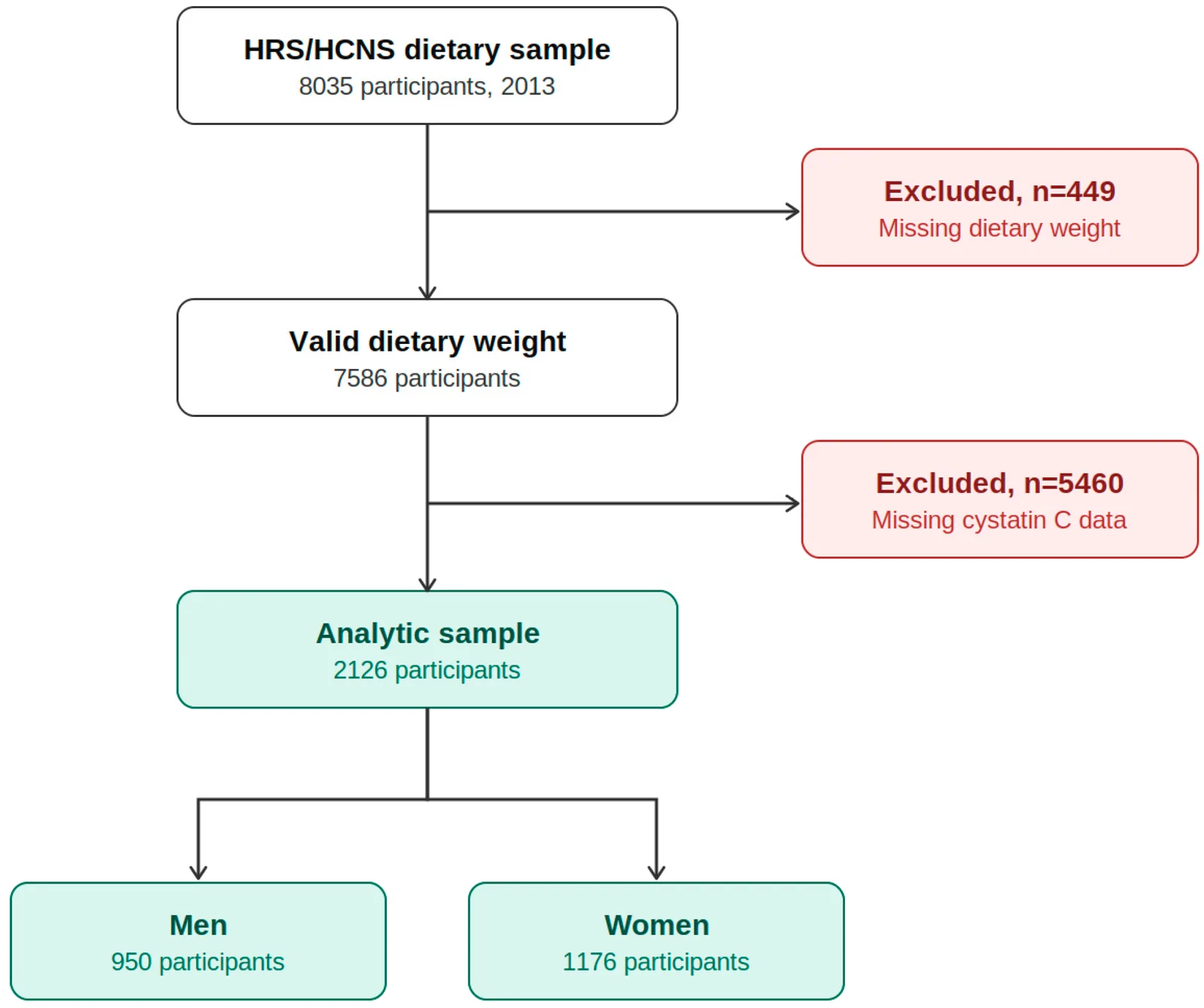
Background/Objectives: Diet is a modifiable determinant of kidney health, and sex differences in kidney physiology support sex-specific evaluation of dietary patterns. We examined the association of Planetary Health Diet Index (PHDI) adherence with cystatin C-based eGFR decline, and its modification by sex, in US adults aged 50 years and older. Methods: We analyzed 2126 Health and Retirement Study participants (950 men, 1176 women) with diet assessed by food frequency questionnaire in 2013 and cystatin C-based eGFR measured in 2012 and 2016. Survey-weighted regression models, adjusted for baseline eGFR and for demographic, socioeconomic, lifestyle and clinical covariates, related PHDI to eGFR change and to a ≥30% relative eGFR decline; sex interaction was tested on the multiplicative and additive scales. Results: PHDI adherence was nonsignificantly associated with lower eGFR decline (β per 10-point increment 0.218; 95% CI -0.065 to 0.466). Among women, each 10-point-higher score was associated with slower eGFR decline (β 0.355; 95% CI 0.029 to 0.681; p = 0.034) and 20% lower odds of ≥30% eGFR decline (OR 0.799; 95% CI 0.687 to 0.930; p = 0.005); no significant association was observed in men (β 0.080; 95% CI -0.294 to 0.454; OR 1.080; 95% CI 0.901 to 1.295). Sex modified the association with ≥30% eGFR decline on both a multiplicative (p = 0.002) and additive scale (p < 0.001). Conclusions: PHDI adherence was associated with slower kidney function decline in women aged 50 years and older, with non-significant effect in men. Sex merits consideration as a biological modifier when plant-forward diets are evaluated as potentially nephroprotective strategies.
From the paper
- Participants
The analytic sample comprised 2126 participants with a mean age of 64.3 ± 9.2 years, of whom 55.3% were women and 79.2% were Non-Hispanic White.
Results, 3.1. Baseline Characteristics of the Analytic Sample
- Result
Similarly, none of the individual PHDI quartile contrasts reached statistical significance, including Q4 versus Q1 (β = 0.608; 95% CI −0.368 to 1.584; p = 0.212), and the ordinal trend across quartiles was not significant (β per quartile = 0.225; 95% CI −0.071 to 0.520; p for trend = 0.131).
- Limitation
Diet was measured once, in 2013, using a food frequency questionnaire covering the preceding 12 months; this single assessment could not capture within-person dietary change over the subsequent follow-up, thus potentially leading to misclassification; additionally …
Quoted word for word from the full text on PubMed Central.