Personalized environmental risk communication and cancer screening intent among rural private well users
14 weeks
Abstract
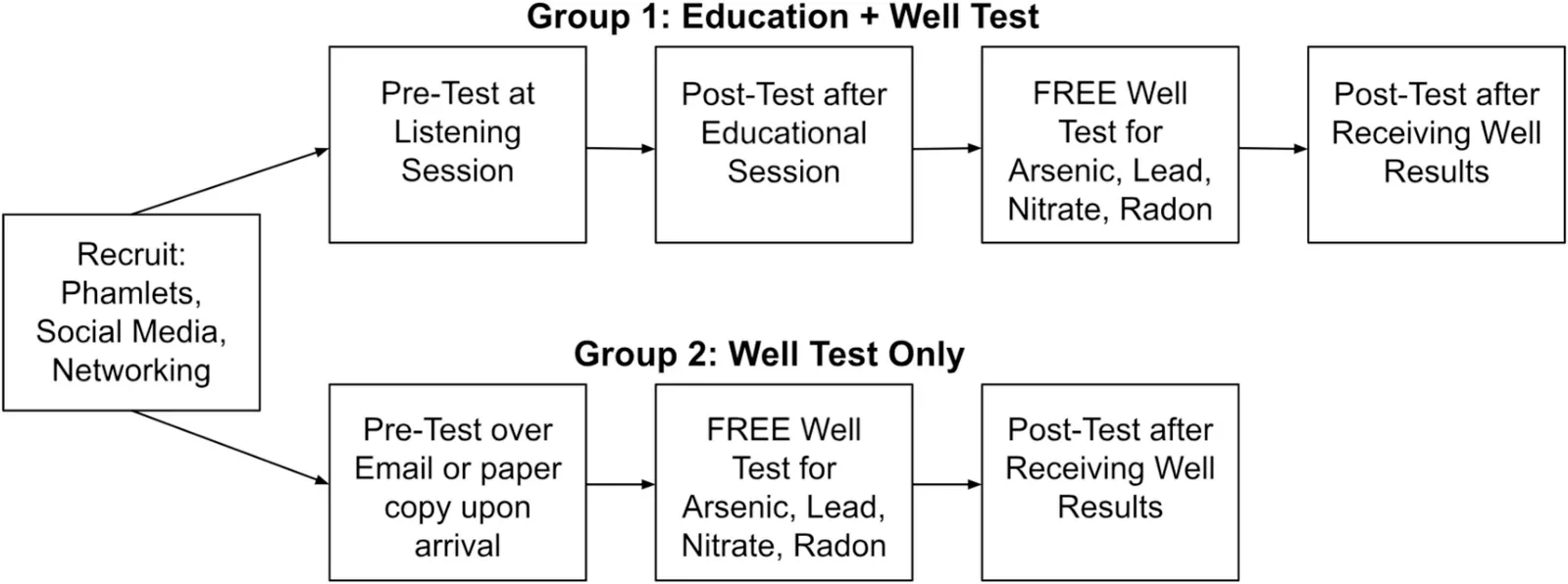
OBJECTIVE: Private well contamination poses underappreciated cancer risks in rural communities where screening rates remain low. We examined whether personalized well water testing and environmental health education framed by the Champion Health Belief Model (CHBM), influence cancer screening intent among rural private well owners in southeast Georgia. METHODS: Between July and October 2025, a 14-week study enrolled 100 private well owners assigned to an education-plus-testing group (n = 50) or a testing-only group (n = 50). Pre- and post-intervention surveys assessed CHBM constructs and screening intent. Binary logistic regression identified psychosocial and environmental predictors. RESULTS: Overall, 68% of wells contained at least one contaminant, with radon exceeding 300 pCi/L in 56% of samples. Cancer screening intent rose 32% in the education-plus-testing group and 36% in the testing-only group. Understanding personalized well results was the strongest predictor of screening intent (Adjusted Odds Ratio (AOR) = 4.75, p = .029), and detection of any contaminant was independently associated with higher intent (AOR = 2.67, p = .039). CONCLUSIONS: Personalized environmental exposure information may serve as a social-determinants-informed cue to action, bridging environmental risk communication and cancer prevention in underserved rural communities.
From the paper
- Result
Male sex (AOR = 3.02, 95% CI: 1.16, 7.86) and personal cancer history (AOR = 4.71, 95% CI: 1.57, 13.12) were the strongest social predictors of screening intent at baseline.
- Limitation
Participants were recruited from three rural Georgia counties, which limit generalizability to other populations of private well users.
Quoted word for word from the full text on PubMed Central.
The paper
Georgia Southern University
Preventive Medicine Reports, 2 Sep 2026, Open access