A score of inflammation proteins was linked to risk of death
In 40,471 UK Biobank participants in England, full and simplified protein scores were linked to death from any cause, each with a hazard ratio of 1.88.
Independent replication
Limit: The score comparison behind the mortality hazard ratios is missing from the abstract
Edited by Boris Djordjevic · AgingResearch.News
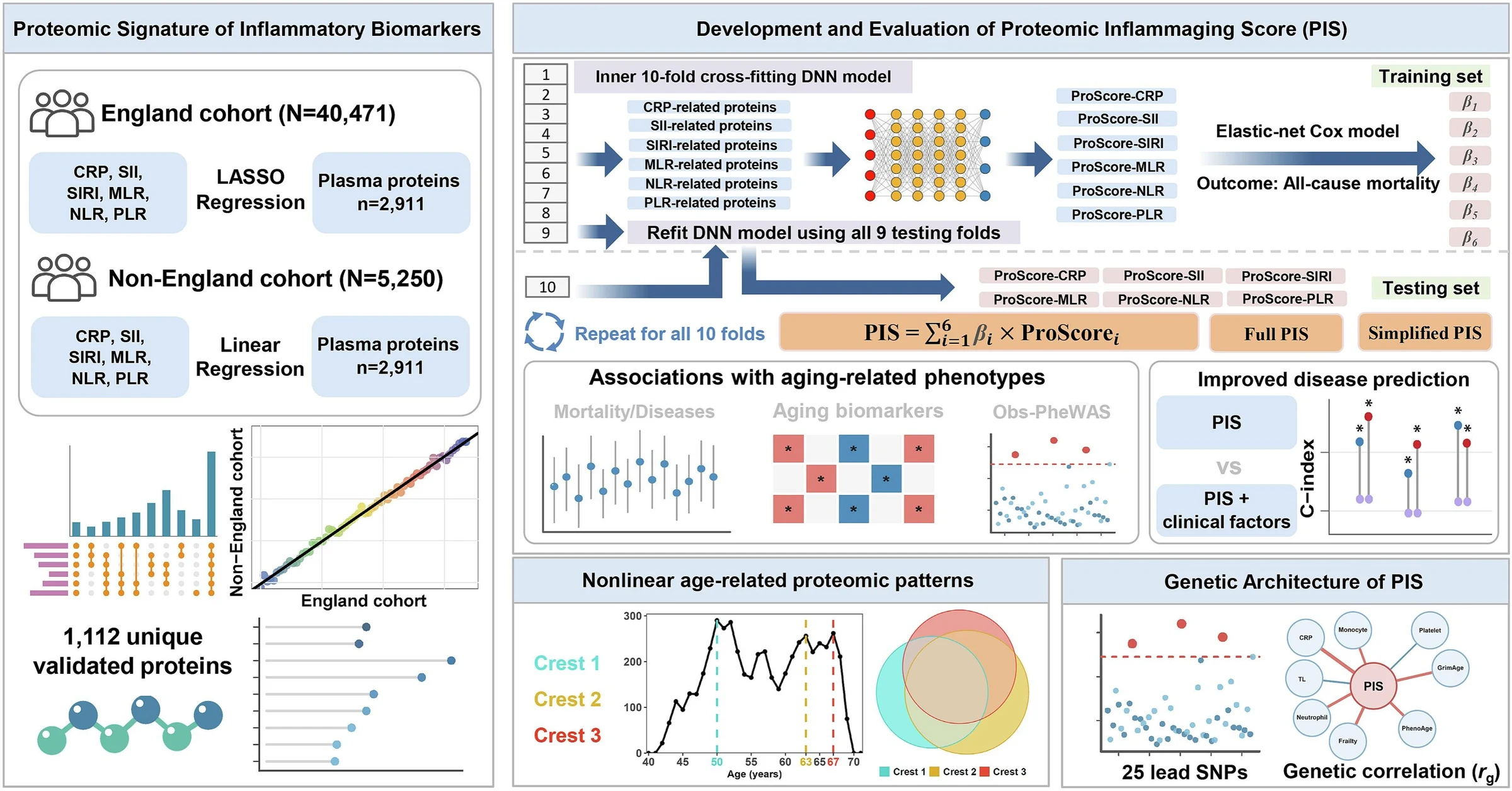
In an observational study of 40,471 participants from England in the UK Biobank, researchers developed a protein-based score of age-related inflammation. They identified 1,112 proteins linked to all six inflammatory markers studied, retaining 93 proteins in simplified versions.
Both the full and simplified scores were associated with death from any cause, each with a hazard ratio of 1.88—a measure comparing death rates over time. The scores were also linked to multiple aging-related conditions and improved mortality prediction over conventional biomarkers. A validation cohort of 5,250 participants from outside England showed comparable predictive performance. Protein-based measures of inflammation peaked near ages 50, 62 to 63, and 67 years. In genetic analyses, 25 lead genetic variants were associated with the score.
Why it matters
Routine inflammation markers capture a limited picture of a process central to biological aging. A more detailed measure may help researchers study its links to disease burden across multiple body systems.
Caveats
This observational study cannot determine whether these inflammatory proteins cause disease or death. The abstract does not report participants’ baseline ages, health status, duration of follow-up, or the score comparison corresponding to the hazard ratios.
The paper
Proteomic signatures of systemic inflammation in aging, multimorbidity, and mortality
Huazhong University of Science and Technology
Experimental Gerontology, Sep 12, 2026, Open access


