Temperature-linked deaths rose in China as age-adjusted rates fell
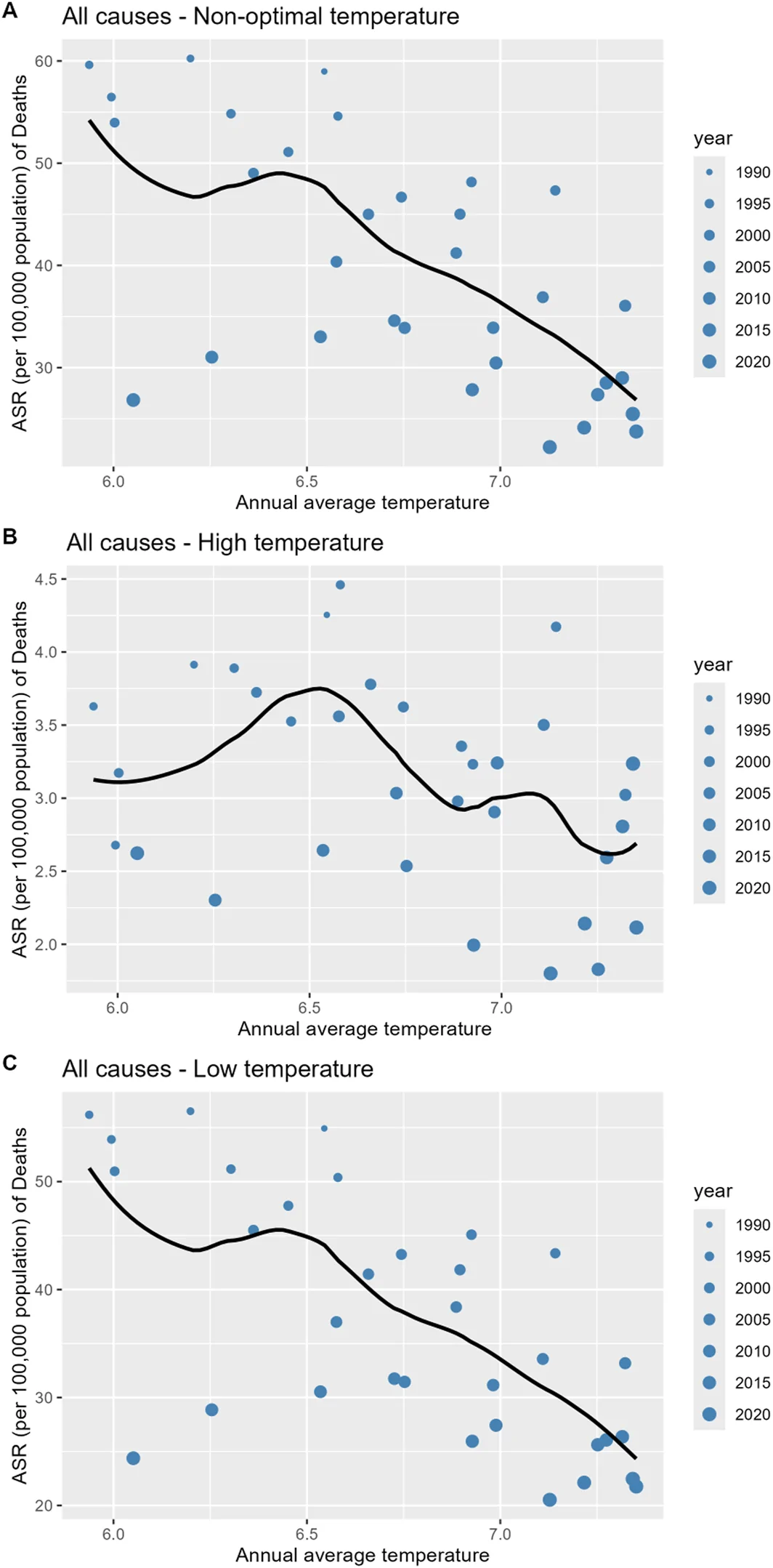
Estimated temperature-linked deaths rose 32.835% from 1990 to 2023, while death rates adjusted for population age fell 60.706%.
Our read
Populations- Studied:
- Computational study of people in China
- What changed:
- Deaths attributable to non-optimal temperature exposure increased 32.835% from 1990 to 2023, while the age-standardized mortality rate decreased
- The catch:
- The models omitted confounding from air pollutants like PM2.5 and local microclimates
- In the record:
- The 128th paper on heat with results in people; 260 on record in all. Its result on mortality agrees with all 43 other findings on record.
- Why it’s aging research:
- It looks at how biology varies with age or lifespan.
Editor of record: Boris Djordjevic · AgingResearch.News
Researchers used computational models to examine deaths linked to high and low temperatures among people of all ages in China during 1990–2023. They combined climate data with mortality estimates from the Global Burden of Disease database. They also projected mortality through 2050 under two emissions scenarios.
The estimated death toll rose, while mortality rates fell after accounting for differences in population age. Cold remained the main temperature-related risk. Heat-related deaths increased more rapidly than cold-related deaths. People aged 80 and older were especially susceptible. Future projections varied by disease and emissions scenario, with elevated risks projected for some diseases.
Why it matters
Temperature-related mortality raises questions about how climate-health planning should address risks in later life. The authors called for prevention tailored to age, disease and emissions scenarios.
Caveats
The analysis used annual, population-level estimates; its correlations do not establish causation. Future mortality estimates depend on the models and emissions scenarios.
From the paper
- Result
From 1990 to 2023, the number of all‐causes death cases attributable to non‐optimal temperature exposure increased from 379,335.825 cases (95% UI: 326,097.253–454,624.647) to 503,892.550 cases (95% UI: 428,004.927–591,948.999), with a relative increase of 32.835%.
- Limitation
First, our future projections employed RCS models to characterize the nonlinear temperature–mortality relationship, which is more theoretically appropriate than simple linear models.
Quoted word for word from the full text on PubMed Central.
The paper
Wenzhou Medical University
GeoHealth, Sep 11, 2026, Open access

Comments
Be the first to comment.